

This Week In Blunders – Nov. -15-21
“When all else fails, there's always delusion.” – Conan O’Brien
They say a lot of people go into psychology in hopes of one day curing themselves. After decades in the field, psychologist Eric Brown remains a work in progress.
The 77-year-old Newton, Mass., psychotherapist fell in love with an online scammer and committed a $1.2 million fraud at her urging.
He believed he was investing beside “Amy” in precious metals and cryptocurrency.
He stole much of his investment stake from a client and a relative. Then he got more loot by lying on a bank loan application – committing frauds to become a fraud victim himself.
On Monday, a federal jury convicted Brown for wire fraud, making a false statement on a bank loan application and engaging in an unlawful monetary transaction. His sentencing is scheduled for Feb. 22, 2027.

According to the criminal complaint, Brown’s maladaptive syndrome began in September 2023 with $25,000 of his own money, sending it to a Fuex Group Limited, a platform that has turned up in other scams.
His lovely Amy sent him bogus statements showing that their joint investments were making money.
This was a mental health professional who had more than $389,000 in taxable income in 2022, according to the indictment. Perhaps because of his substantial debts, he needed more.
According to the complaint, Brown borrowed $310,000 from a relative, claiming he needed the money to improve an office building he owned. Instead, he wired it to Hong Kong.
Then he ripped off a patient who had been injured by a drunk driver. Brown had treated the woman for psychological problems stemming from the accident, and she trusted him enough to put him in charge of her $700,000 settlement.
Brown told her he could earn better returns on her money. He never told her that her accident settlement was financing his fantasy romance with Amy.
Brown also kept Amy a secret from Citizens Bank, as he took out a $517,800 home equity line. He said he needed the money for taxes and loan consolidation.
Then, surprise, surprise – by January 2024, he was unable to withdraw from his supposed investments. And Amy? Where did Amy go? Amy?
A shrink, of all professionals, should know when he’s being manipulated. But love is blind.
Similarly, a banker should recognize the tell-tale signs of financial fraud. But greed is equally blinding.
Consider Shan Hanes, a Kansas bank CEO who fell for a cryptocurrency scam and embezzled $47 million from his own bank trying to collect imaginary riches.
The bank collapsed and Hanes got more than 24 years in prison in 2024.
Read: More:
Piggy Banker (Business Blunders)
Hey, Pig. The Feds Found Your Crypto (Business Blunders)
Both Brown and Hanes were professionals entrusted with other people’s money.
They couldn't spot a fraud until they became one.
Wall Street’s AI-Q test
Wall Street investors worry that artificial intelligence will replace human brain power. Now they’re more worried that it has replaced common sense.
The Dow Jones and S&P 500 plunged into correction territory this week, dragged down by the same tech stocks that rocketed the indexes to record highs.
Investors have poured hundreds of billions of dollars into the AI boom, betting that the technology would transform the economy and generate extraordinary profits.
Yeah, some day. But now they’re wondering when those profits will come, and whether they paid too much for the privilege of waiting.
As borrowing costs rise, financing the AI boom is getting more expensive. And who knows how long those billions of dollars in advanced chips will retain their value before newer ones render them obsolete?
Then there’s the growing anger over data centers, fears of widespread job losses and the political backlash that comes with both.
We don’t know if this is an ordinary correction or the beginnings of a deeper nose dive. The next bad signal could be companies slashing their AI spending. That would be the tell.
For now, Anthropic’s mammoth initial public stock offering this week, followed by a similar behemoth offering by SpaceX in June, looks to some investors like a cash-out strategy that will leave millions of buy-and-hold investors holding the bag, CNBC reports.
Artificial intelligence may change the world. But it won’t change the laws of financial gravity.
This Week’s Ponzi
Here’s a new lesson from the Ponzi playbook: Never give your money to people who put their hats on backward.
Indianapolis-based Backward Hat Capital raised more than $600 million from more than 2,000 investors, promising to more than double their money in a year through a secret foreign-currency trading algorithm driven by artificial intelligence.
On Wednesday, the Justice Department charged co-founders Phillip Patrick Williams, 51, and Devin Allen Johnson, 29, with securities fraud and conspiracy for running a Ponzi scheme.
According to the Securities and Exchange Commission, the partners used more than $250 million from newer investors to pay earlier ones while diverting more than $220 million to themselves.
We don’t have to guess where the diverted funds went: exotic cars, luxury homes, unrelated businesses and gambling, according to the SEC.
How else are you supposed to keep up with the in-crowd in Indy? Williams sponsored professional auto racing through his company Droplight, RACER magazine reported.
They put their hats on backward. They left their investors upside down.
Failing up
Bankruptcy is a way of life in America. File enough times and maybe you can be president, too.
Say what you will about our deeply embattled president, but he is a proven master at failing up.
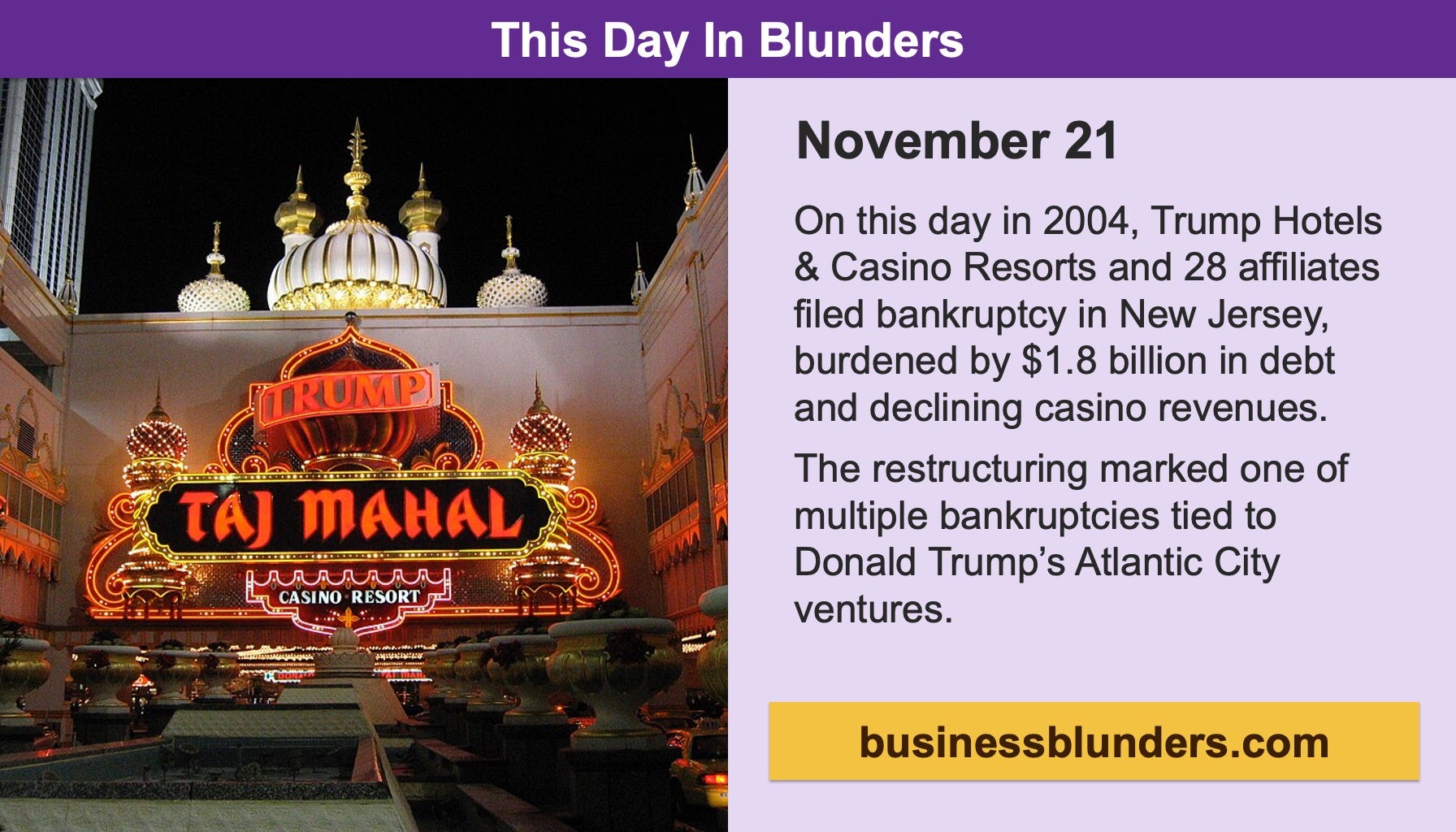
Read More: Donald Trump Business Bankruptcies. A Summary. (American Bankruptcy Institute)
Don’t Miss These Blunders
Elizabeth Holmes – Theranos You can see everything ... except remorse. She was sentenced to prison. Now she’s a movie star.
Nvidia Rhymes With Chlamydia The world’s most valuable company has something resembling an STD. There’s no telling when it will stop spreading.
Eliyahu Weinstein – Optimus Investments He was a two-time Ponzi schemer who caught a break from Donald Trump’s ‘pardon industry.’ Then he started a third fraud.
Huang Dang Doodle All Night Long Nvidia CEO Jensen Huang had an affair with former Megaspeed executive Alice Huang. Now his $4 trillion company is singing the blues.
Artificial Intelligence, Natural Stupidity Three alleged fraudsters used AI to impersonate CEOs and lawyers, tricking corporate employees into wiring $129 million overseas. Apparently, nobody thought to call the real boss.
CVS Goes To Seed. They tried to build a daisy chain. Now they’re in the weeds. And America’s healthcare costs keep mushrooming.
Blockhead Buddies On A Blockchain A felon pardons a felon and embraces a dictator. Any wonder why crypto exchange Binance got hacked for $6.3 billion?
Holiday In Cambodia Villa Vie Residences sold customers a permanent vacation at sea. Then it stranded them in Southeast Asia after failing to adequately hedge the one commodity a cruise line can’t operate without.
Rapist Rainmakers The Alexander brothers brought billions to Douglas Elliman while the prestigious brokerage allegedly ignored warnings of sexual assault. Now the firm is stuck with the fallout.
David H. Brooks – DBH Industries War made him rich. Fraud made him richer. A $10 million bat mitzvah made him infamous.
The Golden Age Of Grift Americans finally agree on at least one thing: Our politicians are ripping us off while an affordability crisis rages.
Jeffrey Skilling – Enron He left for ‘personal reasons.’ He had personally committed fraud.
Tiptoe Through The Escrow A New York attorney loaned $336 million in client funds to a 33-year-old apartment investor. Now Flagstar Bank is getting dragged into an alleged Ponzi scheme surrounding the mess.
Suicide Is Not Painless Executives, entrepreneurs and investors who died by suicide amid business failures, financial losses and corporate scandals. And a reminder that no business blunder is worth a life.
The Great American Rinse Cycle When Chinese money-laundering networks need a bank, where else would they turn but Bank of America?
Pharma Bro Can’t Help Himself Martin Shkreli went to prison. He was also banned from the pharmaceutical industry for life. Regulators say he keeps coming back for another dose.
Billy McFarland – Fyre Festival Prison didn’t end the party. It was just an intermission.
Desperately Seeking Diesel When Trump runs low on fuel, it’s ‘Fill ’er up, Vladimir’
100 Quadrillion Japanese Dogs Kishu Inu founder Alexander Sisemore allegedly bagged $9 million in a crypto ‘rug pull,’ dumping his secret stash of the meme coins on investors. Will crypto enthusiasts buy anything with a dog on it?
Jérôme Kerviel – Société Générale He cost his bank billions. But who left the vault door open?
If the Shoe Doesn’t Fit … Nike Can Wear It What a tech CEO didn’t know: People like to try on shoes before they buy them.
Don Lapre – The Making Money Show His greatest money-making secret was selling money-making secrets.
Charlie Javice – Frank She was startup wunderkind with student loan website. She gave JPMorgan Chase a $175 million education.
The Fake Andy Warhols The art was fake. The provenance was fake. Even the email address was fake. Now the dealer is missing.
Florida Man Takes Cops For A Ride It takes a lot of balls to rip off police. Pension administrator employee Michael D. Williams settles civil fraud charges without admitting or denying the allegations.
Scamway The granddaddy of multilevel marketing gets stuck with a record $225 million settlement as regulators finally crack down on Amway.
Catch And Release Kevin Kolenda kept getting caught selling bogus prize insurance. He never stopped casting for suckers.
'For now, Anthropic’s mammoth initial public stock offering this week, followed by a similar behemoth offering by SpaceX in June, looks to some investors like a cash-out strategy that will leave millions of buy-and-hold investors holding the bag, CNBC reports.' Yup. Sure looks like that's what it is: "If you buy me a hamburger today I'll gladly pay you Tuesday." Never can understand how investors don't realize that stock valuations (prices of everything from equities to fixed income to commodities) are based on expectations - not 'facts in evidence.' Meaning if you think you're gonna get rich, you invest. Because greed drives so many people. But, hey. Facebook's IPO, even Amazon's, wound up making money. Eventually.