

“When plunder becomes a way of life for a group of men living together in society, they create for themselves a legal system that authorizes it and a moral code that glorifies it.” – Frédéric Bastiat
Did you know that CVS once stood for Consumer Value Stores?
Somewhere along the way, it became a Corporate Vanity Scheme and now that scheme is coming undone.
For nearly two decades, CVS pursued an ambitious plan to buy its way into nearly every corner of American healthcare , expanding wildly from drugstores to prescription benefit managers to health insurance providers, to doctors’ offices and home healthcare.
“Today marks the start of a new day in health care and a transformative moment for our company and our industry,” declared CVS CEO Larry Merlo when the company completed its $78 billion acquisition of Aetna in 2018.
The promise was to make medical care simpler, more accessible and, above all, cheaper.
The reality? Healthcare costs are mushrooming, this unwieldy healthcare behemoth is moving its corporate shells around yet again.
On Wednesday, CVS announced plans to split up its empire, in what would be one of the largest corporate breakups ever.
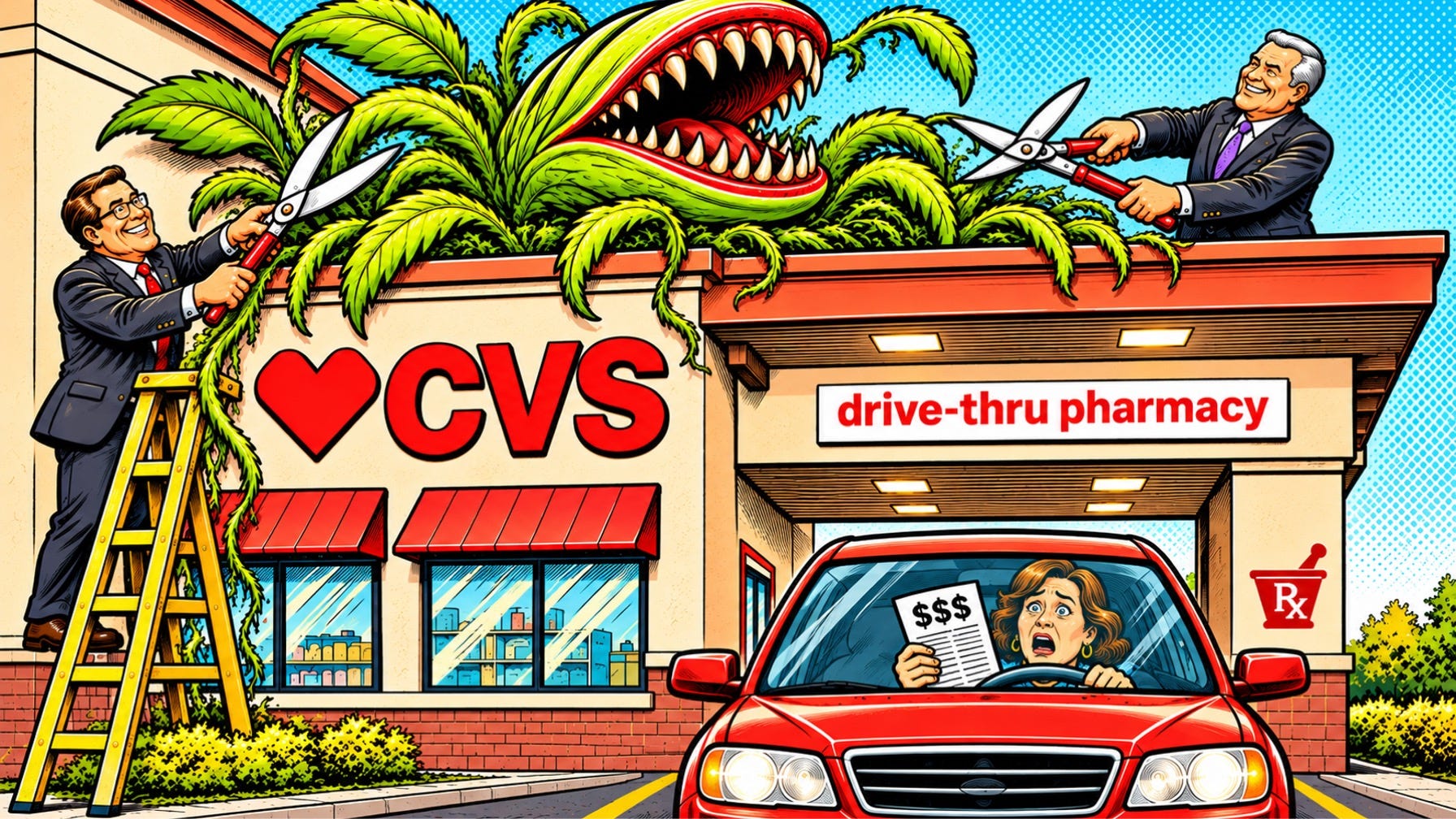
The plan would partially unwind CVS’s pricey Aetna acquisition, separating its roughly 9,000 retail pharmacies from its health insurance and pharmacy-benefit businesses.
But if they were worth so much together, why would they be worth even more taking them apart?
Ask the current CEO, David Joyner, who offered this explaination in a press release:
“Our history is defined by proactively evolving to stay ahead of what’s next in healthcare, and in today’s environment, that means delivering more affordability, greater access, and a simpler experience. … From a position of strength, and a focus on the long term, we plan to create two focused companies to improve consumer engagement, affordability, and care coordination.”
Have you ever heard so much corporate blather while millions of Americans struggle to afford their healthcare? Investors weren’t impressed, either. CVS shares immediately fell more than 12% on the news.
A couple quick facts: U.S. healthcare spending surged 7.2% to $5.3 trillion in 2024, or $15,474 for every American, according to the Centers for Medicare & Medicaid Services. Prescription drug spending alone jumped 7.9% to $467 billion.
And there’s no relief in sight. Federal actuaries project national healthcare spending will reach $9 trillion by 2034, consuming more than one-fifth of the U.S. economy.
CVS isn’t the entire problem, but it has never been a healthy part of the solution.
