

“I can calculate the motions of heavenly bodies, but not the madness of people.” – Isaac Newton
Crypto entrepreneur Alexander Sisemore created 100 quadrillion Kishu Inu meme coins.
I’m not good at astrophysics, or typing zeros, but I believe that’s 100,000,000,000,000,000 of dog-themed digital tokens.
At their peak, they traded for a millionth or two of a penny. I’m not good at quantum phsyics either, but that micro-fraction multipled by 100 quadrillion amounted to a whopping $1.6 billion market valuation.
That means for just a few bucks, you could be a Kishu Inu millionaire or even a Kishu Inu billionaire. And what if this “digital asset” skyrocketed in value to a full penny?
Woof!
You’d be in doggie heaven. And if turned out you were barking up the wrong tree … Well, at least got a cute cartoon Japanese dog for your money.
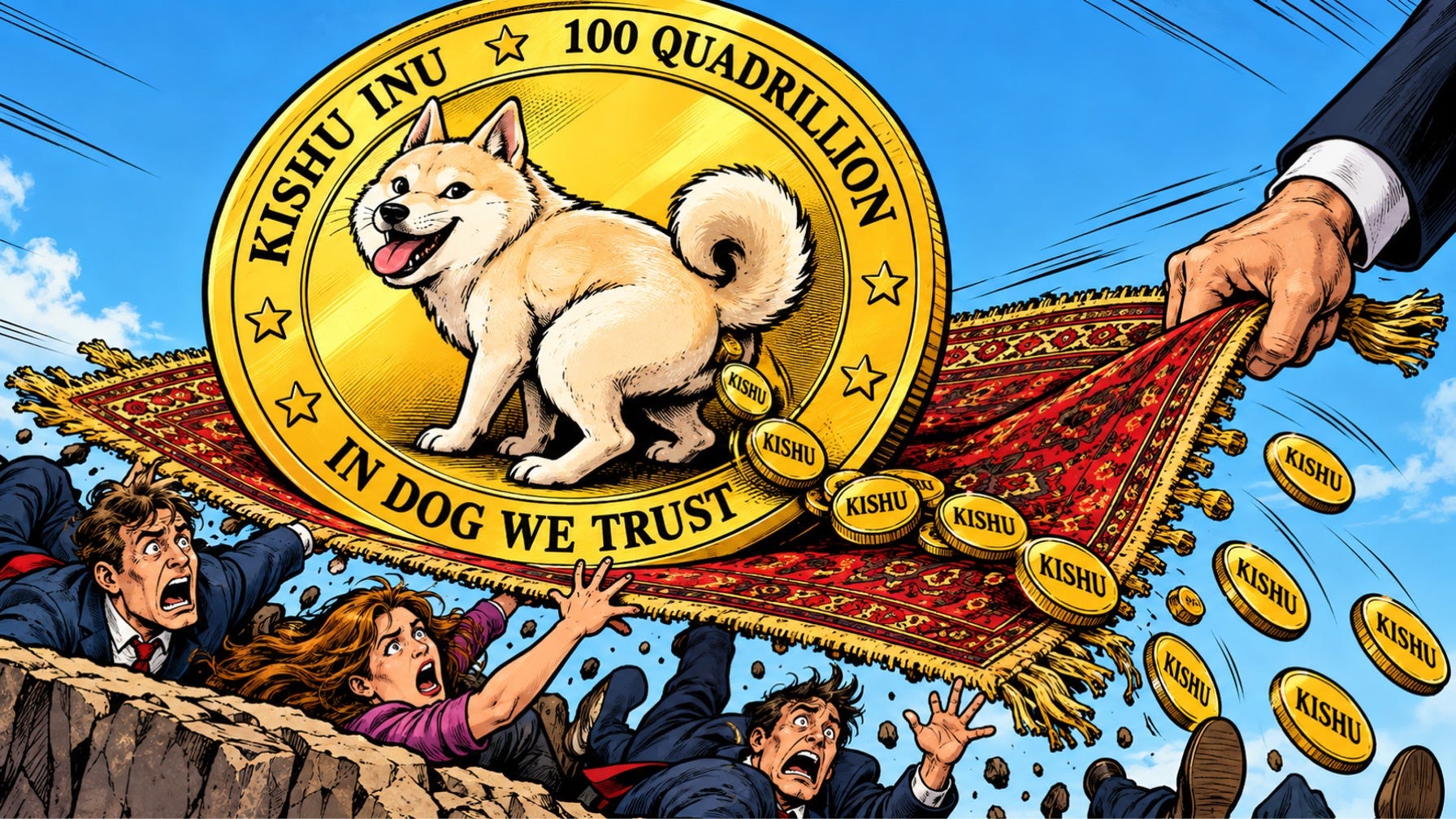
Sound like fun? Just like Beanie Babies, but without the plastic beans.
On Wednesday, federal prosecutors announced wire fraud charges against Sisemore, 28, of Fayetteville, Ark., in what they termed a “rug pull.” In crypto parlance, that’s when insiders hype a token, draw in buyers, then cash out, leaving everyone else holding an empty digital bag.
“Kishu man” and “Kimbo,” as Sisemore is more widely known, plans to fight the charges, his attorney told The Chicago Tribune. Meantime, Kimbo hangs in limbo as he faces up to 20 years in prison if convicted.
The criminal complaint alleges that he pocketed $9 million in personal profits with his undisclosed holdings of Kishu Inu. The website on which the token was launched, kishu.finance, claimed there were no such holdings:
“Kishu Inu was fair-launched, and the dev team has no ‘team tokens’. In other words, our creators had to purchase $KISHU on the open-market.”
Kishu Inu launched in April 2021, during the Dogecoin craze. The Dodgecoin, which featured a Shiba Inu, launched as a joke to highlight the absurdity of meme coins. But the joke landed.
Dogecoin once soared to more than 73 cents and still trades for nearly 9 cents. Kishu Inu still trades, too, for about 0.00000000008 cents, assuming I accurately typed all the zeros. (Got a pooper scooper? Here’s a link to its whitepaper.)
In years past, penny stock brokers pulled similar schemes, but penny stocks were worth at least a penny. Plus, these charlatans had to open an office, buy some used office furniture, set up a few phones and a fax machine, and then hire gaggle of cold-calling slicksters to peddle their worthless shares.
With blockchain technology and some clever digital marketing, fraudsters can get so much more out of unwary investors.
All they need is a stinky bag of digital doggie-do.
