

NOTE TO READERS: This story discusses suicide. If you or someone you know is struggling or in crisis, help is available in the U.S. by calling or texting 988, the Suicide & Crisis Lifeline.
Only two people have taken their own lives while I was writing about their devastating business blunders. They were both bankers.
One was Ed Mattar, who founded and ran to ruin the Best Bank of Boulder. Hours before he was to be sentenced to prison, he died by suicide in a Denver hotel.
The other was Michael Wise, who became an icon of the savings-and-loan bust as the former CEO of Denver’s Silverado Banking. He was never convicted in that scandal.
He later went to prison for an unrelated Ponzi scheme and, upon release, went to work for a mortgage company. After the company shut down amid the 2008 financial crisis, he found himself out of a job.
In April 2009, he took his life at Tampa International Airport.
This is not how any life should end. No failure, no fraud, no financial loss is worth a life.
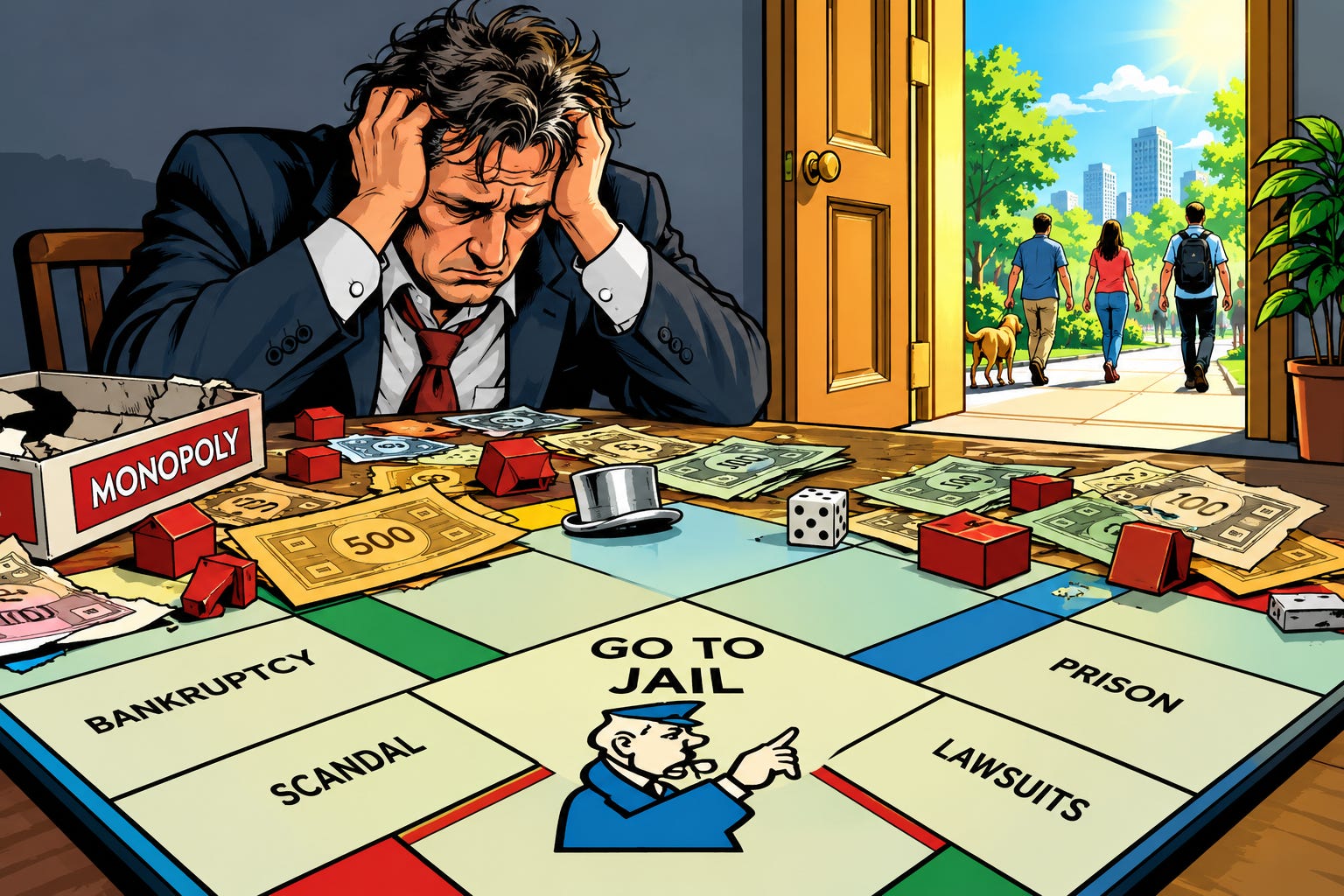
Business disasters can feel permanent when you’re living through them. They aren’t. Fortunes can disappear. Companies can fail. Reputations can be destroyed. People go to prison and come out again. Life goes on.
The Monopoly game includes a “Go to Jail” card, and maybe that’s as bad as any business life should get.
An August 2026 report from The World Health Organization reports that around the globe:
More than 720,000 people die due to suicide every year.
Suicide is the third leading cause of death among 15–29-year-olds.
Seventy-three percent of global suicides occur in low- and middle-income countries.
The reasons for suicide are multi-faceted, influenced by social, cultural, biological, psychological, and environmental factors present across the life-course.
For every suicide there are many more people who attempt suicide.
Wealth and professional success offer no immunity. For some, the despair of a massive blunder, and the public humiliation that can follow, has apparently felt unbearable.
In January 2002, Enron executive J. Clifford Baxter took his own life after agreeing to testify before Congress regarding a massive corporate fraud scandal.
Carol,
I am so sorry for this. I feel I just can’t go on. I have always tried to do the right thing but where there was once great pride now it’s gone. I love you and the children so much. I just can’t be any good to you or myself. The pain is overwhelming.
Please try to forgive me.
Cliff
Not even Enron was worth a life.
This Blunder List is a collection of cautionary tales and a memorial to executives, entrepreneurs and investors who died amid business failures, financial losses and corporate scandals. (For details, free links to reporting are included in each item.)
Some caused the catastrophes that engulfed them. Some were victims of other people’s misconduct. Some simply found themselves trapped inside events they could no longer control.
Markus Jooste, Steinhoff
On March 21, 2024, Jooste, the former CEO at the center of Steinhoff’s massive accounting scandal, took his own life at age 63. His death came one day after South Africa’s financial regulator imposed a $25 million fine for false and misleading financial statements. Steinhoff was the parent company of the ubiquitous Mattress Firm in the U.S. Read More: A CEO Who Made His Own Bed (Business Blunders)
Gustavo Arnal, Bed Bath & Beyond
On Sept. 2, 2022, Arnal, Bed Bath & Beyond’s chief financial officer, plunged from a building as the struggling retailer was closing stores, cutting jobs and trying to stave off financial collapse. His death, which came at age 52, was ruled a suicide. It came just days after the company announced a major restructuring plan.
John Gembara, Washington Federal Bank for Savings
In December 2017, Gembara, CEO of Chicago’s Washington Federal Bank for Savings, took his own life at age 56 shortly before federal regulators closed the bank. Subsequent prosecutions exposed an extensive embezzlement and fraud operation at the institution.
Martin Senn, Zurich Insurance
On May 27, 2016, Senn, the former CEO of Zurich Insurance, took his own life at age 59. His death came about six months after abruptly leaving the company following disappointing financial results and the collapse of its planned $5.6 billion takeover of RSA Insurance Group.
Pierre Wauthier, Zurich Insurance
On Aug. 26, 2013, Wauthier, chief financial officer of Zurich Insurance, took his own life at age 53. His death came after he reportedly complained about intense pressure from company Chairman Josef Ackermann. Ackermann resigned days later, although an investigation subsequently cleared him of responsibility for Wauthier’s death.
Carsten Schloter, Swisscom
On July 23, 2013, Schloter, CEO of Swisscom, took his own life at age 49. He had spoken publicly about the relentless pressures of running Switzerland’s largest telecommunications company and his difficulty disconnecting from work.
Ian Gibbons, Theranos
On May 23, 2013, Gibbons, Theranos’ chief scientist, died by suicide at age 67. His death came amid mounting concerns about the company’s technology and a legal dispute in which he faced being questioned under oath about Theranos’ claims.
Jody Sherman, Ecomom
In January 2013, Sherman, founder and CEO of online retailer Ecomom, took his own life at age 47 as the startup struggled financially. His death prompted a broader discussion in Silicon Valley about the extraordinary pressures facing entrepreneurs.
Aaron Swartz, Reddit/JSTOR
On Jan. 11, 2013, Swartz, the 26-year-old internet entrepreneur and early Reddit figure, took his own life while facing federal felony charges for downloading millions of academic articles from JSTOR. His family accused prosecutors of contributing to his death through an aggressive prosecution; federal prosecutors disputed that characterization.
Ilya Zhitomirskiy, Diaspora
On Nov. 12, 2011, Zhitomirskiy, the 22-year-old co-founder of social-networking startup Diaspora, took his own life. His death came after Diaspora, a heavily hyped Facebook rival, struggled to live up to expectations.
Mark Madoff, Bernard L. Madoff Investment Securities
On Dec. 11, 2010, Madoff, son of Ponzi schemer Bernard Madoff, took his own life at age 46, exactly two years after his father’s arrest. Mark Madoff had turned his father in and was never criminally charged, but spent the next two years facing lawsuits, investigations and public suspicion arising from the massive fraud.
Michael Wise, Silverado Savings & Loan
On April 8, 2009, Wise, the former CEO of Denver’s notorious Silverado Savings & Loan, took his own life at age 64 after losing his job when the mortgage company he worked for shut down amid the financial crisis. Wise had been acquitted of bank-fraud charges stemming from Silverado’s $1 billion collapse, but later served federal prison time for running an unrelated $9 million Ponzi scheme. Read More: Michael Wise — Silverado Savings & Loan (Business Blunders)
René-Thierry Magon de la Villehuchet, Access International Advisors
On Dec. 23, 2008, de la Villehuchet, a French money manager whose Access International Advisors had placed about $1.4 billion of client money with Bernard Madoff, took his own life at age 65 after Madoff’s Ponzi scheme collapsed. He had also reportedly invested substantial personal wealth with Madoff.
Ed Mattar, BestBank of Boulder
On Nov. 2, 2007, Mattar, founder of the failed BestBank of Boulder, took his own life at age 68, hours before he was scheduled to be sentenced on federal bank-fraud charges. Regulators had seized BestBank in 1998 with $135 million in bad loans. Its failure ultimately cost the FDIC more than $200 million and uninsured depositors another $27 million. Read More: A CEO Who Didn’t Do His Time (Business Blunders)
J. Clifford Baxter, Enron
On Jan. 25, 2002, Baxter, a former Enron vice chairman who had raised concerns internally about the company’s questionable transactions, took his own life at age 43 as investigators and Congress examined Enron’s spectacular collapse. Baxter had agreed to testify before congressional investigators. Read More: Enron Was A Parody Of Itself (Business Blunders)
Mace David Howell Jr., investment financier
In 2002, Howell, an Arkansas financier whose investors included Dallas Cowboys owner Jerry Jones, took his own life at age 54 amid the collapse of his investment operation. After his death, about 70 investors reportedly filed claims totaling roughly $80 million as allegations emerged that Howell had operated a Ponzi scheme.
Takashi Uehara, Long-Term Credit Bank of Japan
On May 6, 1999, Uehara, a former vice president of the failed Long-Term Credit Bank of Japan, took his own life at age 59. Prosecutors had questioned him about suspected falsification of the bank’s financial statements and allegedly illegal dividend payments.
Takayuki Kamoshida, Bank of Japan
On May 2, 1998, Kamoshida, a senior Bank of Japan official who led an internal investigation into corruption at the central bank, took his own life at age 58. The inquiry resulted in disciplinary action against scores of employees and criticism of how the investigation had been handled. Kamoshida, who was not accused of corruption himself, reportedly left a note saying, “I’m tired. I’ve reached my limit.”
Shokei Arai, Nikko Securities
On Feb. 19, 1998, Arai, a 50-year-old Japanese lawmaker and former Finance Ministry official, took his own life hours before prosecutors were expected to arrest him over allegations that he had received improper financial benefits from Nikko Securities.
Kuniji Miyazaki, Dai-Ichi Kangyo Bank
On June 29, 1997, Miyazaki, the 61-year-old former president and chairman of Dai-Ichi Kangyo Bank, took his own life as prosecutors investigated billions of yen in questionable loans connected to a corporate racketeer. He reportedly left a note declaring, “I will accomplish my responsibility with my life.”
George “Chip” Wischer, Lincoln Savings & Loan
On June 18, 1995, Wischer, a 46-year-old former executive in Charles Keating’s American Continental empire, took his own life amid the financial and legal fallout from the collapse of Lincoln Savings and Loan. He was among about 100 defendants named in a $1.2 billion investor lawsuit.
Sheldon Weiner, Lincoln Savings & Loan
On June 16, 1995, Weiner, a 41-year-old former American Continental executive, took his own life amid the financial and legal fallout from the collapse of Charles Keating’s savings-and-loan empire. Two days later, fellow former executive George “Chip” Wischer also died by suicide.
John Friedrich, National Safety Council of Australia
On July 26, 1991, Friedrich, who transformed the National Safety Council of Australia’s Victorian division into a sprawling business empire financed by massive borrowing and fraud, took his own life at age 40. He was awaiting trial in what was then one of Australia’s largest corporate fraud cases.
Yaacov Levinson, Bank Hapoalim
On Feb. 23, 1984, Levinson, former chairman of Israel’s Bank Hapoalim, took his own life at age 52 while under investigation over allegedly improper overseas financial transactions. He reportedly wrote that his strength was exhausted and that he could “no longer bear the degradation.”
Alan Saxon, Bullion Reserve of North America
On Sept. 28, 1983, Saxon, head of Bullion Reserve of North America, took his own life at age 39. Investigators were closing in on his collapsing precious-metals business, where tens of millions of dollars belonging to customers were missing. Saxon reportedly acknowledged losing more than $40 million trading commodities.
Giuseppe della Chà, Banco Ambrosiano
On Oct. 1, 1982, della Chà, vice chairman of the collapsed Banco Ambrosiano, took his own life at age 54, less than four months after the deaths of Banco Ambrosiano Chairman Roberto Calvi and his secretary Graziella Corrocher. The bank had collapsed amid revelations of enormous hidden debts and questionable transactions involving offshore companies and the Vatican Bank.
Graziella Teresa Corrocher, Banco Ambrosiano
On June 17, 1982, Corrocher, longtime secretary to Banco Ambrosiano Chairman Roberto Calvi, took her own life at age 55 as one of Italy’s biggest banking scandals engulfed the institution. Calvi had fled Italy as investigators pursued a huge hole in the bank’s finances, and that day the board stripped him of his powers and called in the Bank of Italy. Corrocher left a note condemning Calvi for fleeing and for the damage he had done to employees and the bank. The next morning, Calvi was found dead beneath London’s Blackfriars Bridge. His death, initially treated as suicide, was later determined to be a murder.
Frank Nugan, Nugan Hand Bank
On Jan. 27, 1980, Nugan, co-founder of Australia’s Nugan Hand Bank, took his own life at age 37 as his financial empire began to unravel. The bank subsequently collapsed owing investors tens of millions of dollars and became the subject of one of Australia’s most notorious financial investigations.
Eli Pinkas, Swiss businessman
In 1980, Pinkas, took his own life at age 60 as investigators closed in on his alleged schemes. He was at the center of an international banking scandal involving roughly $140 million in questionable loans. He left a suicide note for his ex-wife urging her to join him. She was later found dead, too.
F. Donald Coster/Philip Musica, McKesson & Robbins
On Dec. 16, 1938, Musica, a convicted swindler who reinvented himself as F. Donald Coster and rose to become president of McKesson & Robbins, took his own life at age 62. Investigators had exposed his true identity and an enormous accounting fraud involving fictitious inventory, sales and receivables.
George E. Cutler, New York Mercantile Exchange
On Nov. 16, 1929, Cutler, a member of the New York Mercantile Exchange, jumped to his death at age 65 after reportedly suffering heavy losses in the stock-market crash. Contrary to popular lore, ruined investors weren't jumping en masse from Wall Street buildings after the crash. But some did die by suicide.
J.J. Riordan, County Trust Co.
On Nov. 8, 1929, Riordan, president of New York’s County Trust Co. and a prominent New York Democrat, took his own life at age 48. He reportedly suffered heavy personal losses in the stock-market crash. The bank delayed announcing his death while its books were examined to reassure depositors that the institution itself remained sound.
C. Fred Stewart, Chicago real estate
On Oct. 25, 1929, Stewart, a Chicago real-estate investor, took his own life at age 49. His death came just one day after Black Thursday amid reports that he had suffered substantial financial losses.
A final note
Rogue trader Jérôme Kerviel lost about $7 billion while employed at Société Générale in one of the largest trading disasters in history.
As his secret trades unraveled in 2008, he contemplated suicide, and came close twice.
In the end, he decided to serve his time and rebuilt his life after prison. Today, he gives presentations about finance, failure and recovery, while continuing to dispute Société Générale’s version of the scandal.
Read More: Jérôme Kerviel – Société Générale (Business Blunders Hall Of Shame)
Blunders happn. Companies fail. Fortunes disappear. Reputations collapse. People go to prison.
Life goes on.