

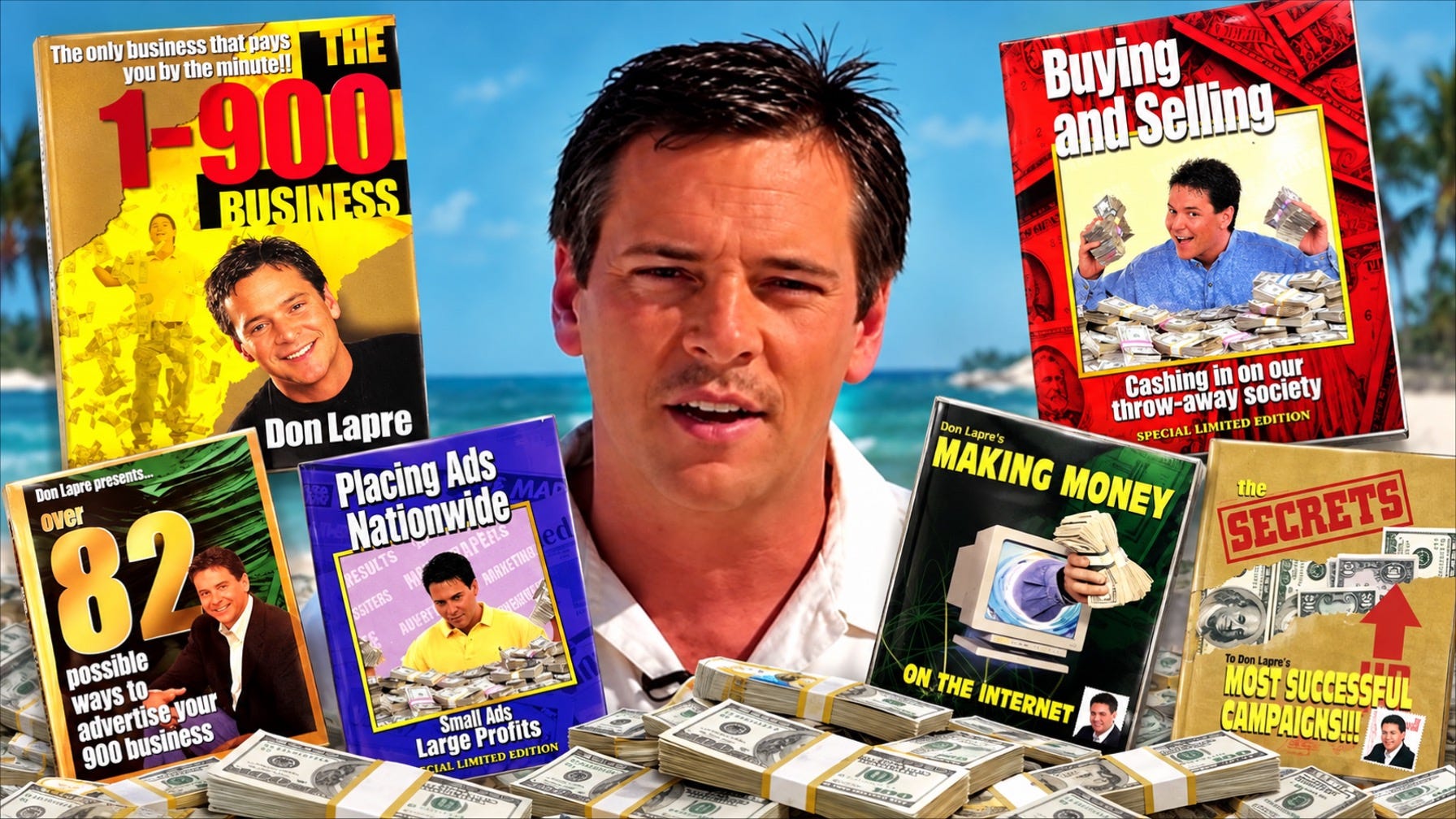
Channel-surfing insomniacs in the 1990s often landed on The Making Money Show With Don Lapre, a half-hour infomercial selling America on a dream.
Lapre was a young man who claimed to hold the secret to riches, and for $40 he’d share it with you.
His Making Money Secrets package came with tapes and booklets explaining how to make money from home, including Lapre’s favorite formula: tiny classified ads and 900 numbers.
The idea was simple. Lapre’s company could sell you a pay-per-minute phone line offering sports picks, psychic readings, dating or chat services.
You didn’t have to produce the schlocky content for these phone lines. Your job was to place tiny classified ads persuading people to call your number. When they did, you got a cut of the charges.
Lapre claimed he’d used the formula to go from a one-bedroom apartment to making $50,000 a week.
Did anybody wonder why a guy banking this much cash couldn’t pay for his own damn classified ads?
Leveraging the miracle of salesmanship over substance, the show ranked among the 10 most frequently broadcast cable infomercials in the nation.
And Lapre’s $40 package was only the beginning.
Once customers bought it, Lapre’s salespeople called them with offers for 900-number businesses and other services. Lapre acknowledged in 1995 that his company couldn’t survive by just selling introductory packages.
One former salesman later offered a blunter description.
“Most of the crap in there isn’t information on how to run a business,” Elliot Storch told Phoenix New Times. “It’s basically for giving you a number to call Don so he can sell you something else.”
By 1996, another former employee said, Lapre’s companies were taking in as much as $1.6 million a week, and spending at least $600,000 a week to keep Lapre on television.
The Making Money Show was aptly named.
Don Lapre was making money.
The making of a money maker
Lapre was born in Providence, R.I. and grew up poor in Sunnyslope, Ariz.
His mother worked at a convenience store. His father had a house-painting business and was laid up for two years with a bad back. Lapre said he scavenged discarded furniture from alleys and sold it at the Park ‘N’ Swap to help the family. He dropped out of high school to help make ends meet and worked in his father’s painting business.
In 1988, he started the 1828 Club, a dating service for young adults. Within months, he filed for Chapter 7 bankruptcy.
That same year, Lapre married Sally Redondo, who would become the mother of their two children, and in 1990 the couple launched another venture, Unknown Concepts, offering credit repair.
The company promised access to credit cards, loans and discount vacations for $37. What customers got was information about companies that might provide these things … Yeah, might. And for $37, you can read all about it.
Arizona’s attorney general sued Lapre and his wife under the state’s Consumer Fraud Act. The couple was barred from operating credit-service organizations and ordered to pay civil penalties and more than $5,000 in restitution.
No worries.
On to the next thing
Next, Lapre wrote a 36-page booklet telling homeowners how to recover certain Federal Housing Administration insurance refunds after paying off their mortgages.
It reportedly cost about 60 cents to produce. Lapre sold it for $85 through an advertisement in a local newspaper.
It was successful enough to raise money for Lapre’s next big thing after a friend introduced him to the wonders of the 900 number. Callers to these telephone lines paid as much as $2.99 a minute.
Lapre placed some 1,100 advertisements in newspapers around the country directing people to call.
That’s when Lapre realized there might be an even better business than making money from classified ads. He could sell the idea itself.
But wait, there’s more!
In 1992, Lapre took his pitch to television.
The Making Money Show offered an introductory package cheaply enough to attract a mass audience. But the $40 kit was only the beginning.
Customers could subsequently be pitched much more expensive 900-number businesses involving psychic lines, sports information, dating and entertainment. The Phoenix New Times reported that customers could wind up spending about $850.
By 1994, Lapre claimed his “Making Money” operation was generating $40 million per year.
That was the claim, anyway. Too bad his customers weren’t getting anywhere near this rich.
Complaints accumulated over additional charges, refunds and the difficulty of actually earning the riches Lapre promised.
Nevertheless, Lapre kept moving. He launched reminder services. He opened retail stores. He moved onto the Internet. He invested millions in a Mexican real-estate development.
Then, in 1999, his money-making machine ran dry.
Lapre’s business empire filed for Chapter 11 bankruptcy protection, listing about $9 million in assets and $12.5 million in liabilities.
“I fail at more things than anyone I’ve ever met,” he told Phoenix New Times. “But I try more things than anyone I’ve ever met. I’m a good loser.”
The Greatest Vitamin in the World
In the 2000s, Lapre returned to television with what he dubbed, “The Greatest Vitamin in the World.”
Lapre offered people an opportunity to make money selling this magic pill over the Internet. Participants bought websites and advertising and were told they could earn commissions when customers purchased vitamins.
“You get just 20 people to try the greatest vitamin in the world, we will send you a check for a thousand dollars,” ” Lapre promised in an infomercial.
CBS News examined the operation in 2004 and found customers who had spent thousands of dollars buying websites and advertising earned little or nothing.
The Food and Drug Administration also warned Lapre’s company over claims suggesting the supplement could address conditions including diabetes, stroke, heart disease, insomnia, cancer and arthritis. The FDA sent another warning in 2006.
Federal prosecutors eventually became much more interested in an Lapre’s associated scheme of selling vitamin-hawking websites.
Prosecutors alleged that from 2004 through 2007, Lapre sold essentially worthless Internet businesses to about 226,000 people. They alleged that he hauled in nearly $52 million with this scheme.
In June 2011, a federal grand jury in Phoenix indicted Lapre on 41 counts including conspiracy, mail fraud, wire fraud and money laundering.
According to prosecutors, participants were encouraged to spend money on websites and advertising with the expectation that vitamin sales would generate commissions. Prosecutors alleged that Lapre supplied false sales records that made it appear the businesses were succeeding and encouraged customers to buy still more advertising and services.
Lapre denied the fraud:
“I tried to create the best product on earth,” he wrote on his website, “paid out millions, made very little trying to make it a success, had attorneys review my entire company, paid out millions in refunds, tried to make the commission and products better every single year, and in spite of all that, I have been accused of something I did not do.”
Lapre failed to appear for his June 2011 arraignment. U.S. marshals found him the following day hiding at a fitness center in Tempe, Arizona, suffering from self-inflicted wounds.
His trial was scheduled to begin Oct. 4, 2011 but on Oct. 2 of that year, he was found dead in his cell at the Central Arizona Detention Center in Florence.
His death at 47 was ruled a suicide.
All in fun
Lapre never stood trial on the federal charges and was never convicted of them. His death left prosecutors’ allegations untested.
At one point, Lapre had offered a fitting description of his approach to business.
“I just want to have fun creating ideas and selling them,” he told Phoenix New Times. “I wish I had a big ego, but I really don’t give a rat’s ass about what people think about me.”
His legacy remains as a two-decade trail of get-rich promises, customer complaints, regulatory problems, two bankruptcies and a 41-count federal indictment.
Plus at least one important lesson for insomniacs watching late-night television:
Selling the American dream is a lot more lucrative than buying it.