

Banks spend millions on risk controls, compliance departments and computer security. Then every so often, they hand a young trader the keys to the vault and act surprised when the money disappears.
Jérôme Kerviel wasn’t the world’s first rogue trader, and despite the costly lessons of his spectacular folly, he would not be the last.
In January 2008, managers at French banking giant Société Générale discovered that Kerviel had placed €50 billion in unauthorized trades. After the bank unwound them, it had lost €4.9 billion, or about $7 billion. It was the largest rogue-trading loss ever blamed on a single employee.
For 13 years, another rogue trader, Nick Leeson at Britain’s Barings Bank, had held this dubious record. Then came Jérôme Kerviel whose record still stands.
Read More: Nick Leeson – Barings Bank (Business Blunders Hall Of Shame)
Like Leeson before him, it was yet another case of doubling down to avoid admitting failure. But at least he meant well. Or so he claimed.
“I had several motivations in making those orders, but first and foremost I had in mind to make money for the bank,” Kerviel told investigators, according to The New Yorker.
Back-office education
Kerviel, who was born in the Brittany region of France, joined Société Générale in 2000. He was 31 when the scandal first broke.
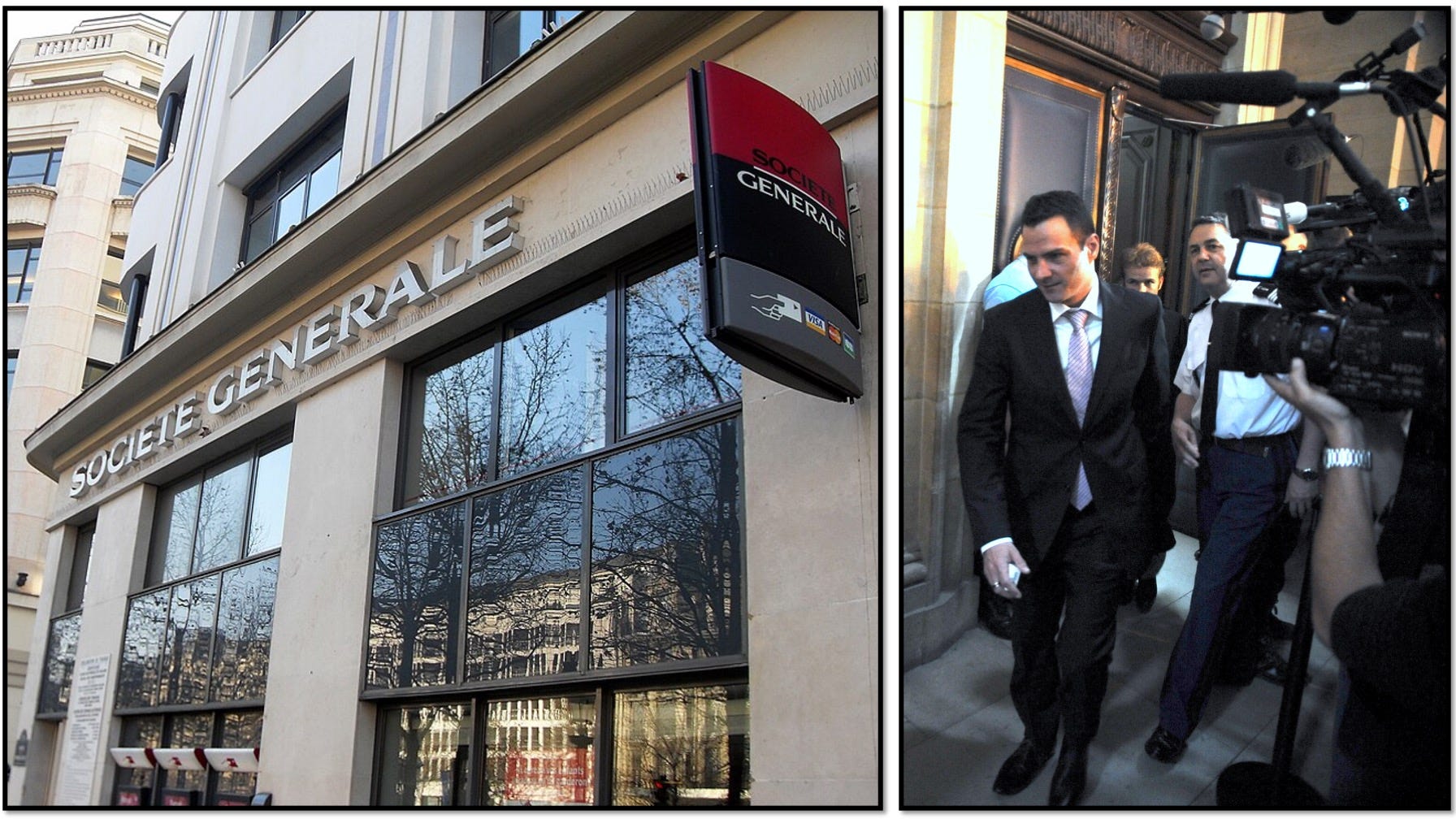
Kerviel earned a master’s degree in finance from Lumière University Lyon 2. He started in the bank’s middle office, where he learned how trades were processed and monitored.
He moved onto the trading floor and began making increasingly large unauthorized bets on European stock indexes. To hide his exposure, he entered fictitious offsetting trades into the bank’s systems, making his positions appear hedged when they weren’t.
By 2007, the strategy had become astonishingly successful. Kerviel generated about €1.4 billion in hidden profits that year.
Had the trades been legitimate, Kerviel could have taken a bow for this massive success, and he might have been handsomely rewarded. But he wasn’t supposed to be making bets like these. His job was largely arbitrage, or exploiting small price discrepancies with offsetting trades, not wagering billions on which way the market would move.
Red lights flashing
By January 2008, Kerviel had accumulated about €50 billion in positions, according to Société Générale’s account of the case. That was more than all of the bank’s shareholders’ equity at the time.
The bank said Kerviel fictitious transactions, false explanations and forged documents defeated its controls.
His trading, however, did generate warnings that went ignored.
Société Générale’s risk-control staff repeatedly flagged Kerviel’s trades, and in November 2007 the Eurex derivatives exchange contacted the bank about unusually large positions.
Somehow, it wasn’t a problem as long as the world’s stock markets were going up. Only when they began to collapse in a global financial crisis did bank officials finally confront Kerviel
In January 2008, the enormity of his predicament hit him.
“I don’t know if I’m going to come back or throw myself under a train,” he wrote in a text message as bank officials tried to reach him, according to a detailed 2008 New Yorker account.
Tallying the damage
Société Générale began liquidating Kerviel’s positions on Jan. 21, 2008.
The timing was terrible. By the time the bank finished unwinding the positions, it had suffered a €4.9 billion loss.
Kerviel instantly became one of the world’s most infamous traders.
His defense was essentially this: Yes, he broke the rules, but his superiors knew, or should have known, what he was doing.
A French court didn’t buy it.
On Oct. 5, 2010, Kerviel was convicted of breach of trust, forgery and unauthorized use of the bank’s computer systems. He was sentenced to five years in prison, with two suspended. The court also ordered him to repay €4.9 billion.
Courtroom spectators gasped at the size of the judgement, The Guardian reported. It was a bit like asking a kid with a Kool-Aid stand to pay off the national debt.
“I don’t know how I’m going to manage,” Kerviel said after the verdict. “I’m going to have to find a job that pays €100,000 a month for the next 4,000 years.”
A bullet in the head
An appeals court upheld Kerviel’s conviction and the whopping €4.9 billion judgment in 2012.
“What happened today is a call for me to put a bullet in my head,” he said, although he immediately added he did not intend to kill himself, according to the Associated Press.
Later though, in a 2025 interview, he said he’d come close to suicide twice, once with a gun and once with his belt while incarcerated. During one of those episodes, he said, a telephone call from his ailing mother interrupted him.
The isolation of prison compounded his despair, but then a miracle happened.
France’s highest court upheld Kerviel’s criminal conviction in 2014, but it threw out the €4.9 billion damages award. He was going to be free, at least of this intractable debt burden.
It turns out, Société Générale’s own shortcomings weren’t taken into account, the higher court ruled. Yes, Kerviel was guilty. But the bank was hardly blameless.
Banks are seldom blameless in these massive debacles.
Four years after Kerviel’s folly, JPMorgan suffered its own trading disaster. In 2012, trader Bruno Iksil, a.k.a the “London Whale,” and his colleagues made enormous derivatives bets that spiraled out of control, costing the bank $6.2 billion.
Regulators later faulted the bank for failures in risk management and internal controls, raising the same question left in the wake of the Leeson and Kerviel debacles: How could a major bank let trading risks this enormous grow without adequate oversight?
In 2016, a Versailles appeals court put a new price on Kerviel’s liability: €1 million. Kerviel had gone from owing one of the largest financial judgments imaginable to owing 0.02% of it.
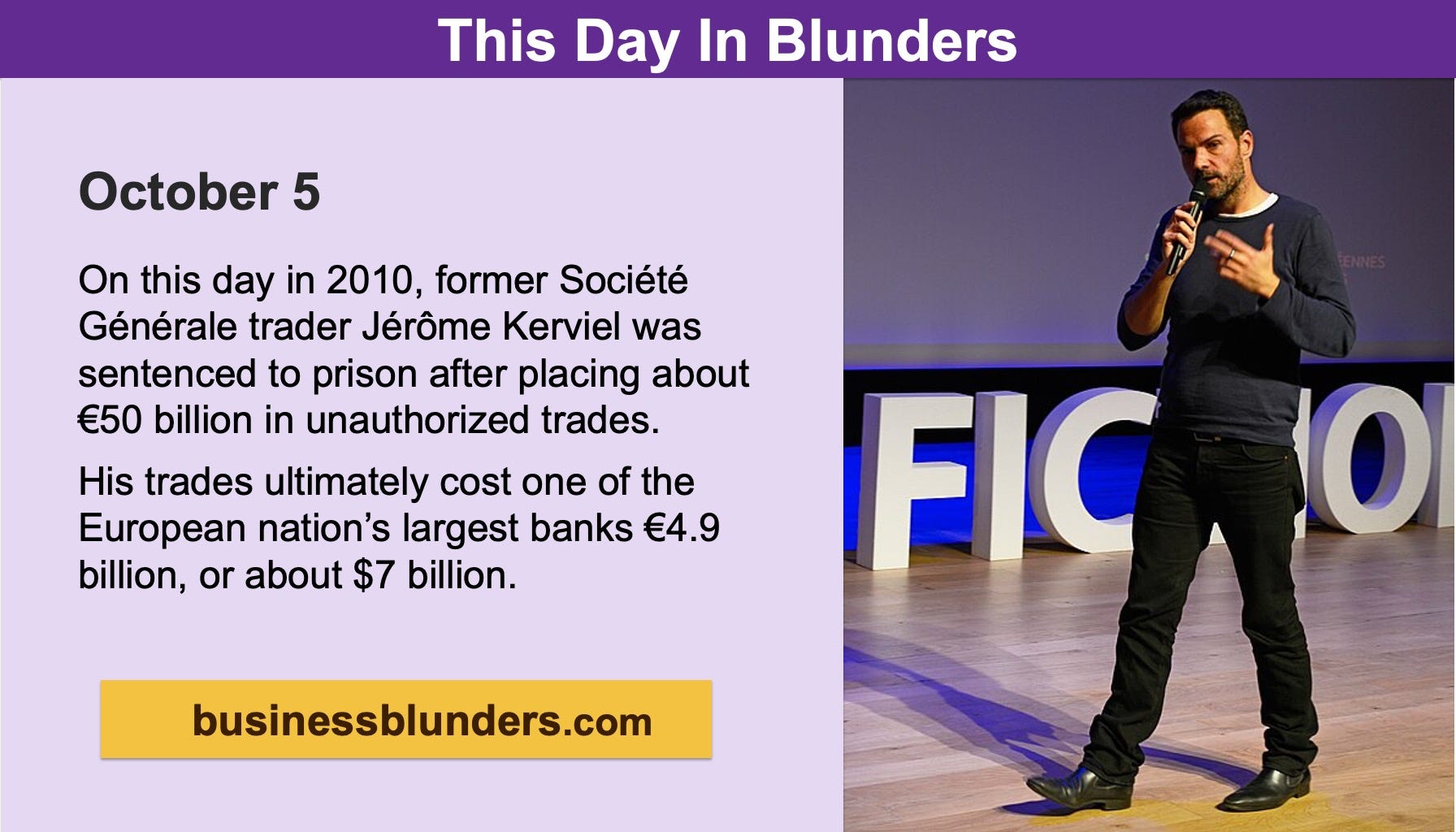
After prison, he took to the one career many white-collar convicts find lucrative: He began appearing before business audiences as a speaker, leveraging the catastrophe that destroyed his banking career.
“J’étais un gros connard …” he said in a December 2024 interview.
Translation: “I was a huge asshole who didn’t realize what he was doing at the time.”
In 2026, he was still giving presentations on finance, corporate pressure, personal responsibility, failure and recovery.
To this day, he disputes Société Générale’s version of the scandal and continues fighting to overturn his conviction. But nearly two decades later, he remains a key figure in the rogue-trader pantheon.
“I’ve acknowledged my mistakes,” he said in a 2025 interview, “but I don’t want to bear alone the excesses of an entire system.”
The detail that deserves more weight: the controls worked. Risk-control staff flagged the trades repeatedly. Eurex contacted the bank about unusual positions. The fraud didn't beat the detection architecture - it survived in the gap between detection and response. The alarm sounded. Nobody treated it as an alarm.
Kerviel's back-office start wasn't biographical color - it was the exploit. He learned which entries would make an unhedged position look hedged to the monitoring systems. The fictitious offsetting trades didn't fool the controls. They spoke the controls' own language. The system saw hedged positions because that's what it was designed to see when offsetting entries appeared. It was correct. It just received false premises.
The fraud that runs longest isn't the one that evades the detection system. It's the one that satisfies it.