

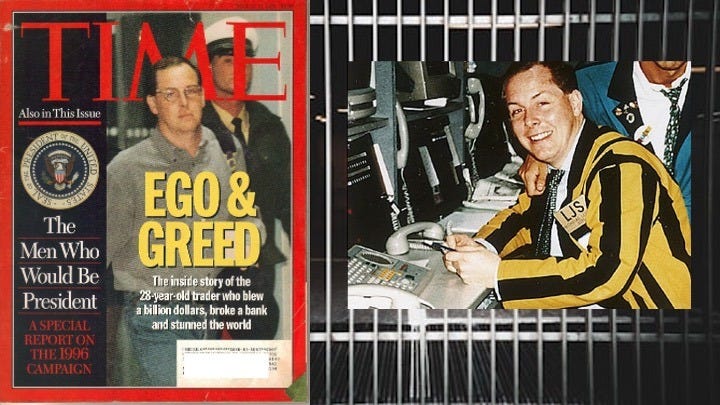
As a 28-year-old derivatives trader Nick Leeson accomplished something Napoleon, two world wars, and the Great Depression could not. He bankrupted Barings Bank, Britain’s oldest merchant bank.
The “star trader” could not admit a mistake and managed to hide more than $1 billion in losses, which was more than the 233-year-old bank’s entire capital.
Barings had essentially handed Leeson the unchecked power to police himself, far away from headquarters. The bank employed Leeson in Singapore to run its futures trading operation on the SIMEX exchange.
When his early trades went bad, Leeson hid the losses in an internal error account numbered 88888. The account was set up to reconcile minor discrepancies. But it swiftly became a financial black hole.
No matter how bad his trades went, Leeson kept doubling down, placing highly leveraged bets on Japanese market movements. When the Kobe earthquake struck in January 1995, markets moved against him and his losses exploded.
In February 1995, Nick Leeson finally came clean, but not in person. He sent a fax to Barings’ London headquarters admitting the scale of the disaster. Then he tried to disappear.
He left Singapore with his wife, traveling through Malaysia and Thailand before surfacing in Europe. His flight from justice only lasted for about six days.
On March 2, 1995, German authorities arrested him at Frankfurt Airport, acting on an international warrant. He was extradited to Singapore, where he pleaded guilty to fraud. On Dec. 2, 1995, he was sentenced to six and a half years in Singapore’s Changi Prison and served just over four.
The pain of prison compounded.
In 1998, he was diagnosed with colon cancer. He underwent surgery and chemotherapy while serving his sentence. His marriage also fell apart. But through it all, he persevered.
Singapore released him early for good behavior in July 1999.
Despite the costly lesson he left behind, Leeson would not be the world’s first rogue trader. Thirteen years later, Jérôme Kerviel would stick one of France’s largest banks,– Société Générale, with more than $7 billion in losses.
Read More: Jérôme Kerviel – Société Générale (Business Blunders Hall of Shame.)
After prison, Leeson returned to Britain with cancer in remission, his banking career destroyed and his name permanently attached to one of the most spectacular financial collapses in history. But unlike the bank he brought to ruin, Leeson got a second act.
His story was later recounted in the 1999 film Rogue Trader, starring Ewan McGregor.
Leeson eventually moved to Ireland, remarried and went back to school, earning a psychology degree.
He became chief executive of Irish soccer club Galway United. He also developed a career as a keynote speaker, talking to companies about risk management, corporate governance, decision-making and what happens when organizations fail to question the people making them money. He reportedly still trades, but with his own money, and he hosts a podcast.
In his 2015, book, Rogue Trader: The Original Story Of The banker Who Broke The System, Leeson laments that he became a victim of his ambitions.
“Success can be easily derived from putting food on the table for your children to eat as it can from running a Fortune 500 company,” he writes. “Unfortunately, it too me too long to learn that.”
In some ways, Leeson became the prototype for new generations of rogue traders.
Thirteen years after Barings collapsed, Société Générale discovered that 31-year-old trader Jérôme Kerviel had secretly placed about €50 billion in unauthorized bets, more than the bank had in shareholder capital. In 2008, when the bank rushed to close those positions in a falling market, it lost €4.9 billion.
Then came the London Whale. In 2012, JPMorgan Chase trader Bruno Iksil and colleagues in the bank’s Chief Investment Office amassed enormous derivatives positions that ultimately cost the bank more than $6 billion.
JPMorgan later paid about $920 million to U.S. and British regulators over the debacle.
Once again, the problem wasn’t just a rogue trader. It was a giant financial institution failing to understand, control and accurately account for what was happening on its trading desks.
Iksil, Kerviel and Leeson all understood the systems. And in all three cases, enormous bets kept growing while supposedly sophisticated banks failed to rein them in.
Barings, founded in 1762, is gone. ING paid exactly one nominal pound to take over what was left.
The bank’s collapse became a case study in the worship of star traders, the lethal mix of ego and leverage, and most of all, failed oversight.
What bank gives unfettered access to its vault to a single, twenty-something trader?