

This Week In Blunders – Oct. 11-17
“If you see fraud and do not say fraud, you are a fraud.” – Nassim Nicholas Taleb
Chinese money-laundering networks service drug traffickers, facilitate fraud and move mountains of questionable cash around the world.
What they need are the services of a reputable bank, and Bank of America has been there to help.
On Tuesday, the U.S. Treasury announced more than $1.21 billion in civil penalties against the nation’s second-largest bank for violations of anti-money laundering laws. This marks the third-largest penalty in Treasury history.
Bank of America admitted that it willfully violated federal anti-money-laundering laws and failed to timely report more than $5 billion in suspicious transactions.
This is no mere record-keeping violation. BOA has been putting national security at risk. Separately, it paid $11.6 million to settle hundreds of apparent sanctions violations involving Russia, Iran, narcotics and terrorism programs.
“The Bank knew for years,” Treasury said in its news release, but “prioritized its revenues.”
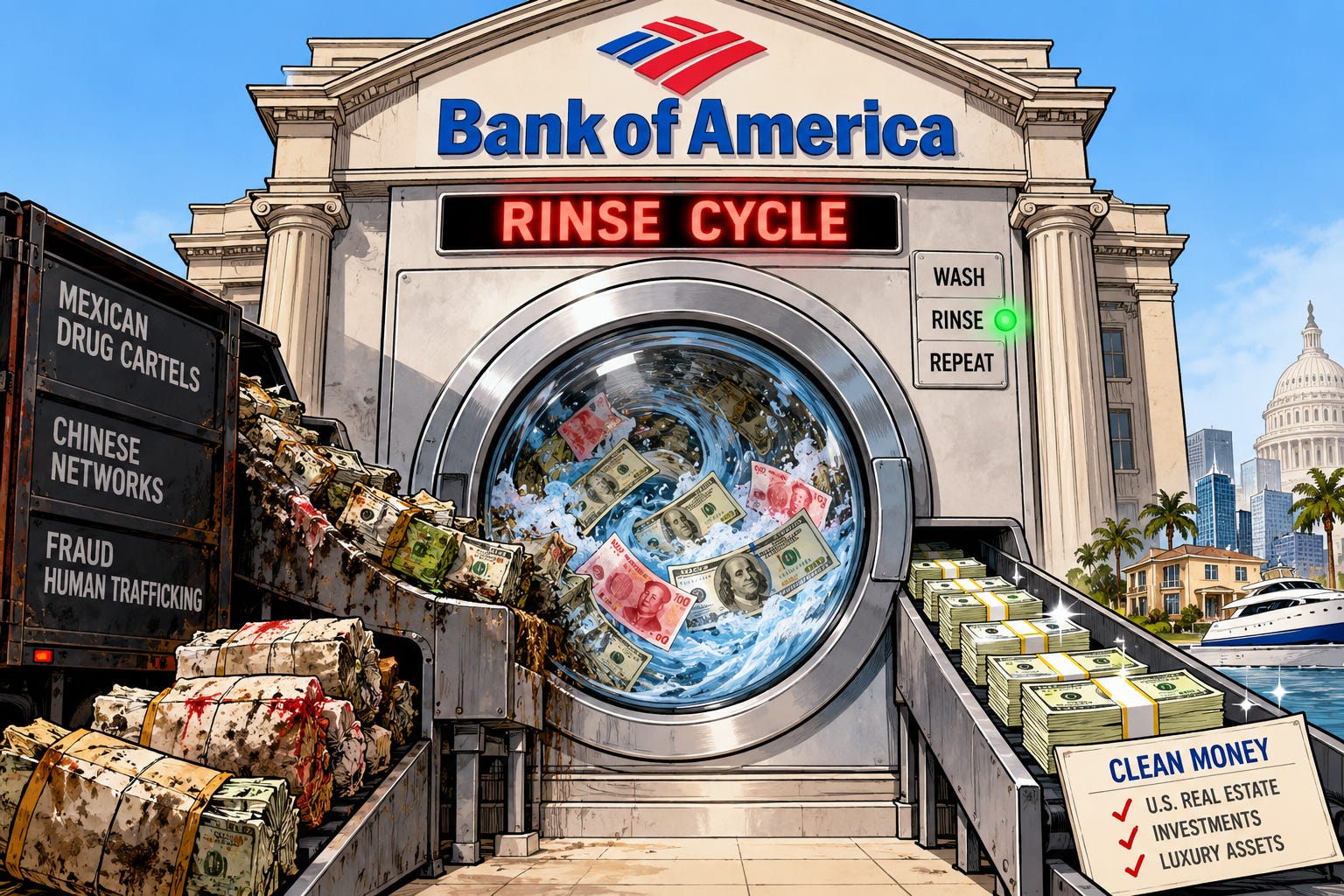
The rinse cycle can generate handsome banking fees. Here’s how it works:
Mexican drug cartels have mountains of illicit dollars in the United States that they need to launder.
Chinese citizens want dollars outside China but face strict government limits on moving money abroad.
Chinese money-laundering networks buy the cartels’ dirty dollars and sell them to Chinese customers, sometimes using social media to bring buyers and sellers together.
The cartel gets its money laundered. Chinese customers get dollars outside China. The middleman gets a cut. And Bank of America was supposed to notice when some of this money came through its vault doors.
FinCEN examined more than 137,000 reports filed by financial institutions from 2020 through 2024 and found some $312 billion in suspicious transactions linked to Chinese networks.
The money moves through shell companies, money mules, trade transactions and sometimes accounts opened with counterfeit Chinese passports. FinCEN even warns that the networks may recruit employees inside banks to help them.
“What would you like the power to do?” goes the slogan at Bank of America.
For some of its worst customers, the answer was apparently: Commit more international crime.
Above and Beyoncé
No matter how much you loved Beyoncé, there was an eight-ticket limit for her 2023 Renaissance tour finale in Kansas City.
A San Diego scalping company allegedly bought 7,624.
The Justice Department and the Federal Trade Commission sued REPS & Co. on Thursday, alleging it used bots and 1,300 accounts to snap up these tickets and resell them for an estimated $833,000 profit.
Why does it cost more for a concert ticket than your first used car? Parasitic resellers.
According to the feds, REPS spent $1.3 billion buying 18.5 million tickets to more than 83,000 events where it exceeded eight tickets, then made at least $120.8 million reselling them. Employees allegedly used thousands of accounts, virtual credit cards, proxy IP addresses and other tricks to get around ticket limits.
“REPS’ entire business model is focused on trying to game the ticket-purchasing system in order to obtain as many tickets as possible to resell at inflated prices to consumers,” said Christopher Mufarrige, Director of the FTC’s Bureau of Consumer Protection.
And Ticketmaster allegedly knew the song and dance. The FTC is separately suing the ticketing giant, alleging it knew professional brokers routinely blew through ticket limits, and profited when those tickets were resold on its platform.
They don’t call it Ticketbastard for nothing.
Read More: Ticketbastard (Business Blunders)
The Justice Department sued to break up Live Nation and Ticketmaster in 2024. The Trump administration has since settled, but 34 states and Washington D.C. kept fighting. The states won a jury verdict in April finding that the concert giants violated antitrust laws. Now the court is deciding remedies.
“Who run the world?”
Beyoncé sings that it’s girls.
Apparently, it’s ticket brokers.
This Week’s Ponzi
Marco Giovanni Santarelli promised investors a portfolio with something for everyone: e-commerce, real estate, cryptocurrency and Broadway.
The self-described theater lover, touted investments in “A Beautiful Noise,” the Neil Diamond musical; “Broadway Vacation,” based on the Chevy Chase movie franchise; and, “Joy,” a musical about Miracle Mop inventor Joy Mangano, among others.
They say there’s no business like show business, but for the Santarelli’s investors, the show didn’t go on.
Santarelli, 57, of Laguna Niguel, Calif., was sentenced to 33 months in federal prison on Wednesday for running a Ponzi scheme that cost more than 400 investors about $63 million.
Prosecutors say that as the CEO of Norada Capital Management, he lost money, concealed more than $90 million in debt, inflated its assets and eventually used money from new investors to pay earlier ones like all Ponzi schemers do.
The private-equity impresario had promised returns of roughly 12% to 17% from his supposedly diversified portfolio. In the end, he discovered a tried-and-true show business maxim: You can keep the production running only as long as somebody keeps buying tickets.
A simple plan
Hide the losses. Sell the shares. Declare bankruptcy. Meet your cellmate …
Don’t Miss These Blunders
Pharma Bro Can’t Help Himself Martin Shkreli went to prison. He was also banned from the pharmaceutical industry for life. Regulators say he keeps coming back for another dose.
Billy McFarland – Fyre Festival Prison didn’t end the party. It was just an intermission.
Desperately Seeking Diesel When Trump runs low on fuel, it’s ‘Fill ’er up, Vladimir’
100 Quadrillion Japanese Dogs Kishu Inu founder Alexander Sisemore allegedly bagged $9 million in a crypto ‘rug pull,’ dumping his secret stash of the meme coins on investors. Will crypto enthusiasts buy anything with a dog on it?
Jérôme Kerviel – Société Générale He cost his bank billions. But who left the vault door open?
If the Shoe Doesn’t Fit … Nike Can Wear It What a tech CEO didn’t know: People like to try on shoes before they buy them.
Don Lapre – The Making Money Show His greatest money-making secret was selling money-making secrets
Charlie Javice – Frank She was startup wunderkind with student loan website. She gave JPMorgan Chase a $175 million education.
The Fake Andy Warhols The art was fake. The provenance was fake. Even the email address was fake. Now the dealer is missing.
Florida Man Takes Cops For A Ride It takes a lot of balls to rip off police. Pension administrator employee Michael D. Williams settles civil fraud charges without admitting or denying the allegations.
Scamway The granddaddy of multilevel marketing gets stuck with a record $225 million settlement as regulators finally crack down on Amway.
Catch And Release Kevin Kolenda kept getting caught selling bogus prize insurance. He never stopped casting for suckers.
The Sins Not Even Trump Can Pardon Nikola founder Trevor Milton got a presidential pardon. It won’t erase the financial consequences of his fraud.
LIV And Let Die LIV Golf can beg for a mulligan in bankruptcy court. But who wants to invest in a losing game?
Amazon’s Imaginary Friend Jeff Bezos’ e-commerce giant allegedly invented a bidder to drive up prices. Guess who pays.
Basketball Or Ballmer Ball? The NBA just suspended Steve Ballmer, its richest team owner, for allegedly making up his own rules.
No One Yelled Fore Good Good Golf is paying steep price after running, ‘the worst ad known to mankind’ and taking Callaway down with it.
Jes Staley’s Magic Kindom When Wall Street was melting down, this top JPMorgan executive sought a financial wizard. He turned to his pal, Jeffrey Epstein.
Flip This NBA Team Billionaire Mark Walter is scrambling to raise billions after his insurance companies reported a $20 billion investment blunder. Now he’s flipping the L.A. Lakers.
Conrad Black – Hollinger International He inherited a fortune and leveraged it into a global newspaper empire. Then he went to prison for stealing from his own company.
‘You Better Find Me Incompetent’ Former Abercrombie & Fitch CEO Michael Jeffries finally faces trial for alleged sex trafficking that began nearly 18 years ago
A Pump And Dump From Prison David Foley hyped penny stocks and bagged millions while serving a federal prison sentence. Now he’s headed back to the office.
Boiler Room 2026 Cold calls. Sales scripts. Promises of 1,000% returns. The SEC says an old stock-peddling scam found a new generation of victims.