

Conrad Black served as chairman and CEO of Hollinger International, which controlled the Chicago Sun-Times, London’s Daily Telegraph, the Jerusalem Post and hundreds of smaller publications. But he didn’t live like a newspaperman.
He insisted on a life of royalty, often on his shareholders’ dime. He even became royalty. In 2001, after becoming a British citizen, he was dubbed Lord Black of Crossharbour, a member of the House of Lords.
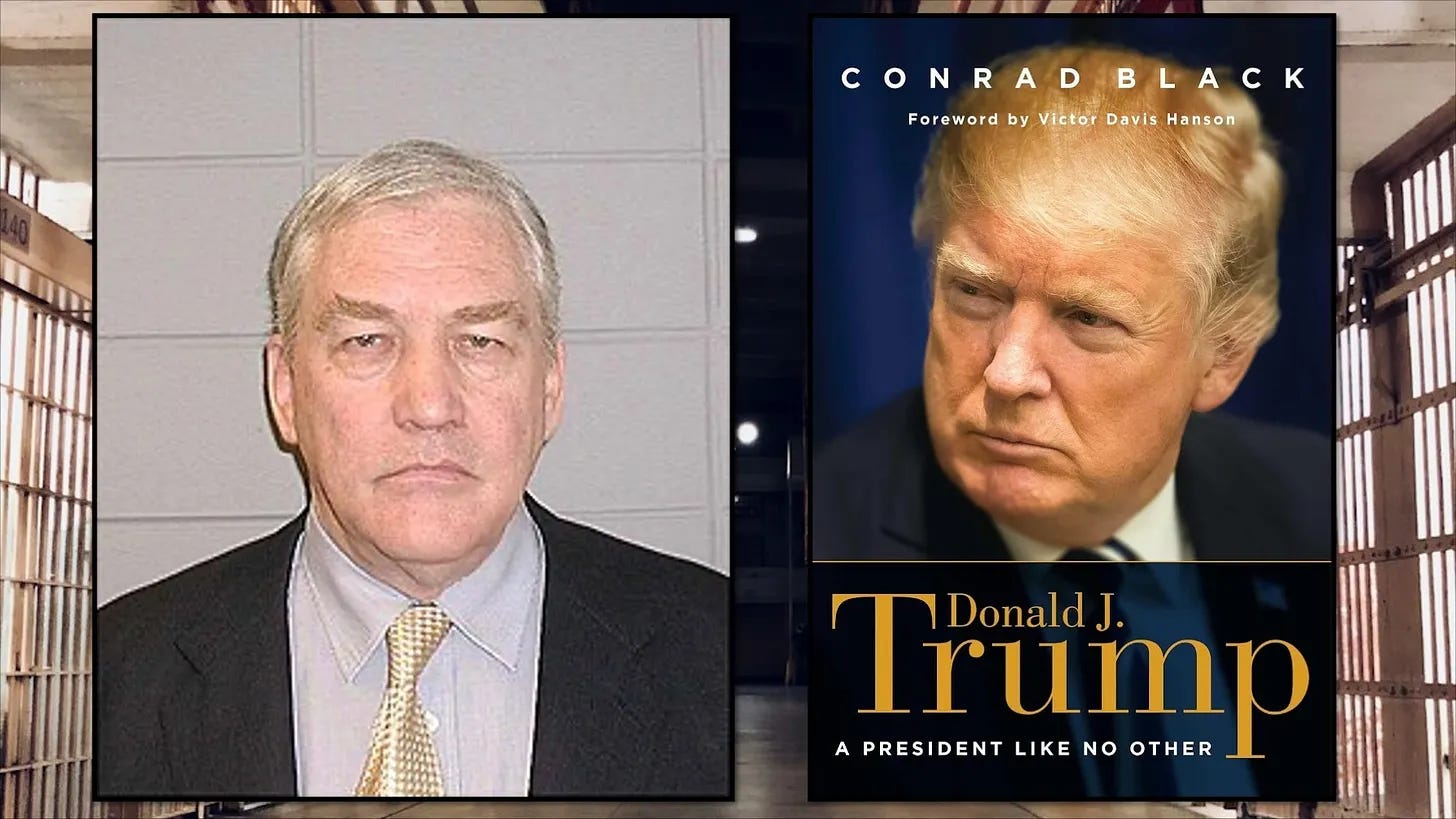
Black and his wife, journalist Barbara Amiel, lived extravagantly, maintaining homes in Toronto, London, New York and Palm Beach and moving through a world of celebrities, politicians and business titans.
The problem was that Hollinger was a publicly traded company. And eventually its shareholders began asking what Black was doing with their money.
The rights of the nobility
Black was a highly privileged nepo baby, born into big money in Montreal, but he wanted to be viewed as a self-made man.
His father, George Montegu Black Jr., was a wealthy businessman who became president of Canadian Breweries Ltd., then Canada’s largest brewing company and part of the powerful circle of financiers behind Argus Corp., one of Canada’s dominant industrial conglomerates.
Black was still in his 20s when both of his parents died within a few years of each other, leaving him and his brother, Montegu, a substantial inheritance. The family fortune gave Black the capital to begin buying struggling Canadian newspapers with longtime partner David Radler.
Controversies followed “his every step.” And his business career was plagued with accusations that he often considered other people’s money … his money.
After taking control of Argus in the late 1970s, Black faced accusations that he had taken advantage of two elderly widows who controlled crucial voting shares in the industrial conglomerate. Black denied doing anything improper.
In the early 1980s, Canadian and U.S. regulators investigated dealings surrounding an attempt by Black and his brother to gain control of Cleveland-based Hanna Mining through Norcen Energy. The allegations were never proved, and related U.S. charges were eventually withdrawn.
Then came the pensioners.
n 1984, Argus controlled Dominion Stores, a struggling Canadian supermarket chain. Under Black, Dominion moved to take roughly $56 million in surplus assets from its employee pension plan. Unions and pensioners fought the move, and an Ontario court ultimately ruled against the company and ordered the money returned to the pension fund.
Black fought his critics every step of the way. He repeatedly sued journalists, publishers and authors who questioned his business practices. In 1990, Penguin Books agreed to destroy thousands of copies of a book about the Dominion pension controversy after Black sued.
None of this slowed him down.
Black kept buying newspapers. By the late 1990s, Hollinger controlled more than 300 publications around the world. And the accusations kept coming.
Shareholders began questioning the enormous sums flowing from Hollinger to Black and his associates through management fees, compensation, perks and payments connected to newspaper sales.
A special committee appointed by Hollinger’s board eventually concluded that Black and his associates had received more than $400 million from the company between 1997 and 2003. It scrutinized Black’s use of Hollinger money for residences, household staff, automobiles, aircraft and other perks. It described what it found as a “corporate kleptocracy.”
One of the schemes involved so-called non-compete payments. It was money ostensibly paid in return for promises that Black and other executives wouldn’t compete with buyers of Hollinger newspapers.
Prosecutors said money that should have accrued to Hollinger and its shareholders instead went directly to Black and other executives.
The SEC separately accused Black and Radler of diverting money from Hollinger, arranging sweetheart transactions involving companies they controlled and misleading the company’s board and shareholders.
Meanwhile, shareholders were getting increasingly annoyed by Black’s imperial lifestyle.
When they questioned expenses that included a trip to Bora Bora, Black responded as arrogantly as any British Lord:
“I’m not prepared to re-enact the French revolutionary renunciation of the rights of the nobility.”
Black was later charged and acquitted of criminal charges related to the Bora Bora trip and other lavish expenses.
But by then, the revolution had already begun.
Caught on camera
In 2005, with investigators closing in, Black managed to turn a complicated corporate fraud investigation into something any jury could understand.
He removed 13 boxes of documents from his Toronto office despite a court order requiring that records be preserved.
Unfortunately for His Lordship, a security camera recorded him and his driver carrying the boxes to a car.
Prosecutors charged him with obstruction of justice and defrauding Hollinger investors out of more than $80 million by allegedly diverting corporate funds to his own use.
His business partner Radler, former Hollinger lawyer Mark Kipnis, and Toronto-based Ravelston Corp. were also indicted. Radler ultimately pleaded guilty to one count of mail fraud and agreed to 29-month prison sentence and a $250,000 fine. He also agreed to testify against others.
In 2007, a Chicago federal jury convicted Black on three fraud counts and the obstruction charge. He was sentenced to 6½ years in prison. He ended up serving about three.
Like North Korea?
Black has always maintained that he was the victim of overzealous prosecutors.
“I was effectively assaulted by the US government four years ago,” Black told a London audience in 2007. “It’s very a formidable adversary. Whatever the limitations of the U.S. government in quelling an insurrection in Iraq they are pretty efficient at terrorizing innocent people."
He fought his case all the way to the U.S. Supreme Court and won a couple important. The court narrowed the federal “honest services” fraud law used against him, and two of his three fraud convictions were eventually tossed. But one fraud conviction survived, involving $600,000 in bogus non-compete payments. And so did the obstruction conviction.
A federal appeals court characterized the surviving fraud conviction as straightforward theft.
Black ultimately served about three years in federal prison. But not even incarceration would silence him.
While fighting his case, Black wrote a memoir, “A Matter of Principle,” portraying himself as the victim of a prosecutorial vendetta. After being resentenced in 2011, he even sought work-release privileges to help promote the book before returning to prison.
He has said he never would have been prosecuted in Canada and compared the U.S. justice system to North Korea.
After decades of accusations, investigations, lawsuits, regulators, prosecutors, convictions and prison, Black remained convinced there was one innocent party in the whole affair: Conrad Black.
A pardon like no other
Black was released in 2012 and deported to Canada. But there was one more card to play.
Black had long been friendly with Donald Trump. Hollinger had sold the old Sun-Times building along the Chicago River to Trump, who demolished it and built Trump International Hotel & Tower on the site.
In 2018, Black published an admiring biography titled Donald J. Trump: A President Like No Other.
One year later, President Trump gave him a full pardon.
The White House praised Black’s “tremendous contributions to business” and noted that Henry Kissinger, Elton John and Rush Limbaugh were among those who had supported clemency.
Black never stopped insisting that his prosecution was unjust.
Today, he’s still writing in Canada. His columns continue appearing in the National Post, more than two decades after his newspaper empire unraveled.
Though he sometimes takes a stand against Trump’s insults and tariffs against his native country, he can be loud with the MAGA megaphone:
“We are now seen as the most absurdly woke and politically correct (and therefore foolish) country in the world.”
And he can’t seem to stop sucking up to the president who pardoned him with headlines like:
“Trump isn’t our problem – we are”
“Formidable Trump changes the world”
“Middle East is on the brink of peace, thanks to Trump”
“Don’t believe the haters — Trump is on his way to a strategic victory in Iran”
His newspapers are gone. His prison sentence is over. His conviction has been pardoned. And the man who once bought ink by the barrel is still getting the last word.
The non-compete payment mechanism is worth pausing on because it illustrates how sophisticated corporate fraud tends to work.
Non-compete payments are legitimate. They appear in virtually every newspaper sale - you pay management not to take their relationships to a competitor after the deal closes. The instrument is real, the legal category is established, the board expects a line item for it. Black didn't invent a fake payment category. He exploited a real one - redirecting money that should have stayed with Hollinger's shareholders through a legitimate-looking channel.
That's why the "corporate kleptocracy" framing, while vivid, slightly misses the mechanism. Kleptocracy implies brazen theft. What Black ran for six years was something more architecturally precise: extraction through legitimate instruments, approved by a board that included Henry Kissinger and Richard Perle, structured through fee arrangements that looked, at each individual approval moment, like routine governance.
The fraud only became visible at the portfolio level - when you added up $400 million across six years and asked whose interests were actually being served. No single transaction looked obviously wrong. The pattern did.
Which is also why the document removal was such a gift to prosecutors. Everything else required expert testimony and forensic accounting. Thirteen boxes loaded into a car on a security camera, in violation of a court order, is a story any jury can follow in twenty minutes.