

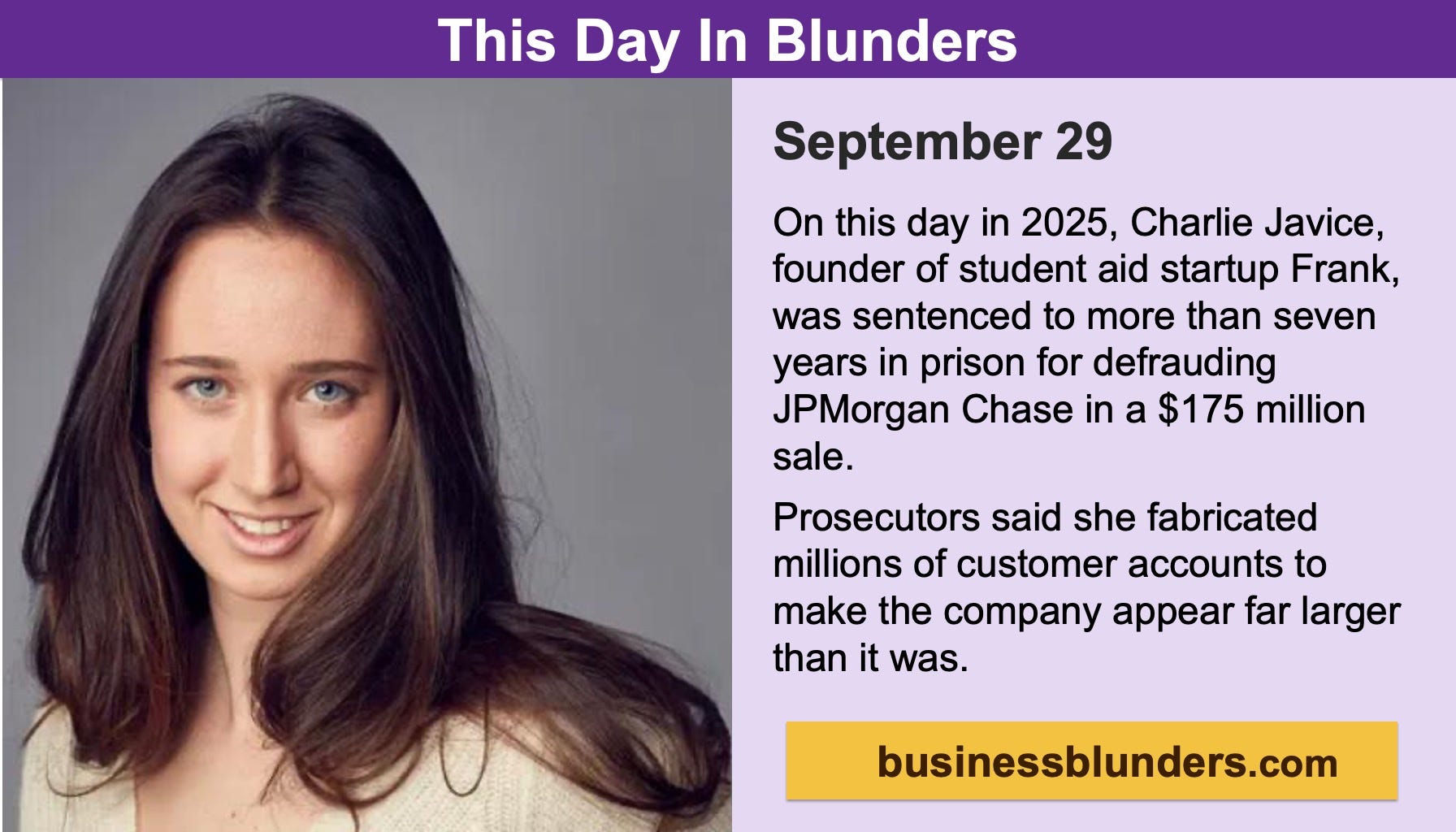
Is it legal to create data for millions of customers who don’t exist? A concerned employee wanted to know.
The boss had an answer: “We don’t want to end up in orange jumpsuits.”
Yet that’s exactly where Charlie Javice was headed.
In 2021, Javice was a twenty-something entrepreneur prepping to sell her startup to JPMorgan Chase. It was a website she called Frank that helped students fill out financial aid forms. She fabricated Frank’s most important asset – data supposedly representing millions of customers. Then she sold the company to the nation’s largest bank for $175 million.
A jury convicted her of fraud on March 28, 2025 and a judge sentenced her to more than seven years in prison on Sept. 29, 2025.
Pending her appeal, Javice remains free on a $2 million bond. Her lawyers told the court she was teaching Pilates in South Florida. They argued that her court-ordered ankle bracelet interfered with her ability to teach, but the court decided to keep the cuff.
Meantime, JPMorgan keeps paying tens of millions in legal expenses for her defense after a judge ruled the contract it signed when it bought Frank requires the firm to indemnify her and her co-defendant, Frank executive Olivier Amar, 52.
At last count, those expenses were approaching $150 million, getting closer to the whopping sum JP Morgan paid for Frank.
In addition to pursuing her appeal, Javice is reportedly seeking a pardon from President Donald Trump.
Read More:
JPMorgan Chumps (Business Blunders)
JPMorgan Can Check Their Butts (Business Blunders)
Advance praise
Javice was born and raised in New York’s Westchester County. Her father worked at a hedge fund. Her mother worked as a teacher and later as a life coach.
She attended the private French-American School of New York and graduated from the Wharton School of the University of Pennsylvania in 2013 with a degree in finance and legal studies.
She was an entrepreneur before she was old enough to drink. At 17, she launched PoverUp, a microfinance venture that she said would help fight global poverty. She claimed PoverUp had attracted 5,000 registrations within hours of launching its beta version and more than 12,000 within a month.

At 19, Fast Company named her one of its 100 Most Creative People in Business. Creative indeed. And Inc. named PoverUp one of America’s coolest college startups.
At 24, Javice founded Frank to help students navigate the maddening process of applying for federal financial aid.
The accolades kept coming after its 2016 launch.
In 2018, Forbes published a glowing profile headlined, “This 26-Year-Old CEO Found Students $7 Billion In Financial Aid.” It was Javice who supplied the $7 billion figure.
In 2019, Crain’s New York Business put Javice on its 40 Under 40 list, and Forbes put her on its 30 Under 30 list.
Read More: Making A List, Checking It Twice
Javice made repeated appearances on business TV shows. She drew attention in New York’s startup circles. Wealthy investors backed her. Marc Rowan, co-founder of Apollo Global Management, invested in Frank. Israeli venture capitalist Michael Eisenberg became an early backer, too.
By the time JPMorgan Chase came calling, Javice had been celebrated as some kind of wunderkind for more than a decade.
Today, she draws comparisons to another young entrepreneur whom investors once deemed a wunderkind: Theranos founder Elizabeth Holmes, who faked results of the blood-test device she was developing. Both built glamorous reputations around startups and then were convicted of defrauding sophisticated investors or business partners.
Fake it till you make it
Javice lived up to her billing as creative, maintaining Frank as an imaginative business growth story.
She claimed it had about 4.25 million users. And JPMorgan Chase coveted all those young customers, figuring it could eventually sell them bank accounts, credit cards and other financial services when they graduated from college. But the firm wanted to verify the numbers before closing the deal, and truth be told, Frank had fewer than 300,000 users.
That’s when Javice and Amar asked the company’s engineering director to create a synthetic data set representing millions of users. The engineering director questioned whether such a move was legal and refused to do it, according to the criminal complaint.
Javice then hired an outside data scientist, who created millions of synthetic customers based on Frank’s actual customer data. Javice then had the fabricated data sent to a third-party vendor that JPMorgan used to verify that Frank’s numbers.
Somehow, the scheme worked. JPMorgan closed the deal, made Javice a managing director and promised her a $20 million retention bonus on top of the roughly $21 million she received from the sale.
Javice and Amar then went shopping to cover their tracks. They bought data on 4.5 million real students for $105,000, and later supplemented the list with still more purchased information.
In the end, JPMorgan paid $175 million for what was essentially a fake email list.
JPMorgan Chastened
What was Javice thinking? A better question may be what was JPMorgan Chase thinking?
JPMorgan claimed it had hundreds of people involved in evaluating the transaction. On the bank’s fourth quarter 2022 conference call, CEO Jamie Dimon said they performed “extensive due diligence.”
Yet it appears that they missed several flashing red warning lights.
JPMorgan’s crack due diligence team thought they were buying relationships with 6,000 schools, but that number doesn’t quite match reality: There are only 5,916 postsecondary institutions where students can use federal financial aid.
They also thought they were buying nearly five million users, yet only two million students a year apply for financial aid. It would have been quite a feat to capture five million students in less than five years.
Did they know that Frank had to settle with the Department of Education in 2018 for violating its registered trademark FAFSA, which stands for Free Application for Federal Student Aid?
Did they contact Frank co-founder Adi Omesy who sued Javice for wage theft in Israel?
Did they notice Javice’s 2017 opinion piece in The New York Times titled, “The 8 Most Confusing Things About FAFSA.” It was so riddled with mistakes that it required an eight-sentence correction.
Did they really think she knew what she was talking about?
This was JPMorgan Chase, a bank with trillions of dollars in assets and armies of investment bankers, lawyers, accountants and due-diligence experts.
U.S. District Judge Alvin Hellerstein called JPMorgan Chase’s due diligence “very poor” at Javice’s sentencing. But he wasn’t buying the argument that the bank’s failures excused her fraud.
“Fraud is fraud whether you outsmart someone who is smart or someone who’s a fool,” he said.
Highly paid Wall Street executives should not be suckers and young entrepreneurs should not be charlatans.
In January 2023, JPMorgan Chase shut down the site.
An expensive education
Javice’s co-defendant Olivier Amar received a slightly lighter sentence of five years and eight months in prison. Unlike Javice, he is currently serving his time. Javice was ordered to forfeit $22.4 million and, jointly with Amar, pay $287.5 million in restitution.
“If it were within my power, I would never make the same mistakes again, not for money, not for recognition, not for anything,” she said at sentencing.
Will JPMorgan, a lumbering, too-big-to-fail behemoth, make the same mistake again? For now, it’s sure getting a lesson.
Imagine getting robbed blind and then suffering a court order to indemnify the perpetrator to the tune of millions.
Javice’s defense hasn’t been cheap. Nineteen lawyers have appeared for her and 16 for Amar. Their bills have included luxury hotels, expensive meals and such curiosities as cellulite butter.
JPMorgan has fought some of those expenses, but a Delaware judge ruled that the bank must keep paying Javice’s legal bills under the agreement it signed when it bought Frank.
The bank wanted relationships with schools.
Instead, it’s getting schooled.