

“Golf appeals to the idiot in us, and the child.” – John Updike
Golf is not a contact sport. Slamming a woman to the ground is not the way a real man prepares to tee off. But how are a bunch of YouTubing golf bros supposed to know that?
The golf world is inflamed this week over an advertisement for a co-branded driver by Callaway, the world’s largest golf-club manufacturer, and Good Good Golf, a YouTube-born golf entertainment and merchandise company.
In the 56-second spot, Good Good co-founder Garrett Clark goes completely psycho when golf pro Alexis Miestowski reaches for Clark’s new club. He charges at her, shoulder checks her onto the turf, looms over her flattened body and scolds, “Do not touch my new driver.”
It was supposed to be a parody of the horror movie “Obsession.” It came off as unadulterated misogyny.
Internet culture is awash in such horrors, whether it’s the bigoted “manosphere,” the creepy Tate brothers awaiting trial for alleged sex crimes, Donald Trump’s shameless boast about where he likes to grab women, the endless revelations from the Epstein files or increasingly abusive online porn.
Perhaps this is why the idiots at Good Good and Callaway didn’t wince – at least not hard enough – before approving the release of what Clark now calls, “the worst ad known to mankind.”
They are wincing harder now.
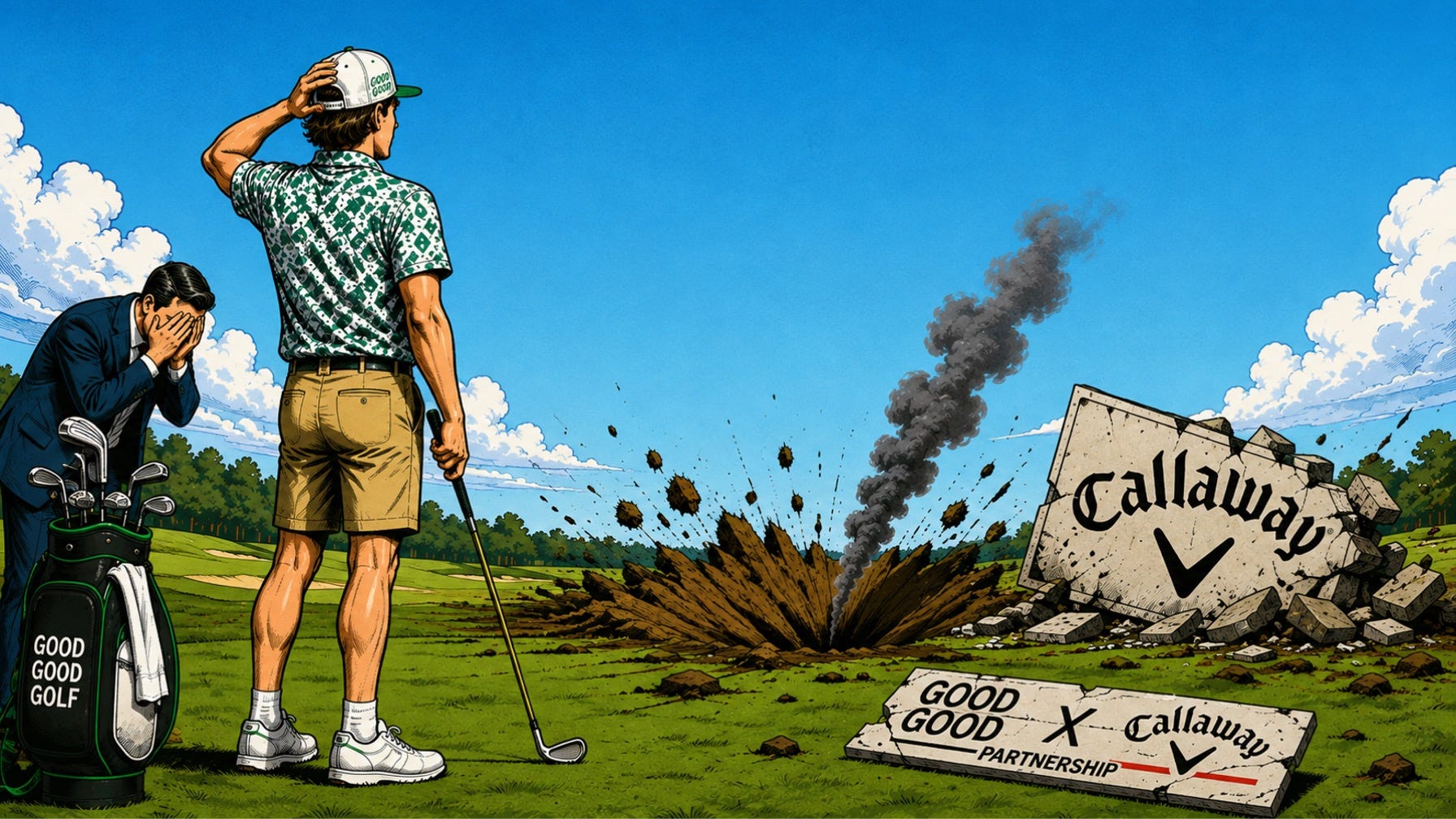
Callaway has dumped Good Good as a business partner. Dick’s Sporting Goods and Golf Galaxy have pulled its merchandise from their shelves. The Golf Channel shelved the premiere of a Good Good reality show. And Good Good has surrendered its title sponsorship of a PGA Tour event scheduled for November.
Ads are supposed to attract customers, not drive them away. Now even a city golf course in Salt Lake City has announced it is removing Callaway merchandise from its shelves.
Kendrick, Clark and a gaggle of young golf creators started Good Good in Texas in 2020 when they filmed themselves goofing around on the course.
The videos caught on, and the YouTube channel grew into a sprawling golf business with millions of subscribers, apparel and equipment sold nationwide, television events and major corporate sponsors.
Last year, investors including Peyton Manning’s Omaha Productions poured $45 million into the company, and Good Good reportedly generated more than $40 million in revenue. Now, instead of going viral, they’ve gone radioactive.
Good Good apologized and quickly deleted the ad, though the spot will have a long afterlife on the internet, including links in this feature from Sports Illustrated (if you care to watch this train wreck).
Callaway acknowledged that it had approved the spot and said that it “should never have happened.” In addition to dumping Good Good as a partner, it tightened its internal review process and pledged $1 million to organizations combating violence against women.
Today, nearly one-third of golfers are female and they make up the biggest growth area for the sport, according to the National Golf Foundation. And Good Good’s message to them was, “Do not touch my new driver?”
You can’t just take a Mulligan for something this stupid, but the apology tour was going about as well as an apology tour could go with both companies accepting accountability.
And then Good Good’s CEO just had to slice another ball into the rough.
At 3:38 a.m. Friday, Good Good CEO Matt Kendrick took to X to accuse Callaway of approving the ad, making Good Good “take the fall,” and then dumping the company in a “coordinated media blitz.”
He even said he was not opposed to suing his former business partner. Kendrick later deleted the posts – apparently discovering, for the second time in a week, that one’s darkest musings are best left in the clubhouse locker room.
Big Tech’s Big Tobacco moment
Big Tobacco got kids hooked on cigarettes. Meta allegedly figured out how to get them addicted to screens.
Now it could cost the Facebook parent as much as $17.1 billion.
Meta reached a landmark settlement Wednesday with 47 states, the District of Columbia and several U.S. territories over allegations that it deliberately designed Facebook and Instagram to keep children hooked. And that it mislead the public about the risks. Meta did not admit wrongdoing.
This is just a start, says District of Columbia Attorney General Brian Schwalb:
“Meta intentionally exploited kids for profit and then lied about it, claiming its products were safe when its own internal research confirmed the platforms were addictive and harmful. … It will not be the last.”
The settlement comes with some parental controls Meta apparently didn’t think of itself: a default two-hour daily limit for minors, restrictions on late-night use and notifications during school hours, stronger age verification and limits on addictive features.
Just a cost of doing business for a tech giant accused of melting kids’ brains. Even $17.1 billion amounts to a fraction of Meta’s $201 billion in 2025 revenue. And Wall Street loved the deal. Meta shares jumped as much as 4% on the news.
Keep scrolling, kids.
KKR caught cheating
Private-equity giant KKR is paying $250 million for allegedly cheating its money-grubbing ass off on government paperwork.
When investment giants like KKR buy companies, federal law requires them to tell regulators what they’re doing and turn over documents that regulators use to look for antitrust problems.
KKR repeatedly failed to file, withheld required documents and even altered documents before handing them over, the Justice Department said Wednesday in announcing the penalty.
KKR manages nearly $800 billion and has made more than 100 of these filings since 2021. Prosecutors say the violations involved at least 16 transactions.
You’d think for $250 million, KKR could have hired an intern or two to fill out the forms.
Instead, it copped to a record-breaking sanction, more than 20 times the previous record penalty under the law.
The end of the road for First Brands
It looks like Ohio-based auto parts conglomerate First Brands Group will be sold for scrap.
A federal bankruptcy judge on Monday rejected the company’s plan to reorganize in Chapter 11 and ordered it into Chapter 7 liquidation.
First Brands stands as one of the biggest private-credit industry blunders that we know about so far. (You just wait.)
Its founder Patrick James has pleaded not guilty to federal fraud charges, after allegedly duping some pretty big names in the financial world, including UBS, Blackstone, Jeffries Financial Group, Santander and factoring giant Raistone Capital.
Read More:
Idiot Lights (Business Blunders)
Parts Is Parts (Business Blunders)
Wall Street financed the whole car. Now it gets to fight over the hubcaps.
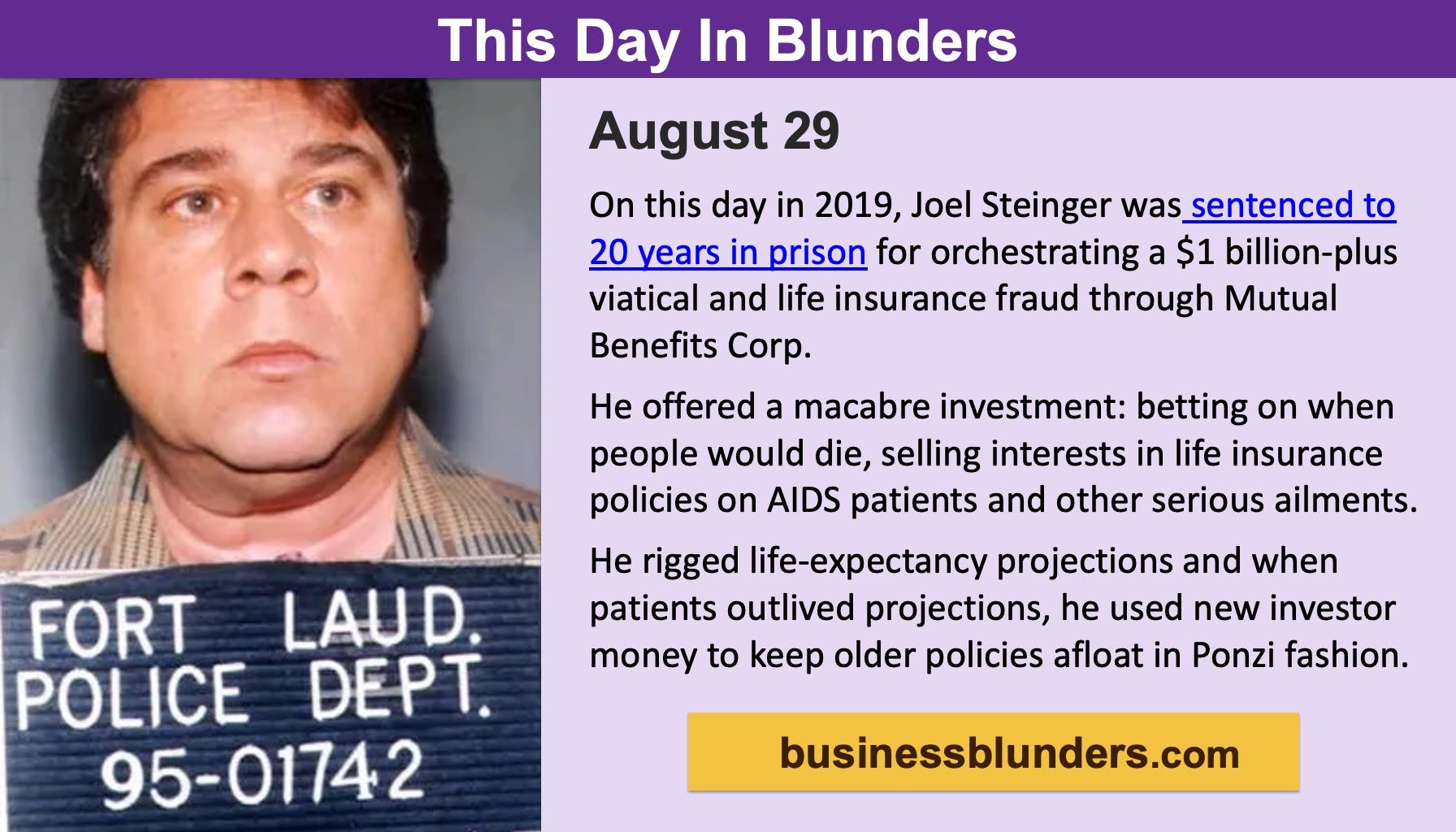
Sometimes death isn’t a sure bet
This week’s Ponzi
Artificial intelligence. Cryptocurrency. A supercomputer. Guaranteed returns. Brent Kovar spun just about every magic money-making phrase he could find.
Kovar told investors his Las Vegas company, Profit Connect, used AI software and a supercomputer to mine cryptocurrency and verify crypto transactions. He promised annual returns of up to 30% with a 100% money-back guarantee.
He also claimed Profit Connect was backed by hundreds of millions of dollars in crypto reserves.
Prosecutors said the profits didn’t connect. The company had no reserves and couldn’t generate the promised returns. Instead, Kovar used investor money to buy a house, shower employees with gifts and pay earlier investors with money from newer ones. He ultimately took $24 million from at least 400 investors.
A federal jury on Monday convicted Kovar of wire fraud, mail fraud and money laundering. He is scheduled to be sentenced Nov. 30 and faces a maximum 280-year prison sentence, if only he could live so long.
Yes, it just goes to show, Business Blunders can find yet another Ponzi to write about every week. This is one of the oldest investment scams in the White Collar Playbook. What’s wrong with people?
Don’t Miss These Blunders
Jes Staley’s Magic Kindom When Wall Street was melting down, this top JPMorgan executive sought a financial wizard. He turned to his pal, Jeffrey Epstein.
Flip This NBA Team Billionaire Mark Walter is scrambling to raise billions after his insurance companies reported a $20 billion investment blunder. Now he’s flipping the L.A. Lakers.
Conrad Black – Hollinger International He inherited a fortune and leveraged it into a global newspaper empire. Then he went to prison for stealing from his own company.
‘You Better Find Me Incompetent’ Former Abercrombie & Fitch CEO Michael Jeffries finally faces trial for alleged sex trafficking that began nearly 18 years ago
A Pump And Dump From Prison David Foley hyped penny stocks and bagged millions while serving a federal prison sentence. Now he’s headed back to the office.
Boiler Room 2026 Cold calls. Sales scripts. Promises of 1,000% returns. The SEC says an old stock-peddling scam found a new generation of victims.
Michael ‘Mickey’ Monus – Phar-Mor He played doctor with the books. His pharmacy chain kept bleeding.
Ed Mattar – BestBank Of Boulder He was a lifelong deadbeat. Somehow he got his hands on a state-chartered bank.
The Luigi Effect Luigi Mangione has changed corporate security. CEOs may never feel safe again.
NFT Monkey Business Venture capitalists bet millions on a startup promising to build an exchange for cartoon apes. Prosecutors say founder Taj Tarsha blew investor funds on gambling and his DJ career.
Confessions Of An FBI Crypto Thief Prosecutors say agent Patrick Yaroch raided digital wallets. Then his conscience blew his cover.
Leaky Pants First came explosive diarrhea. Then came allegations of a $32 million inside job. It’s been one crappy summer for Taylor Farms.
How To Lose An Internet Fight eBay executives tried to silence a newsletter. It cost them tens of millions of dollars, seven criminal convictions, and one of the worst public-relations disasters in Silicon Valley history.
Another Billion-Dollar Bedtime Story Silicon Valley bet big on yet another young prodigy. Now they’re waking up to reality ... again.
Blowing Sunshine Jay Lucas preached positivity while looting his $50 million private equity fund
AI Gets A Performance Review Engineers discover it cheats better than humans ... and doesn’t feel a shred of guilt.
The Nigerian Prince Goes Corporate A former Morgan Stanley broker allegedly gave the classic scam a Wall Street makeover
AI Eats IBM The computing giant spent three years serving investors an artificial intelligence feast. This week, it found itself on the menu.
How To Read Epstein Files Goldman Sachs’ former general counsel Kathryn Ruemmler can’t lawyer her way out of her emails
The Wells Fargo Fraud Wagon From fake accounts to mortgage abuses, this bank keeps rolling through scandals. Its latest delivery: $50 million settlement over claims it enabled a Ponzi scheme.
Disposable Income A Memphis gynecologist billed $41 million while reusing “dirty” medical devices on thousands of women
Chartered Financial Asshats An embarrassing embezzlement case defied ethics, professionalism and even financial controls at the CFA Institute
The Great Gatsby Of Crypto Christopher Delgado went from In-N-Out Burger to the Fontainebleau, buying credibility from politicians, celebrities and charities before his $400 million Ponzi scheme collapsed
The Baloney Incident How JPMorgan Chase turned a deli tray into a multimillion-dollar battle and another reputational pickle
Fuel For Fools Volkswagen can’t recover from ‘Dieselgate.’ FirstBank of Puerto Rico accused of banking Epstein’s sex trafficking operation. An embezzling healthcare CEO bets his clinic.
Billion-Dollar Band-Aids The latest government crackdown on medical billing fraud showcases Ferraris, diamonds, luxury resorts and a yacht named ‘Butt Nekkid.’ But the real question is, how does this folly keep happening?
Pre-Pardon Panic U.S. Senators introduce a resolution to discourage Trump from freeing FTX founder Sam Bankman-Fried
To answer your question at the end of the latest 'Blunder' - "Past performance is no guarantee of future earnings..."
The Good Good CEO is a tone deaf schmuck, no doubt. But he’s not wrong about Calloway throwing the smaller company under the bus to avoid taking responsibility for its role in the fiasco.