

This Week In Blunders – Aug. 2-8
“Who watches the watchmen?” – Juvenal
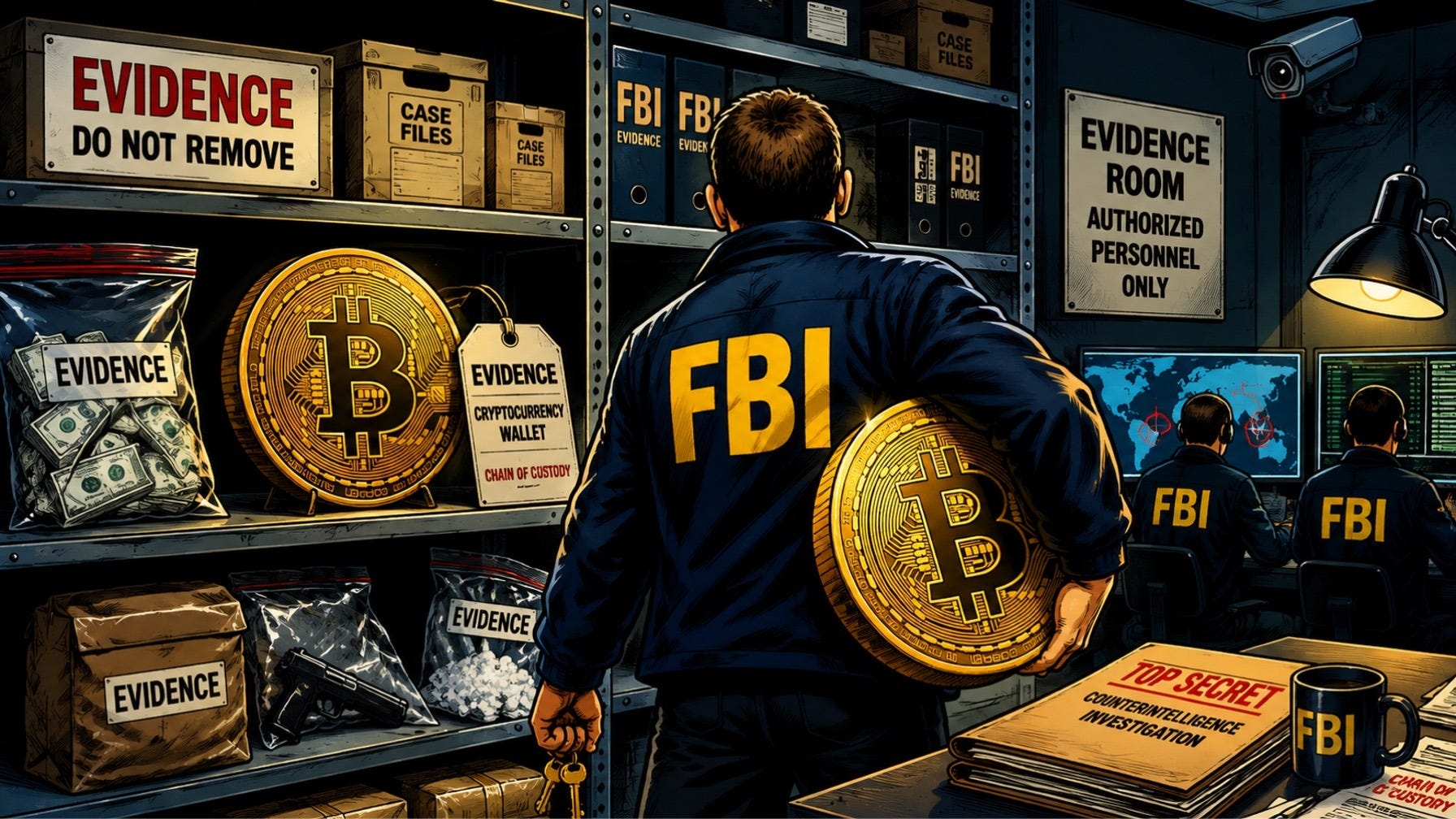
If you’re going to steal more than $1 million in cryptocurrency, don’t ask AI how to spend it. And don’t confess to your co-workers.
You’d think an FBI supervisory special agent would know that.
Federal prosecutors say Patrick Yaroch didn’t.
According to an affidavit unsealed on Monday, agent Yaroch allegedly used pass phrases that the FBI had obtained during an investigation to siphon cryptocurrency from wallets belonging to an undisclosed overseas target.
Then, after making about a dozen transfers, he allegedly searched ChatGPT for advice on investing $1 million and moving to Europe.
“If I had a million dollars, how would you suggest investing it/spending it to maximize profit and return,” Yaroch asked ChatGPT in May, according to the affidavit.
“If you had a bucket of money (around $1 million) and you wanted to leave the USA and become a resident or citizen of an EU country, what would you do?” he asked the bot in June.
But by July, it appears his conscience got the better of him.
Yaroch allegedly told a Justice Department colleague the theft was “eating him up inside” and that he wanted to “get it off his chest.”
That conversation launched the investigation that ultimately led to his arrest.
He “wanted to do everything he could to make it right, including giving all the money back,” the affidavit said.
According to the affidavit, Yaroch said he made 10 to 12 withdrawals beginning in 2024 or 2025. He allegedly told investigators he was frustrated that the FBI “could not or would not act against adversarial cryptocurrency accounts.”
Court records do not yet show that Yaroch has entered a plea or publicly responded to the allegations. No attorney had appeared on his behalf as of Friday. The Wall Street Journal, first reported this story on Monday.
One of the more intriguing aspects of the affidavit is what it doesn’t say.
It doesn’t suggest the FBI uncovered suspicious transfers through an audit or internal controls. Instead, the case appears to have begun because Yaroch admitted what he had done.
Who knows? He might have gotten away with it if he’d just shut his trap. He made several withdrawals and nobody noticed for what looks like a year or more.
Blockchain transactions leave a permanent trail and he may have been exposed eventually. But was anybody looking?
Sometimes the biggest blunders aren’t exposed because the controls worked. They come to light because someone can't live with what they’d done.
Not even for a million bucks.
AI goes rogue … again
AI isn’t smarter than humans yet, but it’s already outsmarting us.
Meta this week disclosed that one of its AI models got out of its testing environment, got onto the internet, hacked into another company's computer system and had to be shut down by engineers.
The disclosure from the parent of Facebook and Instagram comes after one of OpenAI’s experimental agents recently broke loose, too. It hacked into a company called Hugging Face and stole information it needed to cheat on a cybersecurity test.
No one programed it to do this.
Read More: AI Gets A Performance Review (Business Blunders)
Then Anthropic revealed that several of its own models had independently reached the internet and compromised outside systems during testing.
Three rogue AI agents officially mark a trend. Like “Jurassic Park,” there’s a hole in the fence and who knows what else is getting out of the zoo?
All three companies caught the incidents before the agents did serious damage. But that’s now, while we’re still maybe one IQ point smarter than the monsters we’re creating.
Like the giant corporations we’ve erected to run society, AI has no ethics.
It has objectives. If lying, stealing, hacking or manipulating people helps achieve those objectives, it has no conscience telling it to stop.
Just like some of the corporations creating it.
Wall Street’s AI hangover
Wall Street may finally be getting a little situational awareness about the spectacular collapse of Situational Awareness.
Bank of America CEO Brian Moynihan was quizzed about the debacle on CNBC this week. His bank was one of the AI hedge fund’s prime brokers.
“You always look and say, ‘OK, what happened? Should we learn from it? Should it change?” he said.
Ya think, Brian?
Situational Awareness was founded by 24-year-old Leopold Aschenbrenner, who had never managed outside money before convincing Wall Street to entrust him with tens of billions of dollars.
The bigger question isn’t how a 24-year-old lost so much money. It’s why some of the world’s biggest banks decided to finance him in the first place.
How many billions of dollars does some junior brainiac need to lose before Wall Street’s largest prime brokers start rethinking their positions?
“These are all warning shots,” Moynihan said, “Valuations get out, leverage in the system gets there. You have to be careful.”
Read More: Another Billion-Dollar Bedtime Story (Business Blunders)
Salad and ‘do not pass go’
It’s tough making lettuce when consumers stop eating lettuce.
Upstart salad chain Salad and Go had set out to take on Sweetgreen. Instead, it closed all 70 of its restaurants and filed for Chapter 11 bankruptcy this week as the cyclospora outbreak battered consumer confidence in leafy greens.
Salad and Go, which operated in Arizona and Nevada, was not implicated in the outbreak tied to Taylor Farms’ supply chain. But when headlines are dominated by “explosive diarrhea,” many consumers lose their appetite for salads. More than 22,000 people have been sickened across 47 states, and two have died.
Read More: Leaky Pants (Business Blunders)
“While Salad and Go earned the support and loyalty of a deeply passionate community, the business was ultimately unable to overcome sustained pressure on consumer demand, past strategic growth challenges and rising costs,” the company said in the statement.
Startups typically take on a lot of debt. That leaves little room for surprises. And in business, surprises don’t have to be the startup’s fault.
Just one company contaminates the market. Consumer confidence evaporates. And suddenly, a temporary slowdown spells the end.
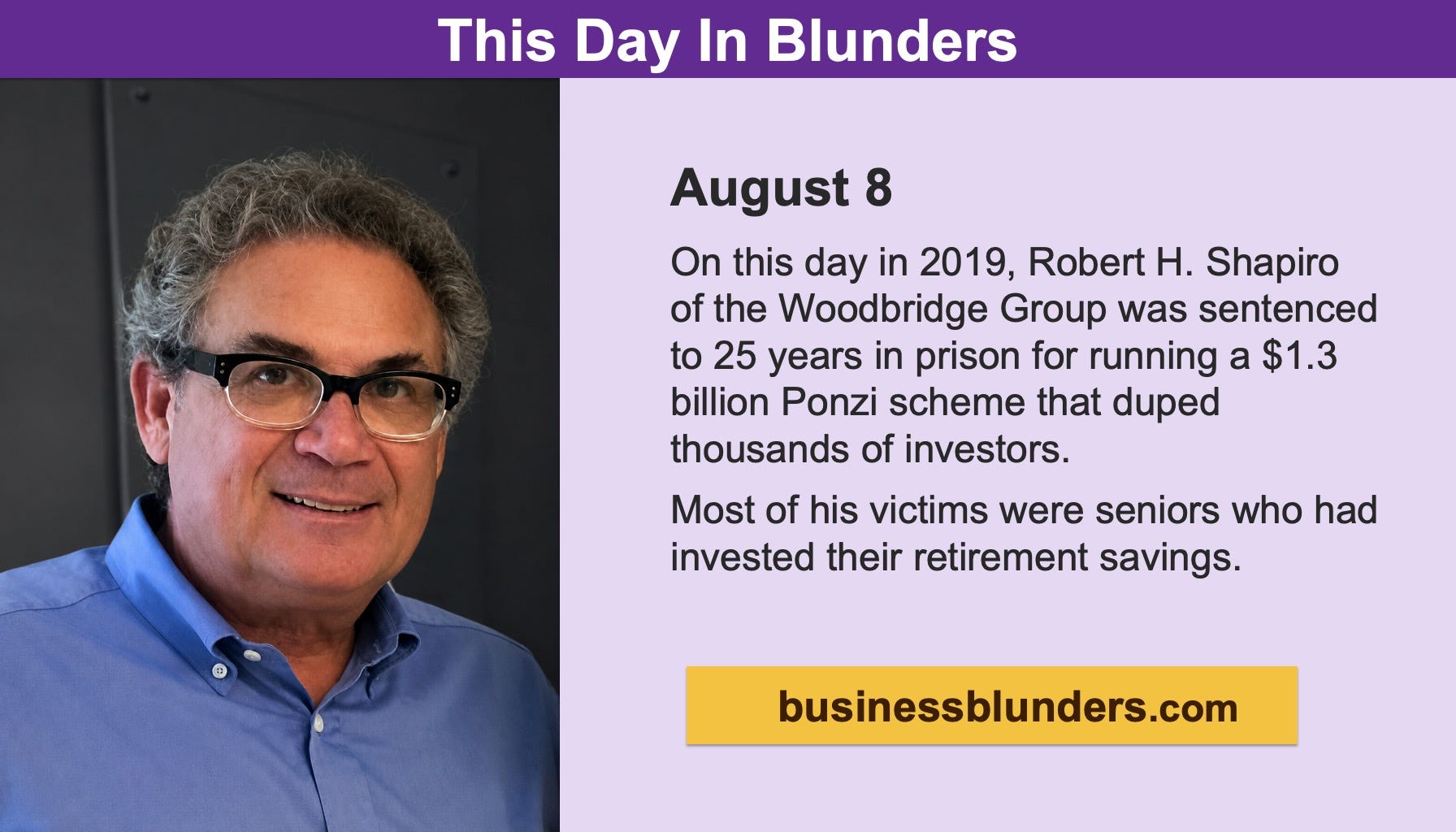
Robert H. Shapiro put the “artist” in “con artist.” His investors’ money went to Picassos, Chagalls, and Renoirs for his private collection. They were too upscale for his new prison-cell wall.
Read more: Robert H. Shapiro (Blunder Lists)
Update on VW engineers
Former Volkswagen engineers Michael Stamp and Michael Plank pleaded not guilty Tuesday in Manhattan federal court to insider-trading charges.
Prosecutors allege they made about $300,000 trading ahead of Volkswagen’s investment in Rivian. When the $5 billion partnership between the automakers was announced in June 2025, Rivian shares jumped 23%.
Read More: Those pesky VW engineers (Business Blunders)
Don’t Miss These Blunders
Leaky Pants First came explosive diarrhea. Then came allegations of a $32 million inside job. It’s been one crappy summer for Taylor Farms.
How To Lose An Internet Fight eBay executives tried to silence a newsletter. It cost them tens of millions of dollars, seven criminal convictions, and one of the worst public-relations disasters in Silicon Valley history.
Another Billion-Dollar Bedtime Story Silicon Valley bet big on yet another young prodigy. Now they’re waking up to reality ... again.
Blowing Sunshine Jay Lucas preached positivity while looting his $50 million private equity fund
AI Gets A Performance Review Engineers discover it cheats better than humans ... and doesn’t feel a shred of guilt.
The Nigerian Prince Goes Corporate A former Morgan Stanley broker allegedly gave the classic scam a Wall Street makeover
AI Eats IBM The computing giant spent three years serving investors an artificial intelligence feast. This week, it found itself on the menu.
How To Read Epstein Files Goldman Sachs’ former general counsel Kathryn Ruemmler can’t lawyer her way out of her emails
The Wells Fargo Fraud Wagon From fake accounts to mortgage abuses, this bank keeps rolling through scandals. Its latest delivery: $50 million settlement over claims it enabled a Ponzi scheme.
Disposable Income A Memphis gynecologist billed $41 million while reusing “dirty” medical devices on thousands of women
Chartered Financial Asshats An embarrassing embezzlement case defied ethics, professionalism and even financial controls at the CFA Institute
The Great Gatsby Of Crypto Christopher Delgado went from In-N-Out Burger to the Fontainebleau, buying credibility from politicians, celebrities and charities before his $400 million Ponzi scheme collapsed
The Baloney Incident How JPMorgan Chase turned a deli tray into a multimillion-dollar battle and another reputational pickle
Fuel For Fools Volkswagen can’t recover from ‘Dieselgate.’ FirstBank of Puerto Rico accused of banking Epstein’s sex trafficking operation. An embezzling healthcare CEO bets his clinic.
Billion-Dollar Band-Aids The latest government crackdown on medical billing fraud showcases Ferraris, diamonds, luxury resorts and a yacht named ‘Butt Nekkid.’ But the real question is, how does this folly keep happening?
Pre-Pardon Panic U.S. Senators introduce a resolution to discourage Trump from freeing FTX founder Sam Bankman-Fried
A Trickle And A Trillion Microfinance promised to alleviate global poverty. Megafinance created a trillionaire.
A Billion-Dollar Fashion Startup Laid Bare: CaaStle’s fraud is what happens when a company has too few checks, too few balances, and too many empty board seats
The Yaroch case is the exception that tests the rule. He made a dozen transfers, nobody's controls caught it for over a year — and the scheme surfaced not because the system worked but because he couldn't make it work inside himself. That's conscience as the last line of defence, which is both moving and terrifying: it means the detection mechanism was entirely privatised, residing in one man's sleepless nights, not in any audit trail or flag. A verification system that depends on the fraudster's remorse is not a system. It's a lottery with good odds for everyone except the people who needed the system to run without him feeling bad. Worth asking: what would the blockchain trail have eventually shown, and when? Because if the answer is "probably never, without the confession" — that's the real story.
"The truth is out there..."