

“Whoever is dishonest with very little will also be dishonest with much.” – Luke 16:10 NIV
Wall Street regularly produces insider trading rings, stock manipulation scandals, money laundering, fake accounts, crypto collapses, Ponzi schemes and enough billion-dollar settlements to stock every Super Bowl party in America.
Yet somehow, the latest battle rocking the financial world is over salami.
In 2024, JPMorgan Chase fired Los Angeles-based wealth advisor Brent Ryan Bodner, after he charged $642.50 on his corporate credit card for a deli tray.
Now $642.50 may sound like an existential threat to a bank with nearly $5 trillion in assets, especially when the offending employee managed only about $1 billion for wealthy clients. But to be fair, the order may have also included a full assortment of meats, cheeses and pickles, as well as chicken wings and cookies.
Nonetheless, Bodner’s lawyer described the case as “the salami incident” in an email to The Wall Street Journal – helping craft a headline that could top a news story like a squirt of Grey Poupon on almost any deli sandwich.
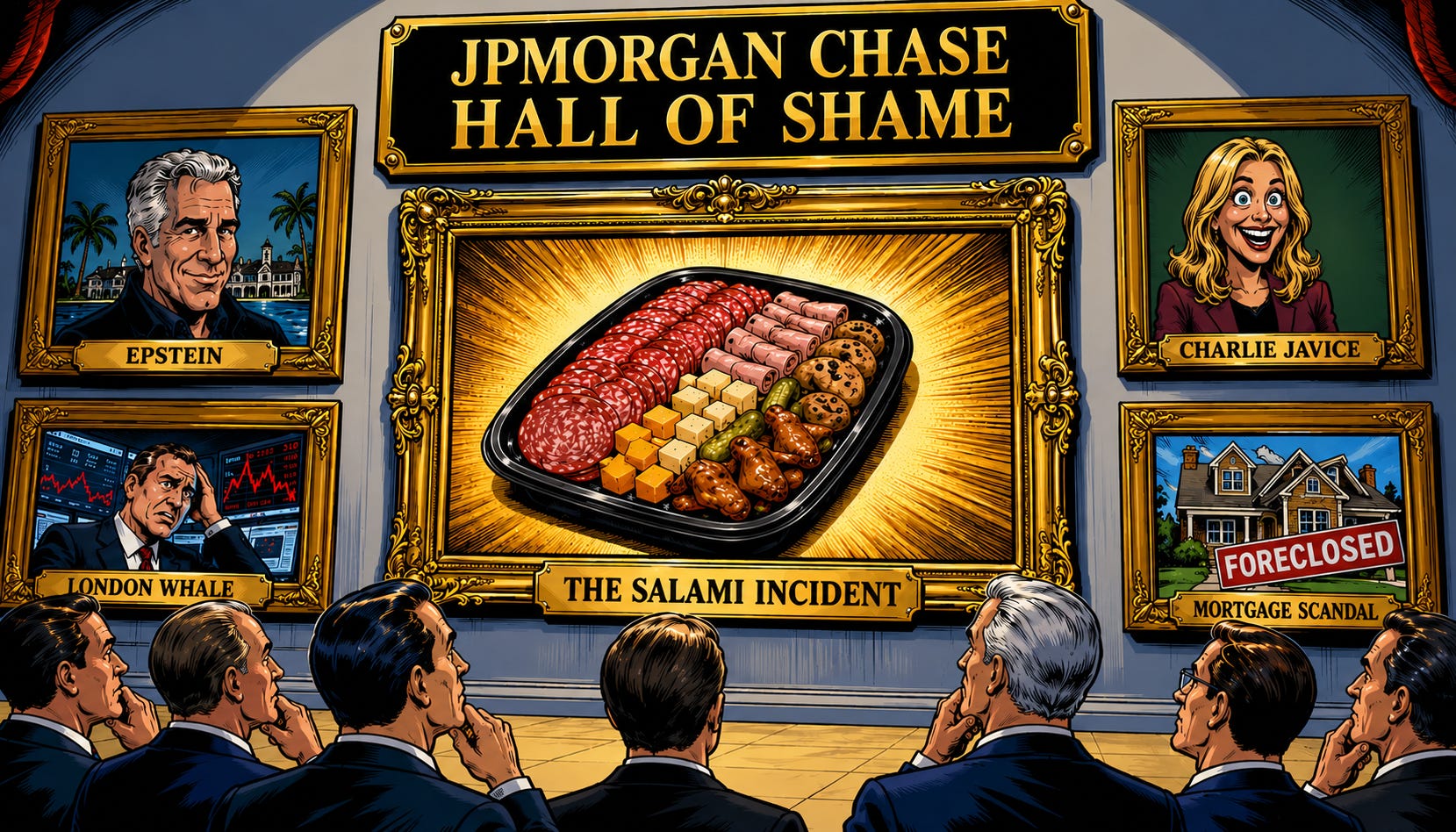
Bodner claimed he was wrongfully terminated and last month he won a $4.25 million judgment before an arbitration panel at FINRA, or the Financial Industry Regulatory Authority, which typically settles such matters for the industry.
Bodner had asked for $30 million. Apparently even the arbitrators thought his meat was overpriced. But on Monday, JPMorgan Chase went crying to federal court with a motion to vacate the award.
The big bank called the judgment“lawless” and said it misrepresented the reason it fired Bodner.
Bodner, who joined JPMorgan Chase in 2012, ordered the deli tray for a Super Bowl party at his home, where he’d hoped to entertain prospective clients. Most didn’t show. San Francisco lost to Kansas City. But the charge for the deli tray went through.
JPMorgan said the expense report – filed by Bodner’s assistant who is also his sister – did not indicate that it was consumed at Bodner’s home, a violation of its expense policy.
Bodner claimed there was a misunderstanding and that the ensuing flap was really just a pretext to poach his clients. The bank countered that he was an at-will employee it could fire for any reason.
“By misrepresenting the nature of an expense to access corporate funds, Bodner had abused a position of trust, and he had violated clear corporate policies,” the bank argued in its petition.
This is a bank that in 2023 agreed to pay $290 million to Jeffrey Epstein victims who claimed it made Epstein’s global sex-trafficking network possible.
And it calls this an abuse of trust?
Here’s how expense accounting works at most companies:
When an employee gets too aggressive, the Big Cheese kicks back the report:
“Hey bonehead, you can’t expense this kind of baloney.”
“Oh, sorry, I was just kinda winging it.”
Or, if the inappropriate expense slips through the approval process like this one deli tray did, the employer can ask the employee to pay it back in the next expense cycle:
“I hope we don’t have to make too big a dill out of it.”
A bank the size of JPMorgan Chase knows that mistakes and misunderstandings happen. You don’t turn them into Deli-Gate.
Bodner is now at Wells Fargo, and it’s a safe bet a sizable percentage of his clients have gone with him. He could entice more by borrowing a line from Arby’s: “We have the meats.”
