

This Week In Blunders – Aug. 9 - 15
“Only the paranoid survive.” – Andy Grove
Luigi Mangione gave up his freedom. He took some of corporate America’s freedom with him.
The 28-year-old pleaded guilty on Friday to federal stalking-to-kill charges and admitted that he researched UnitedHealthcare CEO Brian Thompson, tracked him to the company’s investor conference in Manhattan and shot him dead on a sidewalk in December 2024. Federal prosecutors are seeking a life sentence.
His impact already extends far beyond the courtroom. Thompson’s murder forced companies across America to rethink how they protect their top executives, adding bodyguards, secure transportation, home security and even travel restrictions.
For CEOs, the freedom to walk alone down a city street is all but gone. Mangione, after all, has a fan base, and the fear of copycat killings is real and ever-present.
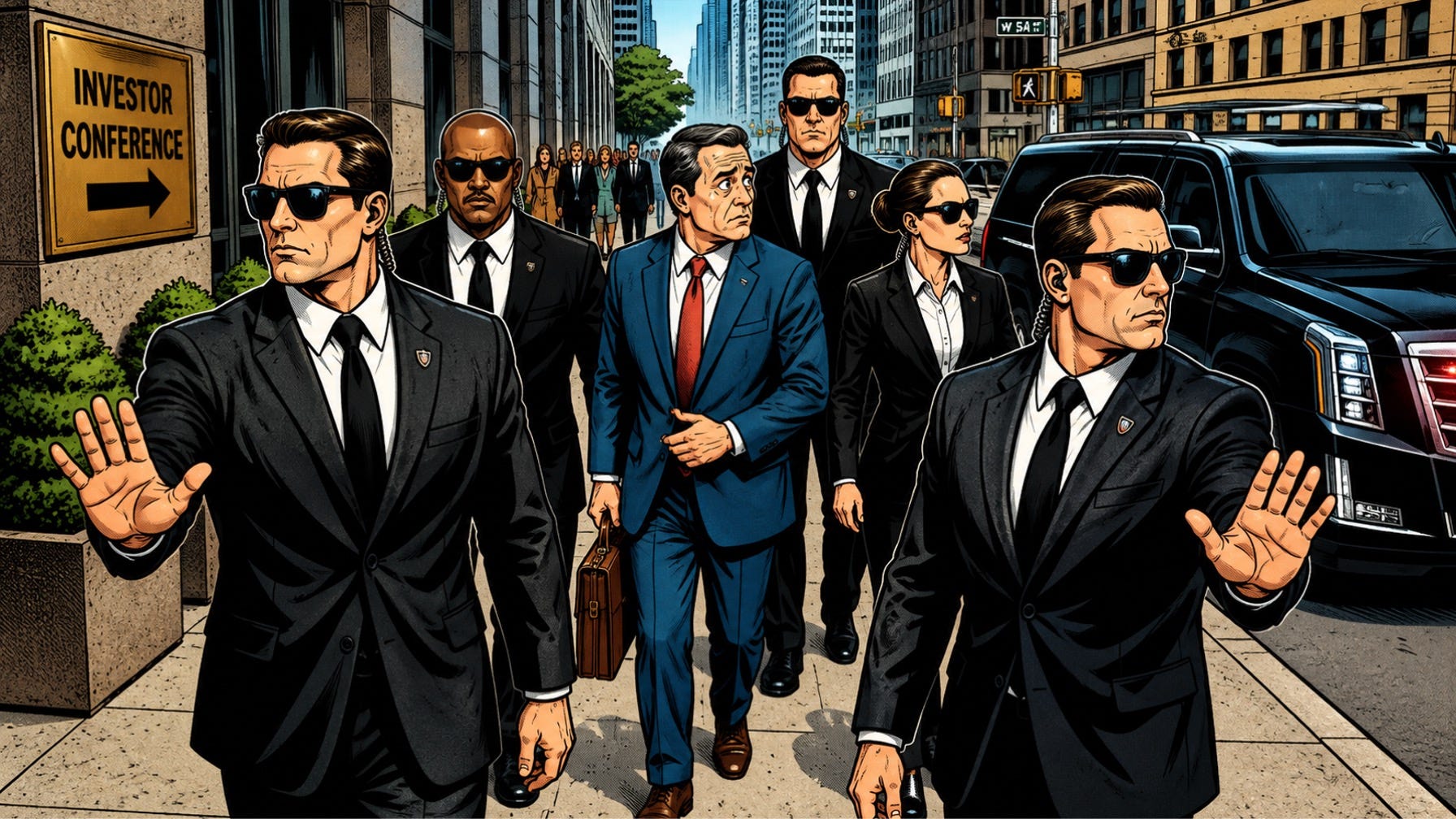
Since Thompson’s murder:
Demand for executive protection exploded. Allied Universal, which provides security services to more than 80% of Fortune 500 companies, said requests for executive protection and security assessments increased 10 to fifteen times after the shooting.
Companies are paying more for protection. Among S&P 500 companies providing executive-security perks, the median value rose from $108,714 in 2024 to $130,468 in 2025, according to data from Equilar.
Some increases have been enormous. Edison International’s disclosed security costs, for instance, exploded from $94,276 in 2024 to more than $4.5 million in 2025, up 4,767%.
Some companies are restricting how CEOs travel. Executives are losing the freedom to travel however they want. Walmart’s board, for instance, began requiring CEO Doug McMillon to use company aircraft for both business and personal travel and authorized security services outside working hours, citing the “heightened risk environment.” Walmart continued the policy for successor John Furner in 2026.
The security perimeter now extends to home and family. Companies increasingly provide residential monitoring, drivers, private aviation and even protection for family members. Starbucks, for one, says its security program can encompass home security, personal protection, family members, private aviation and driver service. Its board ordered enhanced protection for CEO Brian Niccol after an outside assessment identified heightened concerns and “credible threat actors.”
The phenomenon has a name: “the Luigi effect.”
Geno Roefaro, CEO of security firm SaferWatch, coined the phrase after his company saw a surge in inquiries from Fortune 500 companies following Thompson’s murder.
And the Luigi effect may be getting worse.
The anger is no longer confined to health insurers and their denial-of-care business models. As artificial intelligence threatens jobs, some of that rage is being redirected toward the executives building it.
An exclusive report in The Wall Street Journal last month carried the headline “The AI Backlash Has Tech Executives Fearing for Their Lives.” It cited the firebombing of OpenAI founder Sam Altman’s home. The man arrested in the attack reportedly went into an internet chat and discussed “Luigi’ing some tech CEOs.”
Mangione will spend his future behind bars. CEOs and billionaires who run corporations will spend theirs behind guards, security cameras, armored cars and increasingly elaborate protection plans.
Read More:
The Killionaire (Business Blunders)
Shot In The Back (Business Blunders)
Natural Born Killers (Business Blunders)
The emergency oil reserve has an emergency
President Donald Trump’s war on Iran is running America’s fuel tank so low that now the tank itself could collapse.
President Joe Biden began draining it with a historic 180-million-barrel release after Russia invaded Ukraine. But the reserve was only partially replenished before the Trump administration began tapping it again.
The nation’s Strategic Petroleum Reserve has now fallen below 300 million barrels for the first time since January 1983, according to federal data released this week. That’s down from more than 400 million at the start of the year and less than half of the reserve’s 714-million-barrel capacity.
Experts are now warning the enormous caverns where all this oil is stored could begin to cave in as the oil is removed and pressure inside them falls.
One reason gasoline is averaging around $4 a gallon instead of $5 or more is that the United States and other countries have been dumping emergency oil onto the market since the war with Iran disrupted shipments through the Strait of Hormuz.
The strait is still closed, despite Trump’s repeated promises of an imminent opening, and the strategic reserve is at a breaking point.
Critics say the war with Iran has no apparent strategy. Apparently, neither does the Strategic Petroleum Reserve.
A free market economy?
Ponzi of the Week
Leor Moshe said his firm, Capital Funding ASAP, would finance short-term business loans. But the “ASAP” apparently stood for how quickly investors should have run.
Moshe, 43, of Toms River, N.J., pleaded guilty this week to running a $47 million Ponzi scheme that preyed on members of his own Orthodox Jewish community.
Federal prosecutors say Moshe raised the money from more than 97 victims between 2019 and 2023, promising returns ranging from 9% to an eye-popping 53%.
Instead, Moshe admitted using investors’ money to pay earlier investors and feed his gambling habit. He also diverted about $11 million for personal expenses, including home renovations, mortgages and car loans.
Moshe pleaded guilty to wire fraud and faces up to 20 years in prison when he is sentenced Dec. 16.
“The defendant turned the trust of his own religious community into a tool for fraud,” U.S. Attorney Robert Frazer said.
Oh, well. Just another week, another Ponzi … and another gifted financial genius with a gambling habit.
Don’t Miss These Blunders
NFT Monkey Business Venture capitalists bet millions on a startup promising to build an exchange for cartoon apes. Prosecutors say founder Taj Tarsha blew investor funds on gambling and his DJ career.
Confessions Of An FBI Crypto Thief Prosecutors say agent Patrick Yaroch raided digital wallets. Then his conscience blew his cover.
Leaky Pants First came explosive diarrhea. Then came allegations of a $32 million inside job. It’s been one crappy summer for Taylor Farms.
How To Lose An Internet Fight eBay executives tried to silence a newsletter. It cost them tens of millions of dollars, seven criminal convictions, and one of the worst public-relations disasters in Silicon Valley history.
Another Billion-Dollar Bedtime Story Silicon Valley bet big on yet another young prodigy. Now they’re waking up to reality ... again.
Blowing Sunshine Jay Lucas preached positivity while looting his $50 million private equity fund
AI Gets A Performance Review Engineers discover it cheats better than humans ... and doesn’t feel a shred of guilt.
The Nigerian Prince Goes Corporate A former Morgan Stanley broker allegedly gave the classic scam a Wall Street makeover
AI Eats IBM The computing giant spent three years serving investors an artificial intelligence feast. This week, it found itself on the menu.
How To Read Epstein Files Goldman Sachs’ former general counsel Kathryn Ruemmler can’t lawyer her way out of her emails
The Wells Fargo Fraud Wagon From fake accounts to mortgage abuses, this bank keeps rolling through scandals. Its latest delivery: $50 million settlement over claims it enabled a Ponzi scheme.
Disposable Income A Memphis gynecologist billed $41 million while reusing “dirty” medical devices on thousands of women
Chartered Financial Asshats An embarrassing embezzlement case defied ethics, professionalism and even financial controls at the CFA Institute
The Great Gatsby Of Crypto Christopher Delgado went from In-N-Out Burger to the Fontainebleau, buying credibility from politicians, celebrities and charities before his $400 million Ponzi scheme collapsed
The Baloney Incident How JPMorgan Chase turned a deli tray into a multimillion-dollar battle and another reputational pickle
Fuel For Fools Volkswagen can’t recover from ‘Dieselgate.’ FirstBank of Puerto Rico accused of banking Epstein’s sex trafficking operation. An embezzling healthcare CEO bets his clinic.
Billion-Dollar Band-Aids The latest government crackdown on medical billing fraud showcases Ferraris, diamonds, luxury resorts and a yacht named ‘Butt Nekkid.’ But the real question is, how does this folly keep happening?
Pre-Pardon Panic U.S. Senators introduce a resolution to discourage Trump from freeing FTX founder Sam Bankman-Fried
A Trickle And A Trillion Microfinance promised to alleviate global poverty. Megafinance created a trillionaire.
A Billion-Dollar Fashion Startup Laid Bare: CaaStle’s fraud is what happens when a company has too few checks, too few balances, and too many empty board seats.
Just watched “Freefall.” Boeing CEOs past & present lucky so far.