

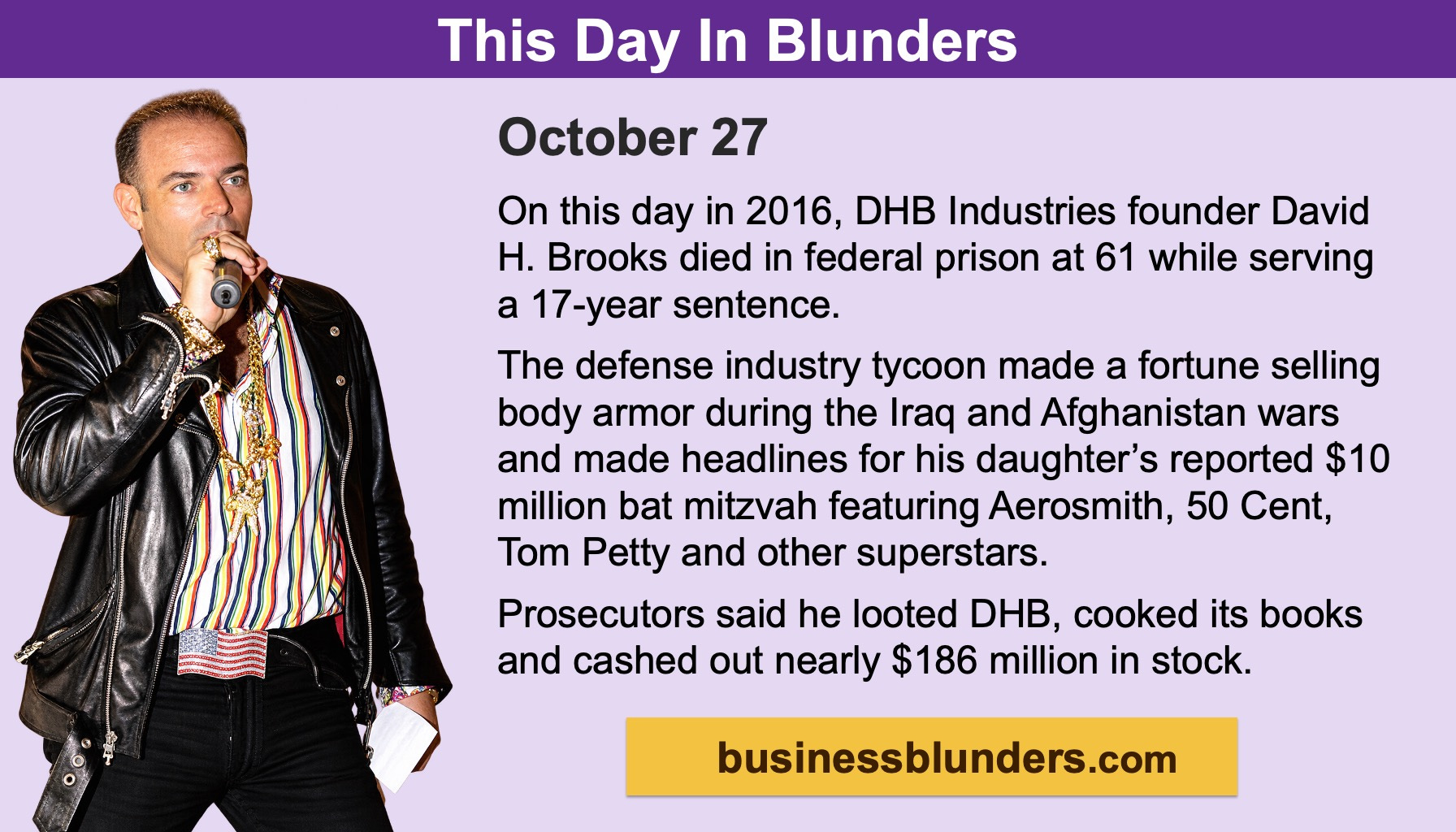
Reader’s Note: As the U.S. burns through missiles and interceptors in the Iran war, the Pentagon is scrambling to replenish its arsenal. Defense contractors are ramping up production, reporting record backlogs and collecting billions in new orders. War means enormous spending, desperate demand and pressure to deliver fast. These are ideal conditions for fraud. Today, the Business Blunders Hall of Shame remembers David H. Brooks, who took full advantage of these conditions during the Iraq and Afghanistan wars.
Miramax Films released a comedy in 2006 lampooning a $500,000 bar mitzvah as the height of parental excess. It was called “Keeping Up with the Steins.”
Hollywood had missed the party. It should have been called “Keeping Up with David H. Brooks.”
Just months before the film’s release, Brooks, a Long Island defense contractor, had thrown his daughter a bat mitzvah that reportedly cost $10 million.
Flush with cash from wars in Afghanistan and Iraq, Brooks took over two floors of New York’s Rainbow Room, built a stage, installed Jumbotrons and assembled a lineup that one rabbi called “Mitzvahpalooza.”
He hired Aerosmith, 50 Cent, Tom Petty, Stevie Nicks, Don Henley, Joe Walsh, Ciara, and Kenny G. (Bruce Springsteen, to his credit, reportedly turned him down.) And Brooks pranced the party in black leather, chains and diamonds before a mid-party costume change into a hot-pink suede getup.
Guests went home with gift bags stuffed with $1,000 worth of electronics. Take that, Stein family and your cheesy, low-budget bash.
Nobody could keep up with David H. Brooks.
Unless, of course, they were cheating shareholders and selling defective body armor to the U.S. military and law enforcement amid the fog of war.
Get rich or die tryin’
Brooks grew up in Brooklyn and Hewlett, Long Island, the middle of three sons of Jewish immigrants and Holocaust survivors.
He earned an accounting degree from New York University and went into the securities business, eventually running a small brokerage operation with his brother, Jeffrey.
In 1992, the Securities and Exchange Commission obtained a permanent injunction against Brooks and hit him with a $405,000 civil penalty for his role in an insider-trading scandal. He was also barred from the brokerage industry for five years.
He could no longer be trusted in the securities industry, so why not go into the defense industry? He bought a body armor company out of bankruptcy and founded DHB Industries the same year he was sanctioned by the SEC.
It was a good business. Sept. 11 made it a great business.
The U.S. invaded Afghanistan in 2001 and Iraq in 2003. Military spending soared, and DHB became one of the nation’s largest suppliers of body armor to the military and law enforcement. Its principal product was the Interceptor vest worn by American troops.
DHB’s soaring stock prices made Brooks spectacularly rich. His compensation climbed from about $525,000 in 2001 to more than $70 million in 2004. And as DHB’s stock approached its all-time high in late 2004, Brooks unloaded about 60% of his holdings for nearly $186 million.
“I’m stanky-rich, I’ma die tryna spend this shit.” – 50 Cent
Livin’ on the edge
A $100,000 belt buckle is a mere trinket to a man willing to blow $10 million on a bat mitzvah.
Brooks made headlines for sporting an American flag belt buckle encrusted with rubies, sapphires and diamonds. He drove Bentleys and Ferraris, took luxury vacations, joined country clubs and made pricey renovations to his expensive homes.
Brooks spent millions on thoroughbred horses. Much of his largesse was billed to shareholders, unbeknownst to them.
He also used company money to pay for prostitutes, not just for himself, but for employees and other associates. His lawyers would later argue that the women motivated his people and made them more productive.
Meantime, the product was suffering.
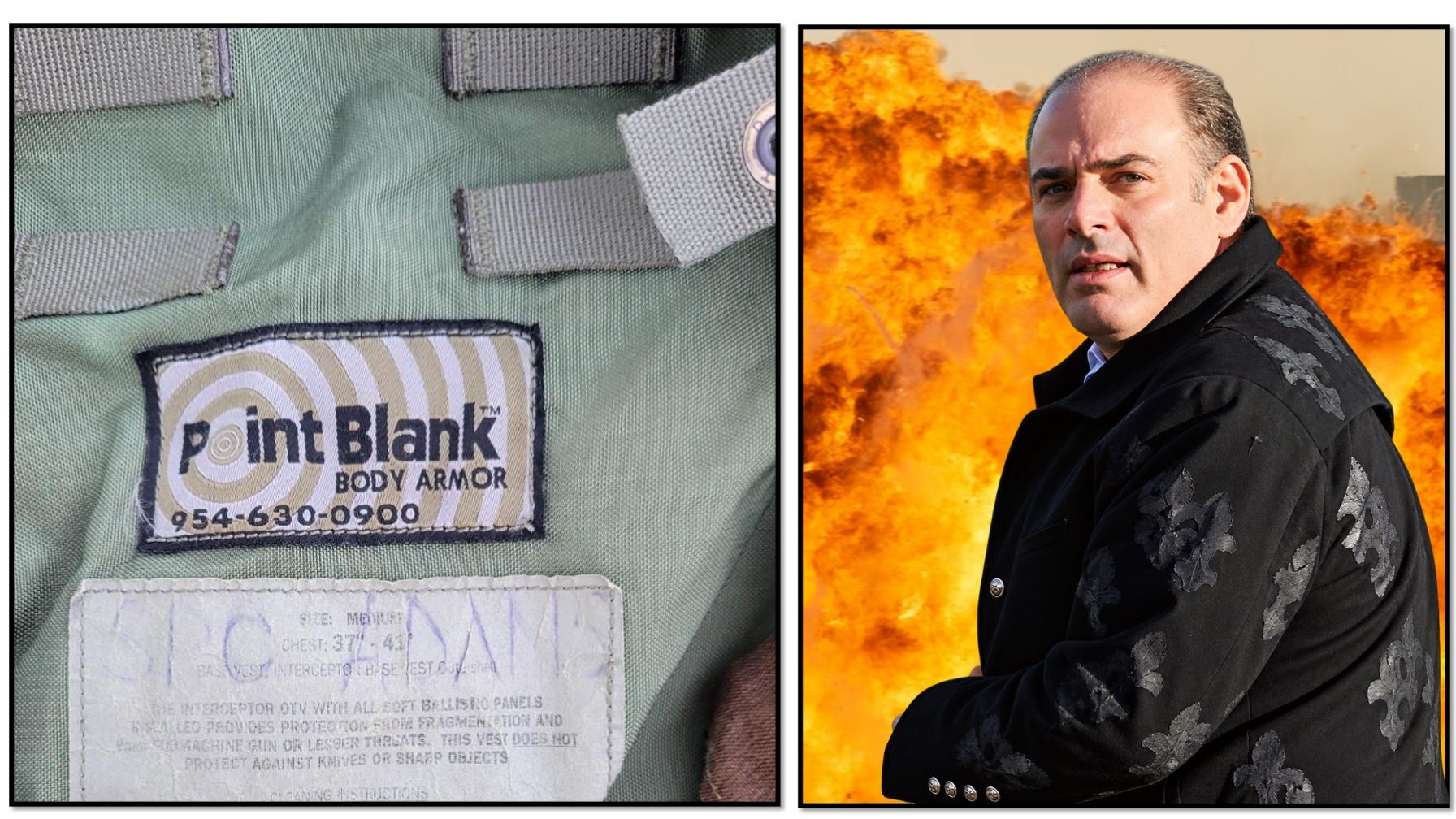
In 2005, the U.S. military recalled more than 23,000 Point Blank body-armor vests in two separate actions after testing raised concerns about whether they met ballistic and contract specifications.
The second recall came just 10 days before the big bat mitzvah.
That same year, the National Institute of Justice announced that body armor containing a synthetic fiber called Zylon could degrade and fail to provide its intended ballistic protection.
DHB’s stock began to crater. Then in 2006, Brooks left the company as regulators and federal prosecutors dug into its finances.
In October 2007, federal prosecutors indicted Brooks on charges stemming from an elaborate accounting and securities fraud. The SEC sued him the same day.
Brooks had spent years livin' on the edge. Now he was about to go over it.
“There’s something right with the world today;
And everybody knows it’s wrong.” – Aerosmith
Free fallin’
Brooks was freed on a $400 million bond, but his bail was revoked after prosecutors revealed that he and his family had concealed millions of dollars overseas.
Then, during the trial, Brooks was caught trying to smuggle anti-anxiety pills back to jail. They were hidden inside pens that someone had left near his seat in the courtroom.
After an eight-month trial, a federal jury convicted him in 2010 on 14 counts, including securities fraud, insider trading, mail and wire fraud, obstruction of justice and other charges. Sandra Hatfield, who had served as CEO and CFO of the company, was also convicted.
Prosecutors said Brooks had cooked DHB’s books, lied to auditors and investors, dumped millions of dollars of stock at inflated prices and treated the publicly traded company as his personal piggy bank.
He ran just about every trick in The White-Collar Playbook. He also pleaded guilty to tax charges.
In 2013, a federal judge sentenced him to 17 years in prison and ordered him to pay more than $90 million in restitution, forfeit about $65 million and pay an $8.7 million fine.
“DHB Industries made body armor that protected the men and women of the U.S. military, who risk their lives to keep us safe,” said U.S. Attorney Loretta Lynch. “To David Brooks, it was merely a vehicle for plunder and a means to feed his own greed.”
“I’m gonna free fall, out into nothin’; Gonna leave this world for awhile.” – Tom Petty
The end of the innocence
DHB survived its founder and its defective line of bullet-proof vests that had put U.S. service members and law enforcement officers at risk.
The company moved its headquarters from Long Island to Pompano Beach, Fla., changed its name to Point Blank Solutions, and filed chapter 11 bankruptcy in April 2010.
In 2011, Point Blank paid $1 million to settle federal allegations that it knowingly manufactured and sold defective Zylon vests during the Brooks era.
Then in 2011, Point Blank sold substantially all of its operating assets to an affiliate of private-equity firm Sun Capital Partners for $36.6 million. And in 2012, Sun Capital merged it with another body armor maker.
Today, Point Blank continues to make body armor and other protective equipment for the military, law enforcement and other customers.
As for Brooks, he died in prison at age 61. “It was sudden and unexpected,” his lawyer told an appeals court in Miami.
Because Brooks died while his appeal was pending, his convictions were later vacated. There’s a legal doctrine that wipes out convictions when a defendant dies before exhausting appeals. His separate tax convictions, which were not part of the appeal, remained intact.
After his death, Brooks’ estate reached a settlement resolving the SEC case, that included $142 million in reimbursement for bonuses and profits Brooks received from DHB stock sales.
Wars still rage. The company he built still sells body armor. And Brooks still appears to hold the record for the world’s most expensive bat mitzvah.
“Offer up your best defense;
This is the end;
This is the end of the innocence.” – Don Henley