

This Week In Blunders – October 18-24
“Corruption, embezzlement, fraud, these are all characteristics which exist everywhere. … What successful economies do is keep it to a minimum.” – Alan Greenspan.
The latest CNBC All-America Economic Survey out this week posed a couple of no-shit-Sherlock questions:
Should government officials be allowed to trade stock in companies with federal contracts?
Should a sitting president’s family get federal contracts?
There’s always a subset of corporate sociopaths at work in America so naturally, 7% said the stock trading was fine and 11% were apparently just ducky with a president’s family scoring federal contracts.
“Grift Becomes Bigger Issue for Voters in Final Days Before Midterms,” screams the headline in today’s Wall Street Journal.
Even a Fox News poll found government corruption was voters’ No. 1 concern, with 60% saying they were extremely concerned, ahead of inflation, gas prices and health care.
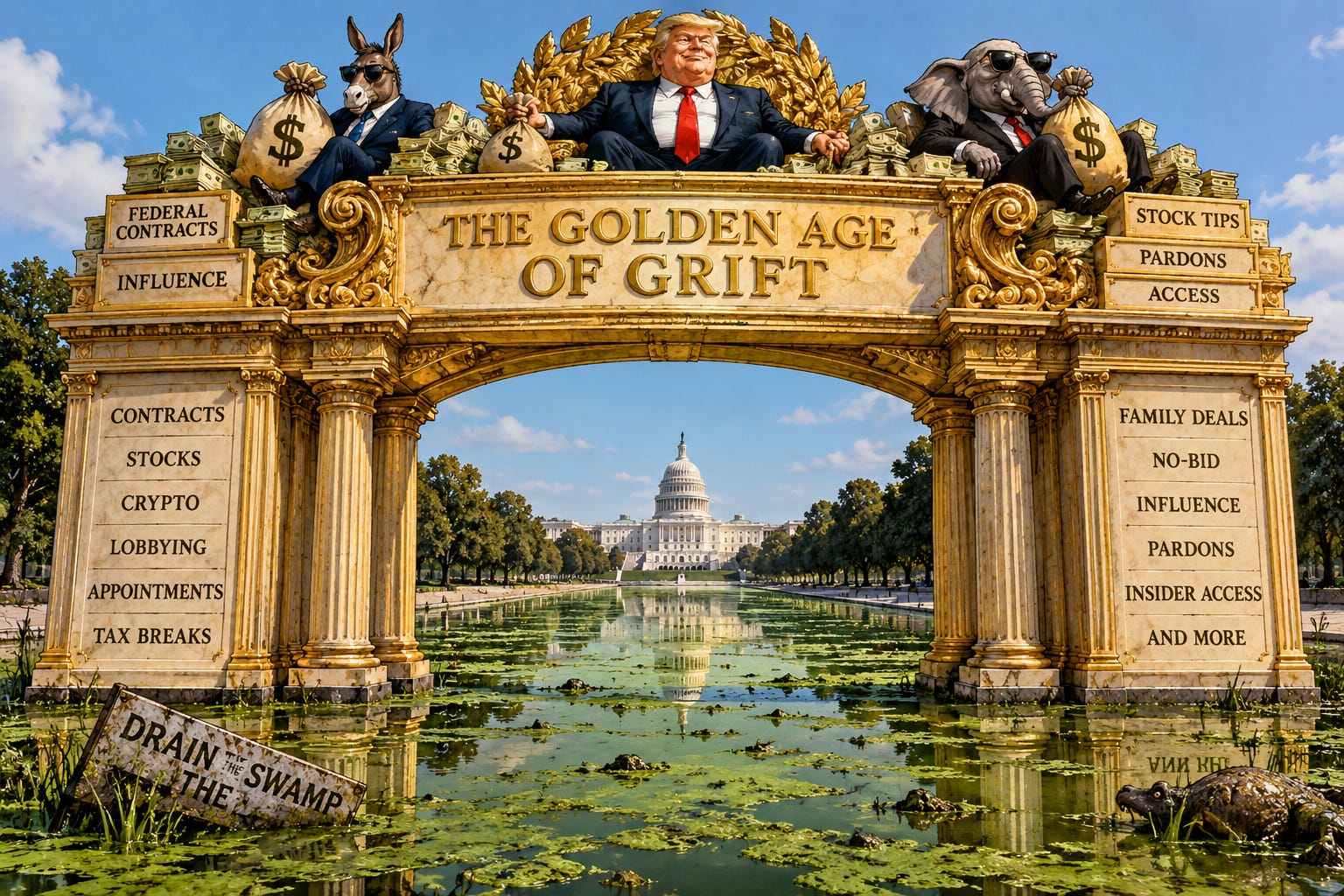
President Donald Trump drained the swamp and now he’s monetizing the mud.
“Now it looks like they’re feeding on the swamp,” Marc Short, chief of staff to former Vice President Mike Pence, told the Journal.
Democrats have plenty of their own swamp creatures, too. And for all their outrage, they have never done more than feign concern about Congressional stock trading. (Neither have Republicans.)
How do so many public servants leave Washington so much richer than when they arrived? Trading stocks while writing the rules is one route. Landing a high-paying corporate gig after getting flushed out of office is another.
Food costs ranked a close second in the CNBC poll. Ranking third was protecting democracy.
These issues all go hand in hand.
Without the checks and balances of a healthy democracy, we have big business and billionaires paying off politicians for the privilege of looting the world’s largest economy.
Corporations have corrupted government. Government has corrupted corporations.
An affordability crisis rages. Seemingly few in Washington actually care.
This is where we are: The Golden Age of Grift.
It’s refreshing to discover that despite all the distractions, misinformation and bald-faced lies Americans know it.
Health care fraud for the big screen
It takes a lot of imagination to allegedly commit $2 billion in medical billing fraud, but it looks like a handful of California health care providers should have written scripts for Hollywood producers instead of patients.
On Thursday, the Justice Department announced charges against 15 people in a Los Angeles health care fraud takedown who prosecutors say fraudulently billed Medicare, Medi-Cal and private insurance companies.
Their alleged schemes could be movies, and they’d be funny if America’s health care costs weren’t running off the rails.
Weekend at Bernie’s Hospice: Geoffrey Jimenez allegedly recruited seniors from community centers and put them into hospice, even when they weren’t terminally ill. Some patients didn’t even know they were in hospice. More than a dozen hospices he controlled through Transitions Hospice Inc. billed Medicare more than $107 million. Medicare paid. Nobody had to die.
Plaque to the Future: Prosecutors say chiropractor Hany Malek posed as a medical doctor and diagnosed patients with arterial disease. Cardiothoracic surgeon Harold Tabaie allegedly followed up with invasive procedures to remove plaque, even from patients who didn’t have arterial disease. Medicare got about $135 million in bills. Who needs a tricked-out a DeLorean when you’ve have someone’s Medicare number?
House Party 7: The Relapse: David and Nathan Young allegedly recruited homeless people into addiction treatment with housing, free flights, hotels, gift cards, cigarettes, marijuana and drugs. Prosecutors say some patients were encouraged to drink or use drugs so they could qualify. Private insurers received more than $1.6 billion in bills. Now that’s a party.
21 Days Later: Thomas Mladinich admitted taking kickbacks to send patients to a substance-abuse treatment facility. Recruiters allegedly promised patients a piece of the referral money if they stayed long enough to earn the payout, or at least 21 days. On Day 22, they could walk out like zombies.
Beach Blanket Billing: Nathan Young and David Young both of Los Angeles, and Honey Phipps and Cody Phipps, both of Greenville, Texas, ran group therapy sessions by Zoom calls. Sometimes there were more than 100 people on the calls. Prosecutors say they were required to turn on their cameras, but were told they could go “lay out on [the] beach.” At least the beach was in-network.
A Few Good Genes: Doctors Hassan Badday and Robby Ayoub allegedly took kickbacks for ordering medically unnecessary genetic tests that prosecutors say were rarely, if ever, used to treat their patients. Together, the doctors allegedly generated about $5.5 million in claims. You want the truth? You can’t bill the truth.
Prescription Impossible: When California temporarily suspended prior-authorization requirements for certain drugs, prosecutors say Christina Mareik and others saw an opportunity. They allegedly flooded Medi-Cal with thousands of bogus prescriptions for expensive, medically unnecessary generic drugs. The tab: $269 million billed and nearly $179 million paid. Your mission, should you choose to accept it: Charge the impossible.
Coming soon! To a health care policy near you!
Failure is not final, unless …
Plenty of entrepreneurs have pulled themselves from the ashes of bankruptcy and reformed after prison sentences. Some fail to see any hope.
Ideally, the trick is to keep your business failures small enough that you can recover. Or have the fortitude to try again, no matter what you may have done in the past.
This week, Business Blunders introduced a collection of cautionary tales from executives, entrepreneurs and investors who died by suicide amid business failures, financial losses and corporate scandals.
It’s offered as a stark reminder that no business blunder is worth a life.
Read More: Suicide Is Not Painless (Blunder Lists)
This week’s Ponzi
Timothy France Johnson, 63, of El Paso, Texas, promised investors “zero-risk” returns from his business of financing NBA preseason games.
Instead, they got nothing but net ... losses. Prosecutors say he spent 11 years running a Ponzi scheme, fabricating contracts and using new investors’ money to pay old ones and cover his personal expenses.
Johnson, the estranged brother of El Paso Mayor Renard Johnson, was sentenced Friday to more than four years in federal prison and ordered to forfeit about $3.1 million.
It took 11 years, but the feds finally called the game.
In other Ponzi news this week, don’t miss “Tiptoe Through The Escrow”.(Business Blunders)
When will investors stop feeding the Ponzis?
Good reputation. Bad judgment.
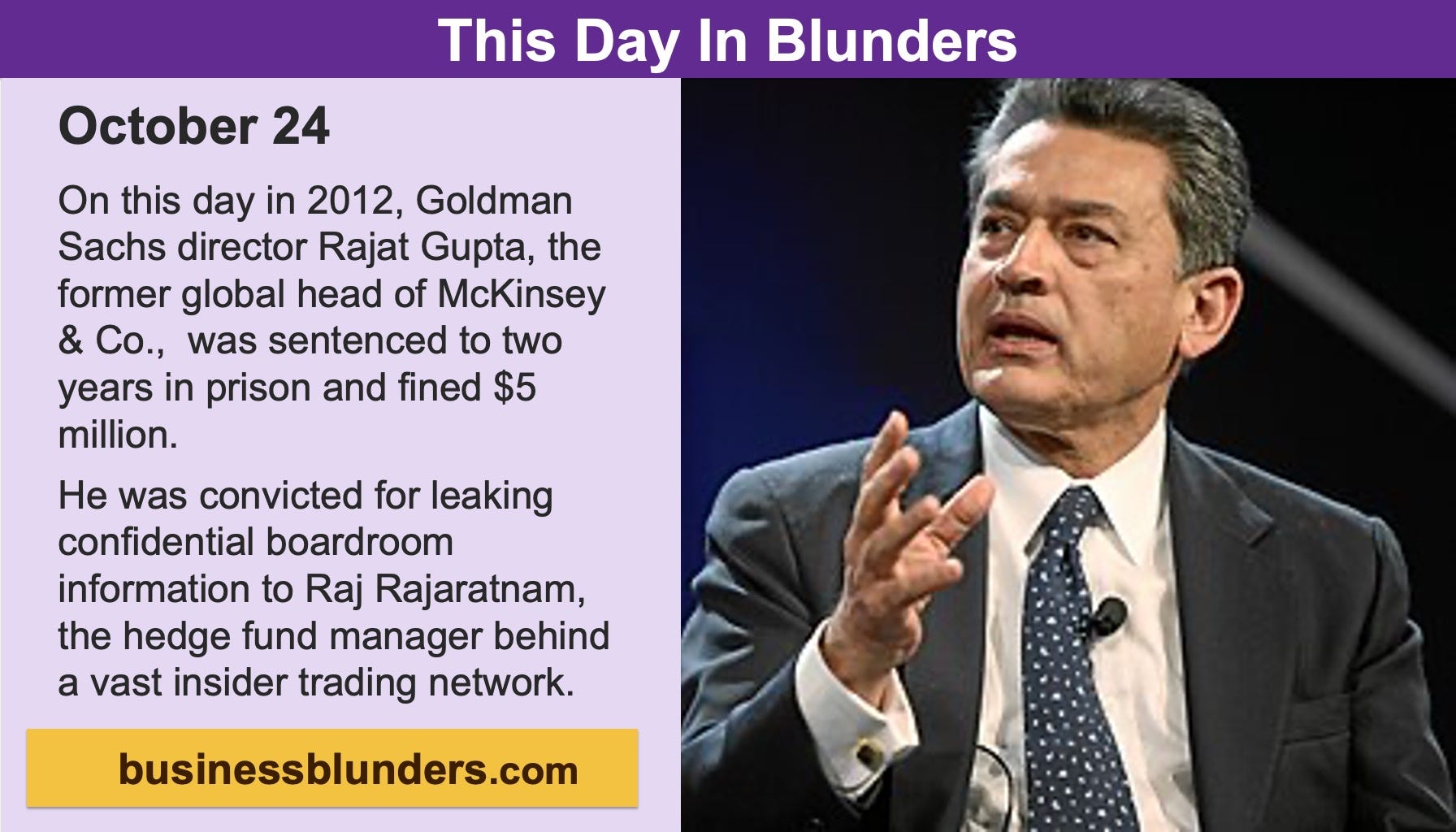
The judge acknowledged he was a good person, but that was not the question before the court. The fact is good people do bad things, and bad people do good things.
Read More: Rajat Gupta – Goldman Sachs (Business Blunders Hall Of Shame)
Don’t Miss These Blunders
Jeffrey Skilling – Enron He left for ‘personal reasons.’ He had personally committed fraud.
Tiptoe Through The Escrow A New York attorney loaned $336 million in client funds to a 33-year-old apartment investor. Now Flagstar Bank is getting dragged into an alleged Ponzi scheme surrounding the mess.
The Great American Rinse Cycle When Chinese money-laundering networks need a bank, where else would they turn but Bank of America?
Pharma Bro Can’t Help Himself Martin Shkreli went to prison. He was also banned from the pharmaceutical industry for life. Regulators say he keeps coming back for another dose.
Billy McFarland – Fyre Festival Prison didn’t end the party. It was just an intermission.
Desperately Seeking Diesel When Trump runs low on fuel, it’s ‘Fill ’er up, Vladimir’
100 Quadrillion Japanese Dogs Kishu Inu founder Alexander Sisemore allegedly bagged $9 million in a crypto ‘rug pull,’ dumping his secret stash of the meme coins on investors. Will crypto enthusiasts buy anything with a dog on it?
Jérôme Kerviel – Société Générale He cost his bank billions. But who left the vault door open?
If the Shoe Doesn’t Fit … Nike Can Wear It What a tech CEO didn’t know: People like to try on shoes before they buy them.
Don Lapre – The Making Money Show His greatest money-making secret was selling money-making secrets.
Charlie Javice – Frank She was startup wunderkind with a student loan website. She gave JPMorgan Chase a $175 million education.
The Fake Andy Warhols The art was fake. The provenance was fake. Even the email address was fake. Now the dealer is missing.
Florida Man Takes Cops For A Ride It takes a lot of balls to rip off police. Pension administrator employee Michael D. Williams settles civil fraud charges without admitting or denying the allegations.
Scamway The granddaddy of multilevel marketing gets stuck with a record $225 million settlement as regulators finally crack down on Amway.
Catch And Release Kevin Kolenda kept getting caught selling bogus prize insurance. He never stopped casting for suckers.
The Sins Not Even Trump Can Pardon Nikola founder Trevor Milton got a presidential pardon. It won’t erase the financial consequences of his fraud.
LIV And Let Die LIV Golf can beg for a mulligan in bankruptcy court. But who wants to invest in a losing game?
Amazon’s Imaginary Friend Jeff Bezos’ e-commerce giant allegedly invented a bidder to drive up prices. Guess who pays.
Basketball Or Ballmer Ball? The NBA just suspended Steve Ballmer, its richest team owner, for allegedly making up his own rules.
No One Yelled Fore Good Good Golf is paying steep price after running, ‘the worst ad known to mankind’ and taking Callaway down with it.
Jes Staley’s Magic Kindom When Wall Street was melting down, this top JPMorgan executive sought a financial wizard. He turned to his pal, Jeffrey Epstein.
Flip This NBA Team Billionaire Mark Walter is scrambling to raise billions after his insurance companies reported a $20 billion investment blunder. Now he’s flipping the L.A. Lakers.