

This Week In Blunders – Sept. 20-26
“I like money on the wall.” – Andy Warhol
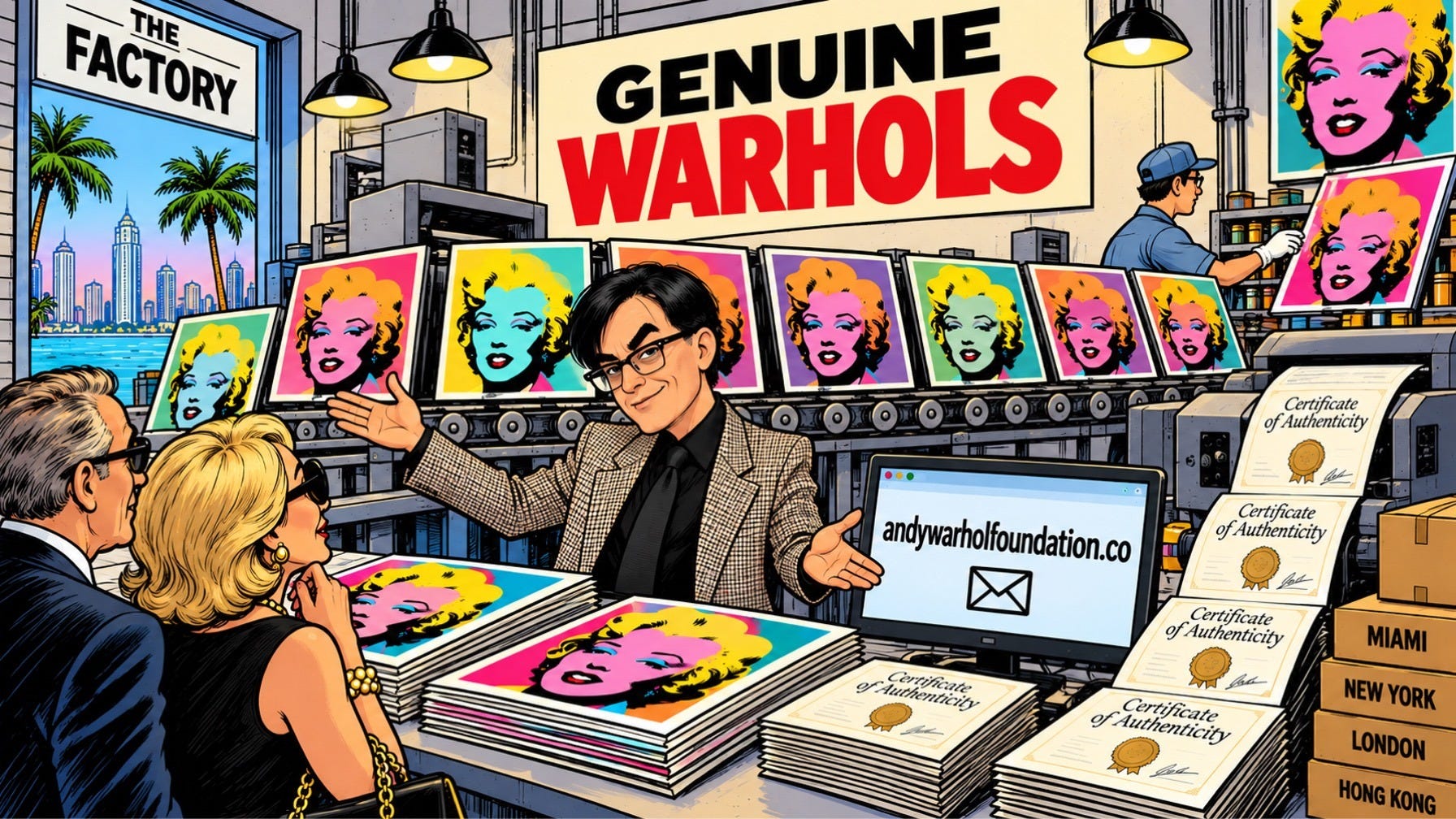
Miami art dealer Leslie Roberts made millions showing fake Andy Warhols. When it came time for his sentencing Friday, he was a no-show.
Roberts was indicted in April 2025 and later pleaded guilty to conspiracy to commit wire fraud. When he failed to appear for sentencing on Friday, his lawyer told the court he didn’t know where Roberts was, Law360 reports.
The judge rescheduled the hearing for a week later. Roberts could face more than 20 years in prison … if he ever shows.
Pop artist Andy Warhol is perhaps the most diabolically hilarious trend that ever hit the 1%.
He turned soup cans, Coke bottles and Brillo boxes into status objects, often mocking American consumer culture while getting rich collectors to pay enormous sums for images of things everyone else could buy at the grocery store.
Florida real-estate investor Richard Perlman and his family, for instance, spent more than $6.7 million buying more than 200 purported Warhols from Roberts, according to The Wall Street Journal. Perlman settled an earlier lawsuit against Roberts and is now suing a litany of other art-world players he alleges supplied, sold or authenticated bogus works.
It may be difficult to tell a fake Warhol from a real one, considering how the artist mass produced so much of his work in a New York studio he called “The Factory.” But a fake art dealer should be easy to spot.
Vanity Fair laid out Robert’s background last year in a piece headlined: “An Art Fraud Case That Is Bonkers Even by Florida Standards.”
Business Blunders needn’t generate too many pixels to summarize it.
Just two words: Florida Man.
By the time the Perlmans walked into Roberts’ gallery, his provenance was considerably easier to check than the Warhols’ works.
Roberts had received a 15-year federal prison sentence for defrauding his great-uncle in a stock scheme. Artist Romero Britto later won a permanent injunction after Roberts sold counterfeit Brittos. Roberts also served 22 months in federal prison for selling forged Peter Max works — followed by another five months behind bars after violating the terms of his supervised release.
He also claimed to have studied at New York Univeristy and trained at Sotheby’s. He actually attended the University of Miami for just two semesters, and NYU said it had no record of him attending, according to published reports.
Does anybody know about this handy research tool called Google?
Then there was the purported Andy Warhol Foundation representative who reassured Roberts’ customers. His emails came from andywarholfoundation.co. The real Foundation is warholfoundation.org.
This is real-life satire at its finest, opening up a supersized can of dumbass that Warhol might have been proud to paint.
Warhol turned mundane consumer products into masterpieces. Roberts turned Warhol into art.
Today’s post is free. Please share Business Blunders with friends.
It’s the debt, stupid
Washington is borrowing money it can’t stop spending. Silicon Valley is borrowing money for chips it can’t stop replacing.
Fortunately, they both have a plan: borrow more.
This week, the 10-year Treasury yield hit its highest level in 19 years.
Washington has run a deficit of more than $2 trillion already this fiscal year, and it has pushed the national debt past $40 trillion. Servicing this debt is already costing taxpayers more than $1 trillion a year. And that’s more than the government spends on defense.
Then there’s the AI beast Silicon Valley can’t stop feeding, even as it warns that it may kill us all.
Tech companies are spending hundreds of billions on data centers, chips and other infrastructure, increasingly with borrowed money. Goldman Sachs, for one, estimates these hyperscalers could issue $420 billion in bonds next year on top of billions and billions they’ve already borrowed.
The trouble is that today’s state-of-the-art AI chips may become yesterday’s technology long before some of the debts used to buy them come due. Can you say TRS-80?
Then there’s inflation, which isn’t going away, making all that borrowing more expensive.
This predicament was easy for anyone to see coming. Nobody cared.
Read More: Hello? What About The 36 Trillion Tab? (Business Blunders, 2024)
Brace yourselves, folks, not just for increasingly unaffordable mortgages and consumer loans, but for what may be the next big one.
John Roque of 22V Research studied 16 rapid spikes in the 10-year Treasury yield since 1970 and compared them with the financial calamities that followed, CNBC reported on Thursday.
His conclusion: “Something always breaks.”
This week in Ponzis
A Ponzi here, a Ponzi there, a Ponzi almost everywhere.
Regulators had a busy week:
Foreign exchange: The Commodity Futures Trading Commission accused Cash FX Group of running a $950 million global Ponzi scheme, promising returns of up to 15% a week from expert traders, algorithms and artificial intelligence. The CFTC says it did almost no forex trading, and investors lost at least $406 million. Nothing like losing millions to artificial Artificial Intelligence.
Trucking: The Securities and Exchange Commission accused Florida trucking entrepreneur Kristopher Lunsford and his companies of raising $127 million by promising investors $1,250 a week per truck. That’s about a 260% annual return. The SEC says $52 million went to earlier investors while Lunsford diverted another $33 million for himself, including millions for travel, bars, nightclubs and casinos. Apparently the money was doing most of the hauling.
Mobile homes: The SEC also alleged that Michael Ayala’s Wavemark Capital raised $9.6 million to buy mobile homes and promised investors guaranteed annual returns of 12% to 14%. It allegedly bought no mobile homes at all, instead using investor money for Ponzi-like payments and other expenses. The only thing that appeared to be mobile was investors’ money.
No real business plan. No real returns. Real money for the alleged perpetrators. Why does one of the oldest frauds in The White Collar Playbook keep fooling investors? Because they’re not reading Business Blunders. Feel smarter now?
The Feeling isn’t ‘mutual’
Don’t Miss These Blunders
Florida Man Takes Cops For A Ride It takes a lot of balls to rip off police. Pension administrator employee Michael D. Williams settles civil fraud charges without admitting or denying the allegations.
Scamway The granddaddy of multilevel marketing gets stuck with a record $225 million settlement as regulators finally crack down on Amway.
Catch And Release Kevin Kolenda kept getting caught selling bogus prize insurance. He never stopped casting for suckers.
The Sins Not Even Trump Can Pardon Nikola founder Trevor Milton got a presidential pardon. It won’t erase the financial consequences of his fraud.
LIV And Let Die LIV Golf can beg for a mulligan in bankruptcy court. But who wants to invest in a losing game?
Amazon’s Imaginary Friend Jeff Bezos’ e-commerce giant allegedly invented a bidder to drive up prices. Guess who pays.
Basketball Or Ballmer Ball? The NBA just suspended Steve Ballmer, its richest team owner, for allegedly making up his own rules.
No One Yelled Fore Good Good Golf is paying steep price after running, ‘the worst ad known to mankind’ and taking Callaway down with it.
Jes Staley’s Magic Kindom When Wall Street was melting down, this top JPMorgan executive sought a financial wizard. He turned to his pal, Jeffrey Epstein.
Flip This NBA Team Billionaire Mark Walter is scrambling to raise billions after his insurance companies reported a $20 billion investment blunder. Now he’s flipping the L.A. Lakers.
Conrad Black – Hollinger International He inherited a fortune and leveraged it into a global newspaper empire. Then he went to prison for stealing from his own company.
‘You Better Find Me Incompetent’ Former Abercrombie & Fitch CEO Michael Jeffries finally faces trial for alleged sex trafficking that began nearly 18 years ago
A Pump And Dump From Prison David Foley hyped penny stocks and bagged millions while serving a federal prison sentence. Now he’s headed back to the office.
Boiler Room 2026 Cold calls. Sales scripts. Promises of 1,000% returns. The SEC says an old stock-peddling scam found a new generation of victims.
Michael ‘Mickey’ Monus – Phar-Mor He played doctor with the books. His pharmacy chain kept bleeding.
Ed Mattar – BestBank Of Boulder He was a lifelong deadbeat. Somehow he got his hands on a state-chartered bank.
The Luigi Effect Luigi Mangione has changed corporate security. CEOs may never feel safe again.
NFT Monkey Business Venture capitalists bet millions on a startup promising to build an exchange for cartoon apes. Prosecutors say founder Taj Tarsha blew investor funds on gambling and his DJ career.
Confessions Of An FBI Crypto Thief Prosecutors say agent Patrick Yaroch raided digital wallets. Then his conscience blew his cover.
Leaky Pants First came explosive diarrhea. Then came allegations of a $32 million inside job. It’s been one crappy summer for Taylor Farms.
How To Lose An Internet Fight eBay executives tried to silence a newsletter. It cost them tens of millions of dollars, seven criminal convictions, and one of the worst public-relations disasters in Silicon Valley history.
He also claimed to have studied at New York *Univeristy^spp. and trained at Sotheby’s. He actually attended the University of Miami for just two semesters, and NYU said it had no record of him attending, according to published reports.
Around our house, we call Him Mr. Google.