

This archive tracks major business blunders that occurred on each day in February, from historic corporate collapses to modern fraud cases and executive failures.

Feb. 1
Penn Central — Collapse (1968)
Pennsylvania Railroad and New York Central Railroad merged to form Penn Central. Within two years, a merger meant to save two failing railroads created one of history’s biggest corporate collapses.
Feb. 2
Movie Gallery — Bankruptcy (2010)
Movie Gallery, parent of Hollywood Video, filed bankruptcy, setting off the liquidation of one of America’s largest video rental chains as competition from Netflix and Redbox eroded its business.
Bernard Ebbers — Death (2020)
WorldCom co-founder Bernie Ebbers died with a legacy that included one of the world’s biggest accounting frauds. Read More: Bernie Ebbers – WorldCom (Business Blunders Hall Of Shame)
Feb. 3
Tulip Mania — Market Crash (1637)
A fabled tulip bubble popped when a routine auction in Haarlem finds no buyers. The financial mania that drove tulip bulb prices to insane levels proved centuries ago proved that even the hottest market will die the moment everyone decides not to show
Standard & Poor’s — Settlement (2015)
Standard & Poor’s agreed to pay $1.5 billion to settle federal and state claims that it misled investors with inflated mortgage-security ratings before the financial crisis.
Feb. 4
Rolls-Royce — Bankruptcy (1971)
Rolls-Royce declared bankruptcy, blaming cost overruns on a jet engine contract with Lockheed Aircraft Corp. Britain’s politicians called it “a national tragedy.”
Feb. 5
Global Aviation Holdings — Bankruptcy (2012)
Global Aviation Holdings filed bankruptcy after years of debt-fueled expansion, grounding World Airways and North American Airlines. Expansion fueled by debt left the airline group unable to stay airborne.
Credit Card Fraud Ring — Charges Filed (2025)
Federal prosecutors in New Jersey charged 18 people in a sprawling international credit card fraud and money laundering scheme that allegedly caused more than $200 million in losses. According to the Justice Department, the defendants used stolen credit card data, shell companies and fraudulent transactions routed through payment processors to move money across borders while disguising the origin of the funds.
RadioShack — Bankruptcy (2015)
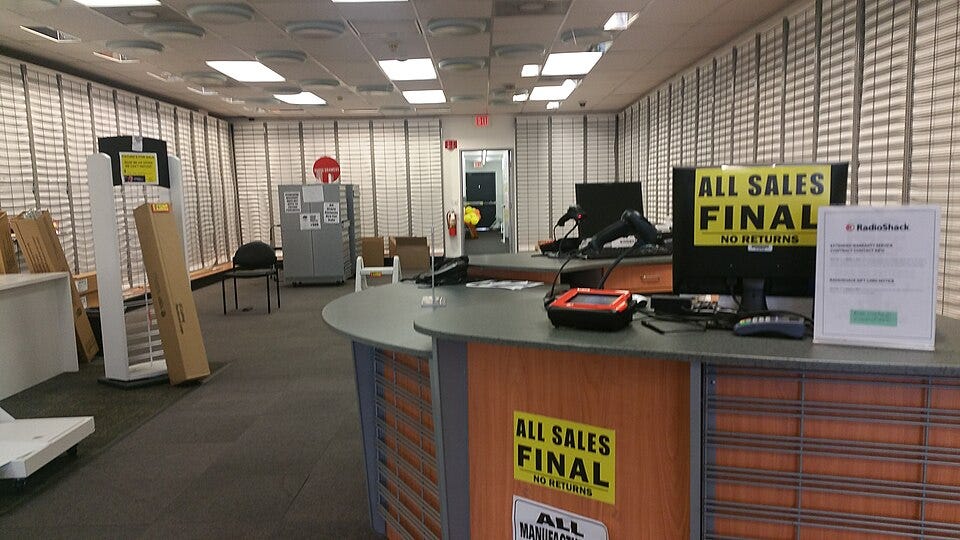
RadioShack filed its first bankruptcy after striking a deal to sell up to 2,400 stores to wireless provider Sprint and a hedge fund that was its biggest shareholder.
Lululemon Athletica — CEO Resignation (2018)
Laurent Potdevin resigned as CEO of Lululemon Athletica after violating company policy through a personal relationship with an employee. A leadership lapse at the top forced a sudden exit at a fast-growing brand. Read More: Lost In Love (Blunder Lists)
Francesca’s Holdings — Bankruptcy (2026)
Francesca’s Holdings filed bankruptcy for the second time and announced plans to close its stores. A fast-fashion boutique chain couldn’t outrun weak sales and mounting debt, landing back in court just years after its first restructuring.
Feb. 6
Norfolk Southern — Industrial Disaster (2023)
Norfolk Southern released and burned vinyl chloride from a derailed train in East Palestine, Ohio. The controlled burn created a toxic plume, triggering evacuations and sparking a reputational and legal nightmare for the railroad. Read More: Drivin’ That Train (Business Blunders)
Feb. 7
Coinbase — Guilty Plea (2023)
A Coinbase former employee pleaded guilty in the first-ever cryptocurrency insider trading case, admitting he tipped others about which crypto assets were going to be listed.
Feb. 8
Bitfinex Hack Case — Guilty Plea (2022)
Ilya Lichtenstein and his wife, Heather Morgan, were arrested for laundering $4.5 billion in cryptocurrency stolen from the 2016 Bitfinex hack. Both pleaded guilty and received prison sentences. Ilya received a pardon in 2026.
Stryker — CEO Resignation (2012)
Stryker Corp. CEO Stephen MacMillan resigned from the medical device maker following an office romance with a flight attendant on the company’s corporate jet. Read More: Lost In Love (Blunder Lists)
Feb. 9
Sears — Guilty Plea (1999)
Sears, Roebuck & Co. pleaded guilty and paid a $60 million criminal fine – the largest in history at the time – for illegally pursuing credit card debtors whose debts were discharged in bankruptcy. Read More: The Outrageous Acts Of Criminally Charged Corporations (Blunder Lists)
Hewlett-Packard — CEO Firing (2005)
Hewlett-Packard’s board fired Carly Fiorina as CEO after years of controversy over the Compaq merger and weak stock performance.
Monsanto — Settlement (2016)
Monsanto agreed to pay an $80 million fine to the Securities and Exchange Commission to settle accounting fraud charges tied to its Roundup rebate program. The company inflated earnings by manipulating rebate timing, making results look stronger than they were.
Uber — Trade Secret Settlement (2018)
Uber agreed to pay $245 million settle a high-profile trade secrets lawsuit brought by Waymo over self-driving car technology tied to former Google engineer Anthony Levandowski. Waymo alleged Levandowski downloaded thousands of confidential files before leaving to launch a competing venture later acquired by Uber.
Feb. 10
Daniel Overmyer — Fraud Conviction (1989)
A federal appeals court reinstated the bankruptcy-fraud conviction of Daniel H. Overmyer, the “warehouse king,” tied to the collapse of D. H. Overmyer Warehouse Co. Once operating more than 350 warehouses, the empire unraveled under fraud and financial strain. Read More:
Feb. 11
Tyson Foods — Criminal Settlement (2011)
Tyson Foods agreed to pay a $4 million criminal penalty for bribing meat processing plant inspectors in Mexico. Read More: The Outrageous Acts Of Criminally Charged Corporations (Blunder Lists)
Kellogg Brown & Root — Criminal Settlement (2011)
Kellogg, Brown & Root, a Houston-based industrial services company, agreed to pay $402 million to settle criminal charges stemming from a bribery scheme in Nigeria. KBR and its then-parent Halliburton also agreed to a $177 million settlement with the Securities and Exchange Commission. Read More: The Outrageous Acts Of Criminally Charged Corporations (Blunder Lists)
Feb. 12
Research In Motion — Product Misjudgment (2007)

RIM co-CEO Jim Balsillie now-famously dismissed Apple’s iPhone as “one more entrant into an already very busy space.” It was the beginning of the end for the BlackBerry. Read More: CEOs Say The Dumbest Things (Blunder Lists)
Max Butler — Sentencing (2010)
Hacker Max Butler, known online as “Iceman,” was sentenced to 13 years in federal prison for operating one of the world’s largest underground marketplaces for stolen credit card data. Prosecutors said Butler trafficked in nearly two million stolen credit card numbers while running forums that connected hackers, identity thieves and fraudsters around the globe.
Feb. 13
Paul Burks — Fraud Sentencing (2017)
Paul Burks, founder of ZeekRewards, was sentenced to more than 14 years in prison for operating a $900 million internet Ponzi scheme. The company promised easy returns from online auctions while paying investors with money from new victims. Read More: 15 Tales Of Lost Ponzi Riches (Blunder Lists)
Drexel Burnham Lambert — Bankruptcy (1990)
Junk-bond pioneer Drexel Burnham Lambert filed bankruptcy, a victim of its own risky debt deals and mounting legal problems.
Feb. 14
Union Carbide — Settlement (1989)
Union Carbide agreed to a $470 million settlement over the Bhopal, India disaster, a deal widely condemned as inadequate compensation for victims of the worst industrial accident in history.
Rita Crundwell — Sentencing (2013)
Former Dixon, Illinois comptroller Rita Crundwell was sentenced to 19 years and 7 months in federal prison for stealing $53.7 million from the city over two decades. Prosecutors said she used a secret account and fictitious invoices to siphon public money into a lavish lifestyle and quarter-horse business while Dixon cut budgets and blamed shortfalls on the economy. It was one of the largest municipal frauds in American history hid in plain sight.
Meta Platforms — Settlement (2022)
Texas sued Facebook’s parent company Meta, saying It collected facial recognition data without consent. The company paid $1.4 billion to settle the lawsuit in July 2024.
Feb. 15
Interstate Hosiery Mills — Accounting Scandal (1938)
Trading in Interstate Hosiery Mills stock was suspended amid an accounting scandal. Inflated figures and shaky books caught up with the company, triggering a market halt and investor losses.
Berkshire Hathaway — Acquisition (1955)
Berkshire Fine Spinning Associates and Hathaway Manufacturing, two struggling textile companies, announced a merger that was supposed to halt their decline. The combined company kept losing money. Then Warren Buffett snapped up the wreckage and kept their name.
Feb. 16
Borders Group — Bankruptcy (2011)
Borders Group filed bankruptcy after struggling to compete with online retailers and e-books. A bookstore giant missed the shift to digital, setting the stage for its eventual liquidation.
Feb. 17
Philadelphia and Reading Railroad — Collapse (1893)

Shares of Philadelphia and Reading Railroad plunged as a wave of selling triggered the collapse of one of the nation’s largest railroads. Years of over expansion and debt tied to coal speculation unraveled in a matter of days as confidence evaporated. The failure helped ignite the Panic of 1893, one of the deepest economic depressions of the 19th century.
Feb. 18
Sholam Weiss — Fraud Sentencing (2000)
Fugitive fraudster Sholam Weiss was sentenced in absentia to 845 years for looting and bankrupting the National Heritage Life insurance Read More: Shalom Weiss – National Heritage Life Insurance (Business Blunders Hall Of Shame)
UBS — Settlement (2009)
UBS reached a deferred prosecution deal and paid $780 million after helping Americans hide assets offshore. Read More: The Outrageous Acts Of Criminally Charged Corporations (Blunder Lists)
Payless ShoeSource — Bankruptcy (2019)
Payless ShoeSource filed bankruptcy for the second time and began liquidating roughly 2,500 stores. It restructured once, then collapsed for good.
Pier 1 Imports — Bankruptcy (2020)
Pier 1 Imports filed bankruptcy after years of declining sales and mounting debt. Once a staple of suburban shopping centers, the brand now survives only online.
Feb. 19
Enron — Criminal Charges (2004)
Ex-Enron CEO Jeffrey Skilling surrendered to the FBI in Houston after being indicted on 35 federal counts related to the company’s massive fraud. It was a pivotal moment in one of the most notorious corporate scandals in U.S. history. Read More: Jeffrey Skilling – Enron (Business Blunders Hall Of Shame)
Feb. 20
Elon Musk — Reputational Crisis (2025)
Elon Musk waved a chainsaw at CPAC as he bragged about cutting jobs as head of the Department of Government Efficiency. It was not a good look for Tesla. Car sales plunged.
Feb. 21
Wells Fargo — Settlement (2020)
Wells Fargo agreed to pay $3 billion to settle charges brought by the U.S. Department of Justice and the Securities and Exchange Commission over the bank’s practice of opening accounts for customers without their knowledge. Read More: The Outrageous Acts Of Criminally Charged Corporations (Blunder Lists)
United Airlines — Operational Failure (2021)
United Airlines pulled 24 Boeing 777 jets from service after a midair engine explosion showered debris over Denver. It was a costly grounding that spotlighted serious failures in aircraft inspection and engine durability.
Feb. 22
Forsage — Fraud Charges (2023)
Federal prosecutors charged the founders of Forsage, a cryptocurrency platform, with running a $340 million global Ponzi scheme. The founders allegedly marketed the platform as a decentralized investment opportunity but instead operated it as a pyramid scheme that funneled money from new investors to earlier ones.
Feb. 23
Ozy Media — Fraud Charges (2023)
Ozy Media CEO Carlos Watson was slapped with criminal and civil fraud charges for defrauding his investors. President Donald Trump commuted his prison sentence in March 2025. Read More: Carlos Watson – Ozy Media (Business Blunders Hall Of Shame)
Feb. 24
Barings Bank — Collapse (1995)
Barings Bank came to grips with a stark reality: It’s trader Nick Leeson had gone rogue and left a fax apologizing for massive trading losses and offering his resignation. By the end of the day, it was clear the 223-year-old London bank had been fatally damaged. Read More: Nick Leeson – Barings Bank (Business Blunders Hall Of Shame)
Feb. 25
Walmart — Settlement (2006)
Walmart agreed to pay $100 million to settle charges by the Federal Trade Commission that it deceived customers and delivery drivers. The case highlighted compliance failures inside one of the world’s largest retailers.
Eliyahu Weinstein — Fraud Sentencing (2014)
Eliyahu “Eli” Weinstein was sentenced to 22 years in prison for a $215 million real-estate Ponzi scheme. President Donald Trump commuted his sentence in 2021. Then in November 2025, he was sentenced to 37 years for yet another scam. Read More: Pardon My Ponzi (Business Blunders)
BitConnect — Fraud Charges (2022)
Satish Kumbhani, founder of BitConnect, was indicted by a federal grand jury for orchestrating a $2.4 billion global Ponzi scheme. The platform promised outsized crypto return, while paying investors with money from new victims.
Feb. 26
Meyer Blinder — Death (2004)
Penny stock fraudster Meyer Blinder died at age 82. His pump-and-dump brokerage once ranked 10th in the nation with 66 offices in 37 states. Read More: Meyer Blinder – Blinder & Robinson (Business Blunders Hall Of Shame)
General Motors — Financial Loss (2009)
General Motors posted a loss of more than $30.8 billion and warned that it could not survive much longer without additional government loans.
Family Dollar — Guilty Plea (2024)
Family Dollar Stores pleaded guilty to a federal misdemeanor and agreed to pay $41.675 million over insanitary conditions at a rodent-infested warehouse. Rats in the warehouse led to contaminated goods and a criminal plea. Read More: Losing $8 Billion In A Dollar Store (Business Blunders)
Feb. 27
Takata — Guilty Plea (2017)
Takata admitted it hid evidence that its airbags could explode and kill drivers, pleading guilty to wire fraud and agreeing to pay $1 billion in penalties. Read More: The Outrageous Acts Of Criminally Charged Corporations (Blunder Lists)
Feb. 28
Groupon — CEO Firing (2013)

Groupon fired its CEO Andrew Mason after losses, accounting restatements and a collapsing share price. “I’ve decided that I’d like to spend more time with my family,” Mason said in a departing email to employees. “Just kidding – I was fired today.”