Fat Brand's Debt Buffet
Fatburger operator binged on other brands and choked on the tab
This Week In Blunders – Jan. 25-31
“Their destiny is destruction, their god is their stomach, and their glory is in their shame.” – Philippians 3:19
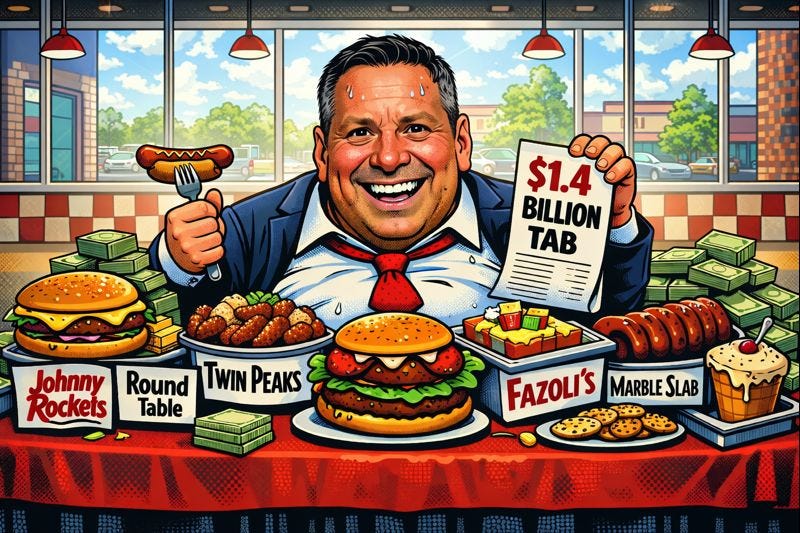
Fat Brands finally filed bankruptcy on Thursday, a victim of its own debt-driven acquisition spree and pricey legal problems.
A big ol’ Fatburger was never enough, and there wasn’t anything this chain could not eat.
Over the past few years, it snarfed up Johnny Rockets, Round Table Pizza, Marble Slab Creamery, Fazoli’s, Twin Peaks, Great American Cookies, Smokey Bones, Hot Dog on a Stick, Buffalo’s Cafe & Express, Hurricane Grill & Wings, Pretzelmaker, Elevation Burger, Native Grill & Wings, Yalla Mediterranean, Buffalo’s Express, and both Ponderosa and Bonanza steakhouses
Now Fat Brands wants to ditch about $1.4 billion in debt through a Chapter 11 bankruptcy filing, as it battles inflation and price-weary consumers. It only has about $2 million in cash left.
In May 2024, a federal grand jury indicted founder Andrew Wiederhorn and others, alleging a scheme to conceal roughly $47 million in compensation from investors.
But in July 2025, the Justice Department unexpectedly dismissed all criminal charges against Wiederhorn, a longtime donor to President Donald Trump. The DOJ also fired its lead prosecutor on the case, a highly unusual step that drew national scrutiny.
A parallel civil case filed by the Securities and Exchange Commission remains unresolved, though a settlement has reportedly been negotiated. Several lender lawsuits are also pending.
There was always plenty of room for skeptics at this feeding frenzy. When Fat Brands launched its initial public stock offering in October 2017, its stock closed well below its opening price of $12 on its first day of trading. And it has floundered ever since.
They’re not minting pennies anymore, but you can buy FAT stock now for less than four cents. A side of fries will set you back a lot more.
Turns out, Fat Brands could load its plate, but it couldn’t swallow its debt.
The first bank failure of 2026 has arrived
Regulators shuttered Chicago’s Metropolitan Capital Bank & Trust on Friday and turned it over to First Independence Bank of Detroit.
Remember all those worries following the Covid pandemic about declining commercial real estate values? Well, they finally hit Metropolitan Capital hard.
Office buildings are still emptier with remote work, retail properties are less trafficked with a rise in online orders, and higher interest rates have made refinancing painful.
More than 570 banks have failed since 2001. Click here for a complete list from the FDIC. Only two failed in 2025, so it looked like we were in the clear.
Related Reading:
Small Town Bankster (Business Blunders)
Piggy Banker (Business Blunders)
The Power of Red (Business Blunders)
Metropolitan Capital was a tiny bank with only $261.1 million, but as the first bank failure of 2026, it carries symbolic weight.
Its collapse suggests that commercial real estate stress is no longer just a warning in regulatory speeches. If commercial real estate values can’t recover and refinancing stays tough, there may be more small bank failures to follow.
The label maker that labeled itself bankrupt
Multi-Color Corp. filed bankruptcy on Friday – but not because consumers stopped reading labels, which get stuck on everything from shampoo bottles to industrial walls.
The global label maker went under because a private equity firm decided a perfectly ordinary manufacturing business should carry the kind of debt usually reserved for small countries.
Clayton, Dubilier & Rice bought the company in a leveraged buyout in November 2021 and ran the classic playbook: Borrow heavily, load the debt onto the company, and exit before the interest bill became the main product. But CD&R couldn’t exit fast enough.
Interest rates rose, growth slowed, and suddenly a business that sold sticky paper was stuck with nearly $6 billion in liabilities. Chapter 11 became the substitute for an IPO or a sale to the next willing buyer.
Now its creditors get to deal with the sticker shock.
Don’t Miss These Blunders
Idiot Lights Wall Street lenders didn’t check the dashboard before First Brands blew the engine
The Incredible Shrinking Airline Seat Canada’s WestJet may have just saved the world from the worst trend in commercial air travel
This Is Sandgaard The CEO of Zynex Medical was indicted for health care and securities fraud. It could mark the end of his rock and roll fantasy.
Needless Markup Amazon’s $475 million bet on the Saks-Neiman Marcus merger goes to zero in bankruptcy court
Was Maxwell Smart? Ghislaine Maxwell lived her life between two international crooks: Her father Robert Maxwell and sex-offender Jeffrey Epstein. Some people think they were spies.
Volkswagen Dipsticks German automaker burns trust even faster than oil
Pork Jello Sandwich Do you mean the McRib isn’t actually made from real rib meat? Say it ain’t so.
Biggest Business Blunders Of 2025 It was a year of forbidden love, economic anxiety, corporate breakups, bankruptcies, CEO resignations, Jeffrey Epstein, and the Tesla Chainsaw Massacre
Sacking Sachs No one pulls off a smash-and-grab like a privateer
Best Read Blunders Of 2025 Here’s what clicked the most for me on Substack this year. Not my best work, not the biggest story, not even the most-important development – but it clicked.


Seems like the pardoner-in-chief does love a fraudster. Moral - if you’re going to fraud, just make sure you sock enough away to pay for that pardon. Tone at the top. I’m sure none of this will affect your 401k though. 😜
Sharp piece on leveraged rollup implosion. That $1.4B debt against $2M cash ratio is staggering but the politcal angle with those dimissed charges adds another layer. Saw a similar pattern with a regional franchise operator last year where the acquisition pace just masked the unerlying unit economics.