Sacking Saks
No one pulls off a smash-and-grab like a privateer
This Week In Blunders – Dec. 28-Jan. 3
“I stopped believing in Santa Claus when I was six. Mother took me to see him in a department store and he asked for my autograph.” – Shirley Temple
Did anybody really think Saks Global would save America’s most iconic luxury department stores by loading them with debt, selling off their real estate and telling their suppliers they’d get paid in 90 days instead of 60?
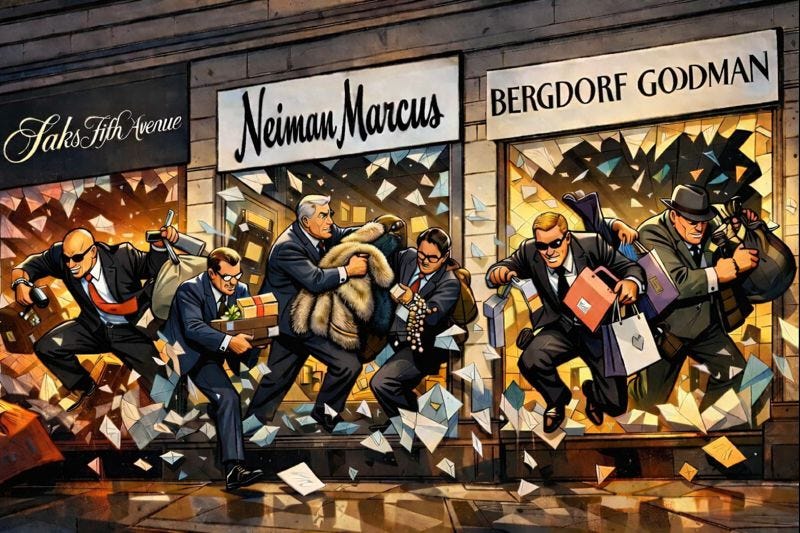
This was the strategy that retail real estate magnate Richard Baker deployed after acquiring Neiman Marcus in December 2024 for $2.7 billion.
Now he’s missed a $100 million bond payment and preparing a bankruptcy filing, according to an exclusive report in The Wall Street Journal earlier this week.
On Friday, Saks announced its CEO Mark Metrick, who has been with the retailer since 1995, was stepping down to “pursue other opportunities.” Yeah, like not going through bankruptcy. But don’t worry, Baker is back in charge:
“I look forward to continuing to work with our highly experienced management team, valued partners, and other stakeholders to secure a strong and stable future for our company.”
Baker is a font of canned PR quotes. Here’s how he blustered about the acquisition of Neiman in 2024:
“This milestone transaction marks a transformative moment for Saks Global and the luxury retail industry. By uniting Neiman Marcus, Bergdorf Goodman, and Saks Fifth Avenue, we have created an unparalleled multi-brand luxury portfolio with tremendous growth potential.”
Milestone? More like a Mill Stone.
Baker and his privately held company have been in a mad scramble to cover Sak’s debt obligations. In June, he scored $600 million from bondholders to keep his retail loot-job alive.
He’s also been selling trophy locations, including the land under the Neiman Marcus in Beverly Hills and the Neiman Marcus at Union Square in San Francisco.
Leveraging the real estate is a familiar playbook. Baker might have borrowed it from Eddie Lampert who acquired Kmart and Sears and stripped them of their real estate before turning them into retail rubble.
In 2017, before running Lord & Taylor out of business, Baker sold its building on Fifth Avenue in Manhattan for $850 million.
Neiman Marcus was once ridiculed as Needless Markup. Now it’s Needed Markdown.
Sak’s backers include Amazon, SalesForce and a slew of bondholders who are soon going to be counting their billions in pennies on the dollar. They knew the score and invested anway: Huge debt burden, weak liquidity, softening demand for luxury goods, economic headwinds, and pissed off suppliers.
In February, Metrick laid out a 12-month plan to pay stiffed vendors and announced that going forward the company would pay its suppliers in 90 days instead of the standard 60 days that most retailers pay.
He said that “the model as it’s been working for the last 100-plus years needs refinement” and that this was “for the good of the entire industry.”
This has to be the single most jackass thing any retail executive has ever said. (And yes, I keep track.)
Read More: CEOs Say The Dumbest Things (Business Blunders)
How about customers paying their Saks credit cards in 90 days? Wouldn’t that be a plus?
Cheesy corporate cuts cost Kraft
Kraft Mac & Cheese has been an American staple since 1937, but Warren Buffett’s move to merge Kraft with Heinz in 2015 led to a series of bad decisions that is sending the iconic blue boxes to the back shelves.
Market share has slipped to 39% from 45%, The Wall Street Journal reported this week.
We can all guess what happened: Cost-cutting, complacency, slow innovation and the rise of premium brands like Annie’s and Goodles.
In September, the Kraft Heinz announced a split, essentially undoing their 2015 deal. It only took 10 years and a 60% decline in shareholder value to come to this decision.
Read More: Buffett’s Big Blunder (Business Blunders)
Meantime, the company ignored a beloved product that consistently delivered $1 billion in annual sales while competitors began eating its lunch.
Goodles added protein. Annie’s added organics. Kraft added a slide deck promising quarterly cost-savings. Yum.
Tesla lost its crown, but who cares?
Nobody has damaged an automotive brand faster than Elon Musk.
This week we learned Tesla sales sales fell 9% in 2025. And that its Chinese competitor BYD has unseated the company as the world’s biggest electric vehicle maker.
Musk enraged the kind of people who might buy an EV with his right-wing politics and chainsaw antics cutting goverment jobs. He also spent about a quarter billion dollars backing a president who let EV tax incentives expire. Then he got in a public spat with President Donald Trump that he could not win.
Read More: Musk Chickens Out To TACO
Musk also delivered an electric truck that looks like a trash can.
Still, it’s no big deal for a man who remains on track to become the world’s first trillionaire. Tesla stock dipped below $215 in April but it’s now up to about $450.
Tesla doesn’t need car sales when it has Musk’s incessant bluster about artificial intelligence, and robotaxis. So quit your snowflake whining and buy a Chevy.
Don’t Miss These Blunders
Best Read Blunders Of 2025 Here’s what clicked the most for me on Substack this year. Not my best work, not the biggest story, not even the most-important development – but it clicked.Tax Time For A Dead Billionaire Texas businessman Robert T. Brockman coughs up $750 million from beyond the grave.
Going All Enron On Them Before subprime auto lender Tricolor imploded, its CEO allegedly proposed one of the dumbest stunts in corporate history
Kat’s Creepy Creations Where can you buy human body parts? Try Harvard Medical School.
How To Rob A Greedy Bank Mary Carole McDonnell has been retired for seven years after allegedly defrauding banks that didn’t bother checking out her story
Small Town Bankster Reckless lending, casino gambling and allegedly doctored books led to the demise of a century-old community bank. Now its CEO faces prison time.
JPMorgan Chase Can Check Their Butts A young entrepreneur duped the bank out of $175 million. Now her defense lawyers are billing the bank for cellulite butter.
Be Thankful For 3D-Printed Chicken Soup Campbell’s fired an employee without first asking the right questions. Now he’s putting a big dent in its can.
Straighten Up And Fly Right Transportation Secretary Sean Duffy says, ‘The Golden Age of Travel Starts With You,’ as the horrifying passenger antics continue
Winter Is Coming For Summers I warned readers about Larry Summers’ gross incompetence in 2013. Now it’s back on full display in emails with Jeffrey Epstein.
Pardon My Ponzi Twice-convicted swindler Eliyahu Weinstein got a Trump commutation. Now he’s going to back to prison for a third fraud.
Insuring Lust AIG can’t seem to find a faithful man
Networking With A Pedophile Goldman Sachs defends its general counsel after her chummy relationship with Jeffrey Epstein is exposed
Getting Sondered Marriott screws its guests as its short-term rental partner files bankruptcy
Felons Fly Free Boeing beats criminal charges for its deadly 737 Max crashes only to be accused of more negligence in this week’s fatal MD-11 crash
White Pizza Seven years ago, Papa Johns’ founder resigned after making racist remarks. Today, the company is struggling with its damaged brand.
Dead Meat The hype on Beyond Meat was beyond reason. Note to investors: It’s mashed peas.
A Dead Billionaire Defaults Gary Winnick, the late founder of a failed telecom startup, sacks his lender from beyond the grave
Dr. Lie Erik Lie, a finance professor at the University of Iowa, catches cheats. His numbers don’t lie.


The real estate stripping playbook here is almost predictable at this point. Baker's move from Lord & Taylor ($850M Fifth Ave sale in 2017) to now Neiman/Saks follows the same pattern Lampert used on Sears. What's intresting is how bondholders (Amazon, Salesforce included) went in eyes wide open knowing the liquidity was weak and suppliers were already pissed. The 90-day payment terms thing Metrick said was "for the good of the entire industry" has to be one of the more absurd statements I've seen. It's basically announcing working capital problems as innovation. These kind of asset-strip plays work until they don't, and it looks like we're at the don't phase.