Cruci-fried Chicken
Has Chick-fil-A been closing on the wrong day for the Sabbath? A federal lawsuit is putting a Texas franchisee of this famously pious chicken chain on the grill.
This Week In Blunders – May 10-16
“For in six days the Lord made the heavens and the earth, the sea, and all that is in them, but he rested on the seventh day. Therefore the Lord blessed the Sabbath day and made it holy.” – Exodus 20:11 (NIV)
The U.S. government has sued a Chick-fil-A franchisee for not giving a Christian a day off on the Sabbath.
Oh, my Lord. Isn’t this a Christian chicken chain that has always been closed on Sundays?
The Equal Employment Opportunity Commission filed the lawsuit this week on behalf of a Church of God member. She belongs to a denomination that observes the Sabbath on Saturday … so there.
The agency has a point under the Civil Rights Act of 1964, which prohibits religious discrimination. But there’s also a point to be made based on the Bible itself.
Genesis, Exodus, Deuteronomy and plenty of other Old Testament books identify the Sabbath as the seventh day – the day on which God rested – which is not Sunday. That, for anyone still keeping count, is the first day.
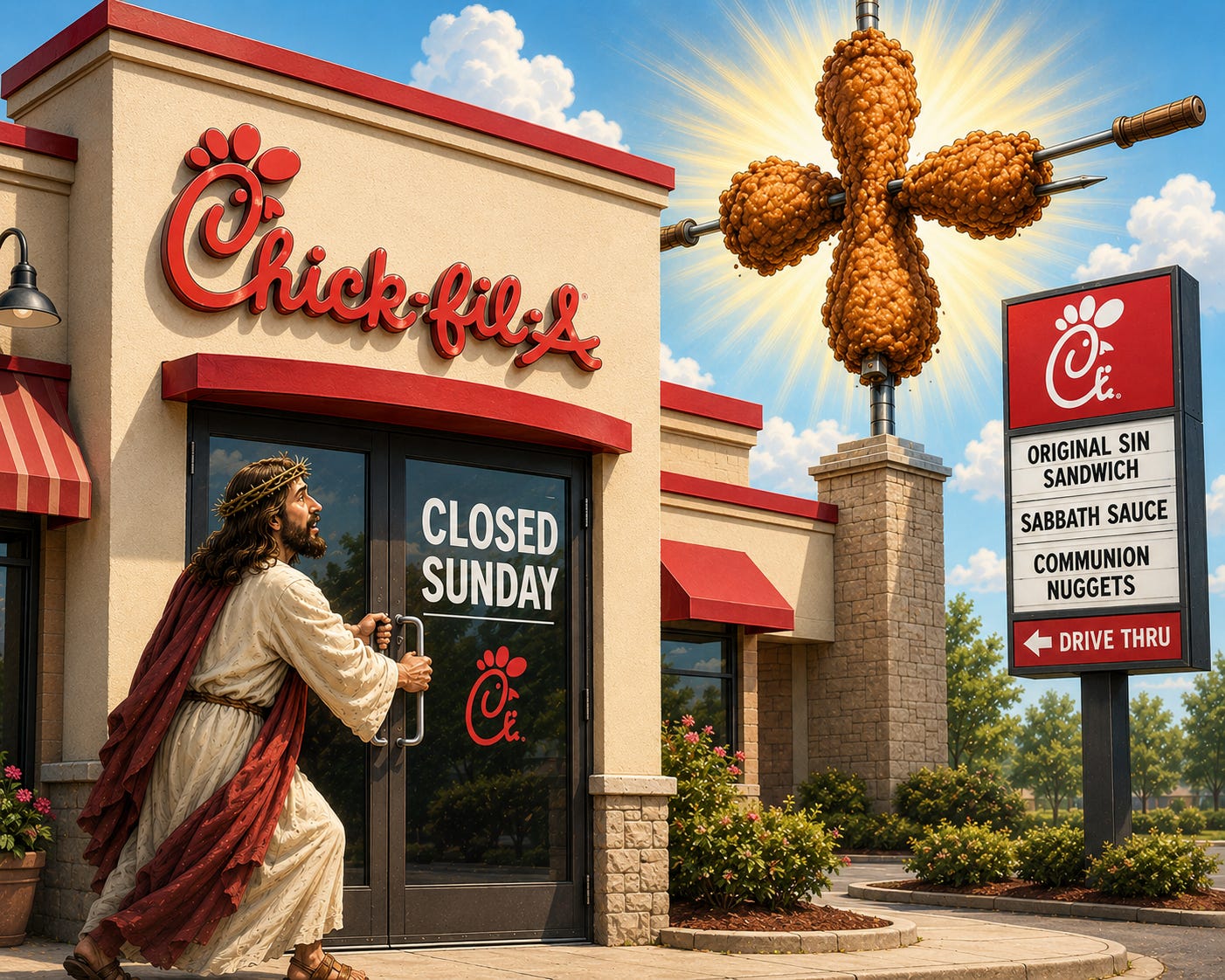
Then there’s the New Testament which shows the earliest Christians were Jews who always observed the Sabbath on Saturdays and still do to this day. (Shabbat Shalom, by the way.)
Jesus was a Jew and here’s what Luke 4:16 (NIV) reports about his observance:
“He went to Nazareth, where he had been brought up, and on the Sabbath day he went into the synagogue, as was his custom.”
Quick interpretation: If you’re going to a synagogue on the Sabbath, it’s Saturday.
No where in the scriptures does it explicitly say the Sabbath has been moved to Sunday. But in the centuries after Christ, Christians buried their Jewish past.
As corrupt Roman leaders and pinheads in pointy hats took over the faith, the Sabbath shifted. This was said to mark the day that Jesus rose from the dead and many have argued the switch was God-ordained.
Argue all you want. But whatever you believe, you can’t give some employees the day off for their Sabbath and deny others the day off on their Sabbath. That’s a heartless policy for a company built on public displays of faith, and the EEOC says it’s illegal.
Hatch Trick, the Austin, Texas, Chick-fil-A franchisee named in the agency’s lawsuit, fired the employee when she refused to work on her particular Sabbath.
Perhaps Chick-fil-A has always had this whole Sabbath thing wrong.
The chain could help more families take their divinely prescribed day of rest if it hired a bunch of heathens to keep the place open on Sundays. Then all those fine, upstanding Christian moms wouldn’t have to cook after church.
The bigger issue, though, is that while most Americans express faith in one religion or another, what they more consistently practice is consumerism. And in America’s widely shared religion of consumerism, being closed on Sunday is the real sacrilege.
It’s not just the stock market that’s rigged
The lottery was one of the few places left where average people believed randomness stood a fighting chance against privilege. But an indictment in Texas this week suggests that even the Lotto has a VIP section.
A Texas grand jury indicted former Texas Lottery Commission director Gary Grief over allegations tied to a $95 million Lotto Texas jackpot in 2023. Grief’s attorney says there was no crime and called the move political.
Investigators allege Grief helped a syndicate of professional gamblers as they printed every possible number combination, turning a game of chance into a massive math equation with a guaranteed winner.
The operation used dozens of lottery terminals to churn out more than 25 million tickets in just three days, according to reports by the Houston Chronicle,
Lotteries have long been vulnerable to “buy the pot” schemes. In 1992, for instance, an Australian syndicate pulled off a similar operation in Virginia. But investigators say the Texas job was different because lottery officials allegedly helped pull it off.
Ordinary players were then left to compete against what looked less like ordinary players and more like a hedge fund.
Americans already suspect insiders have rigged everything from stocks to housing to college admissions. Now even the ping-pong balls seem to bounce toward the penthouse.
Feeling depressed? Take Trintellix
Takeda Pharmaceuticals agreed to pay more than $13 million this week to resolve civil allegations that it paid kickbacks to doctors for prescribing its antidepressant medication, Trintellix.
If your doctors think you’re depressed, it could be because they are getting high-paid speaking gigs and eating at pricey restaurants with Takeda reps.
Does Trintellix sound depressing? At least it kept some doctors happy.
Business Blunders is more than a newsletter. It’s an ever-expanding archive of all the things that go wrong in business. This week I am introducing The White Collar Playbook, a compendium of the most common types of financial fraud and blowups that followed. If you want to plan for the future, know the past.
A Big Mac attack on McMoscow
This Day In Blunders
For your daily dose of What Not To Do In Business, join the Business Blunders community on: Substack – LinkedIn – Facebook – X
Don’t Miss These Blunders
The Patriot Economy: Trump, Jesus, Liberty – Ponzi – Edwin Brant Frost IV pleads guilty to a $140 million scheme he peddled on conservative media
Illegal Eagles – Elite corporate lawyers allegedly formed an insider trading ring and “made out like bandits” with clients’ confidential information
The White-Collar Playbook – The most common types of financial fraud and the companies that didn’t get away with them
NACHO NACHO Man Wall Street bets Strait of Hormuz stays closed and gasoline prices will sting all summer long
Full Court Heist Atlanta Hawks senior finance executive Lester T. Jones Jr. is headed to prison after looting his team
Red Flag Alerts Meets Business Blunders What could go wrong? Everything! And we’ve seen it all before. Watch Herb Greenberg and Al Lewis compare notes on the Golden Age Of Grift.
This Day In Blunders: About The Series Explore the history of business faux pas, failures and frauds in this day-by-day calendar of calamities
It Takes Moxie To Push Oxy A pharmacist goes to prison. Purdue Pharma settles. The Sacklers walk.
Tricolor Me Blue JPMorgan Chase, Barclays and Fifth Third Bank can’t escape the obvious conclusions as they defend themselves in a subprime auto lending debacle
Sand Trap Saudi Arabia launched LIV Golf in a hostile takeover of the sport. Now it looks like the oil-rich nation can’t afford to stay on course.
Don’t Gloat About Your Moat A common turn of phrase helped prosecutors win an antitrust ruling against Live Nation. Could its concert monopoly finally be over?
The Substack Ponzi Tyler Bossetti built a huge social media following. His secret: 30% investment returns.
A Friend Of A Friend Of Epstein Warren Buffett gave Bill Gates’ foundation $43 billion. Now he doesn’t even talk to the guy.
Steal Crypto, Buy Pokémon Technology has infected our economy with unprecedented stupidityBanking On Epstein The sex trafficker couldn’t have done it without America’s biggest banks. Now Bank of America is paying off his victims.
Back In The Box Renault-Nissan’s fugitive CEO Carlos Ghosn fled Japan in a crate. Now his Beirut refuge is under fire.


