Full Court Heist
Atlanta Hawks senior finance executive Lester T. Jones Jr. is headed to prison after looting his team
This Week In Blunders – April 26-May 2
“Yes, I am the victim of a Basketball Jones.” – Tyrone Shoelaces
His name was Jones and he had a Basketball Jones.
Lester T. Jones, Jr. received three years and five months in prison this week for embezzling $3.7 million from the NBA’s Atlanta Hawks.
Prosecutors say he spent the money on the kind of stuff Americans apparently need to keep up with the Joneses: $80,000 in overseas travel; $99,800 in clothes at Saks Fifth Avenue; a $115,795 diamond ring; $21,888 in Omega watches, and more than $160,000 in tickets to concerts and other events.
Didn’t anyone notice him traveling so often and wearing gaudy baubles before the tab hit $3.7 million?
Probably not, because Jones, 46, was senior vice president of finance, second only to the chief financial officer. And he was the sole administrator of the Hawks’ corporate credit card account with American Express.
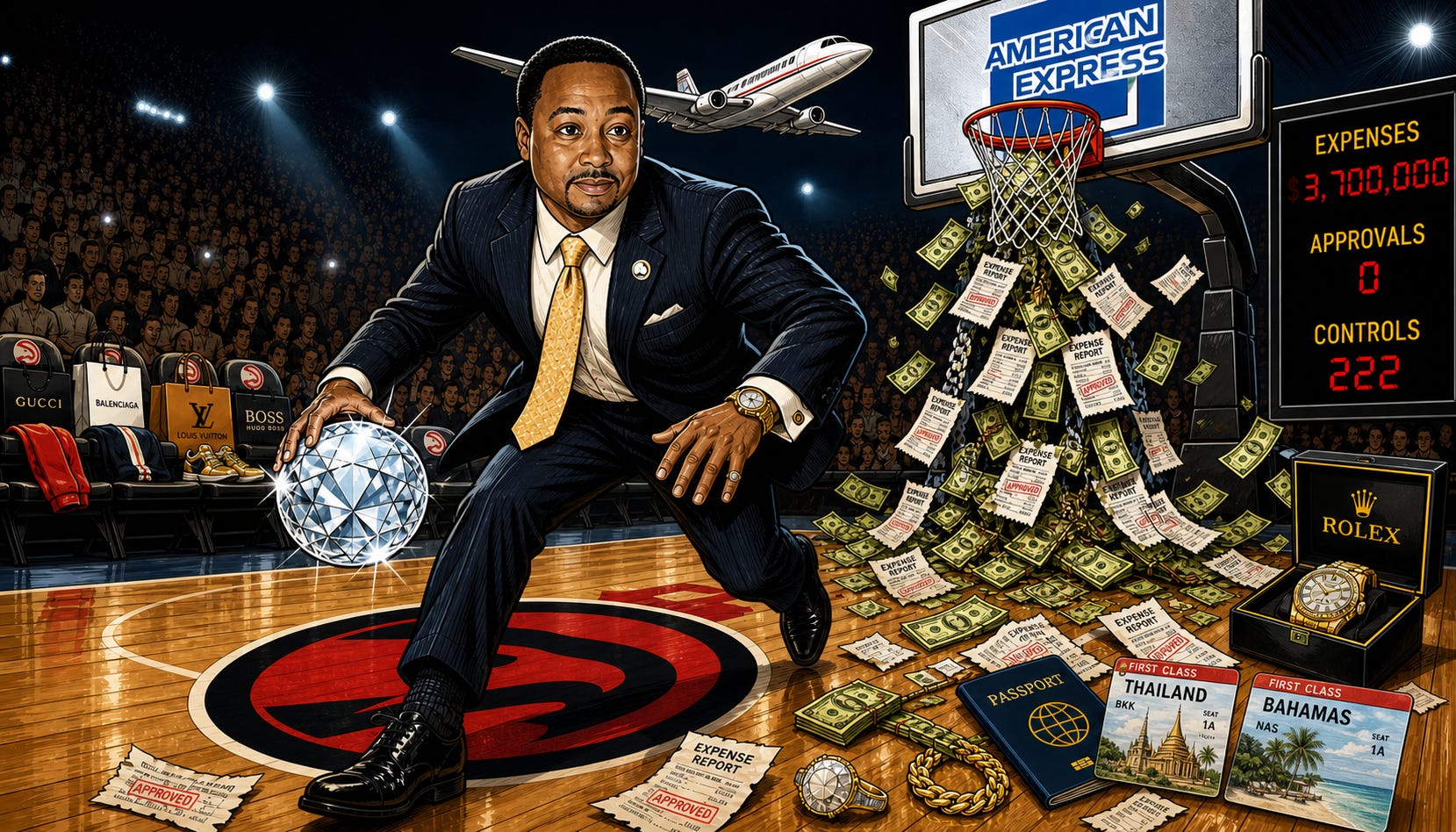
Jones ran up huge tabs and covered his tracks like only a senior finance executive knows how to do, according to a charging document to which he plead guilty in December.
The headlines have to be an embarrassment for the Hawks because their blunder is glaringly apparent. Who puts one guy in charge of the corporate credit account with little to no oversight?
Take a lesson from Business Blunders: Embezzlers strike their employers all the time. I could easily write a newsletter called “This Week In Embezzlement.”
A 2024 report from the Association of Certified Fraud Investigators estimates that a typical organization loses 5% of its revenue to what it calls “occupational fraud.”
The biggest reason: Weak financial controls, including poor external and even internal audits. The biggest red flag: Someone living way beyond their means – like they’re always Jonesing for something.
How do top financial professionals go so horribly wrong?
According to Jones’ LinkedIn profile, he was a senior auditor for PwC.
And guess where he got his start? … Arthur Anderson.
He joined the disgraced accounting giant in 2001 – before the firm was run out of business after it was sued for auditing a Ponzi scheme known as the Baptist Foundation of Arizona and then caught shredding documents at Enron.
Sing-along with Cheech and Chong:
First Brands Gives Lenders Its Second Book
How do you defraud some of the world’s savviest lenders?
Two sets of books.
How do you hold on to the loot as you stiff them in bankruptcy court?
Move as much of it as you can to Luxembourg.
Investigators probing the collapse of auto parts conglomerate First Brands Group say that’s exactly what happened as UBS, Blackstone, Jefferies Financial Group, Santander loaned it billions.
As reported in The Wall Street Journal this week, a court-appointed examiner alleges First Brands ran parallel accounting systems – one reflecting reality, the other built for lenders – while pressuring employees across its global finance operation to massage numbers to hit targets.
The structure, the examiner wrote, was the point: The more opaque things became, the easier it was to shift valuations, blur accountability, move assets and delay detection.
It didn’t work out so well for the company’s founder Patrick James in the end. He was charged with running a multibillion-dollar fraud in January. He has pleaded not guilty.
Beginning in 2011, James ran around the world acquiring 15 auto parts companies that made Fram oil filters, Autolite spark plugs, ANCO wiper blades and such.
The examiners said these acquisitions “appear to lack a valid business rationale.” But they allegedly made for some fancy merger accounting that duped top lenders out billions.
Does anybody ever ask who did the accounting? The Ohio-based company ran its accounting operations out of Romania and Mexico.
Read More:
Idiot Lights (Business Blunders)
Parts Is Parts (Business Blunders)
Spirt Airlines gives up the ghost
Congratulations to the Trump Administration for NOT bailing out Spirit Airlines.
The airline’s bondholders did the American taxpayers a favor by refusing a possible $500 million bailout. For them, it appears Trump’s terms were worse than just collecting pennies on the dollar in a bankruptcy liquidation.
“The president was like a dog on a bone trying to figure out a way to keep Spirit afloat,” Transportation Secretary Sean Duffy said at a press conference this morning as Spirit took its final flights.
The airline industry has long been subsidized in at least two ways: The government or the bankruptcy process.
This airline has filed bankruptcy twice. A recent spike in jet fuel prices following Trump’s attack on Iran put it into a final tailspin.
This is the airline that pioneered bag fees and hidden charges as it offered ultra-low fares. It was by no means strategically important. Taxpayers don’t really have $500 million lying around. The planes, gates and employees will be snapped up by other carriers.
Some people still miss Pan Am. No one will miss Spirit.
Read More: Calling Spirit Airlines On The Oujia Board


