Walmart Keeps The Change
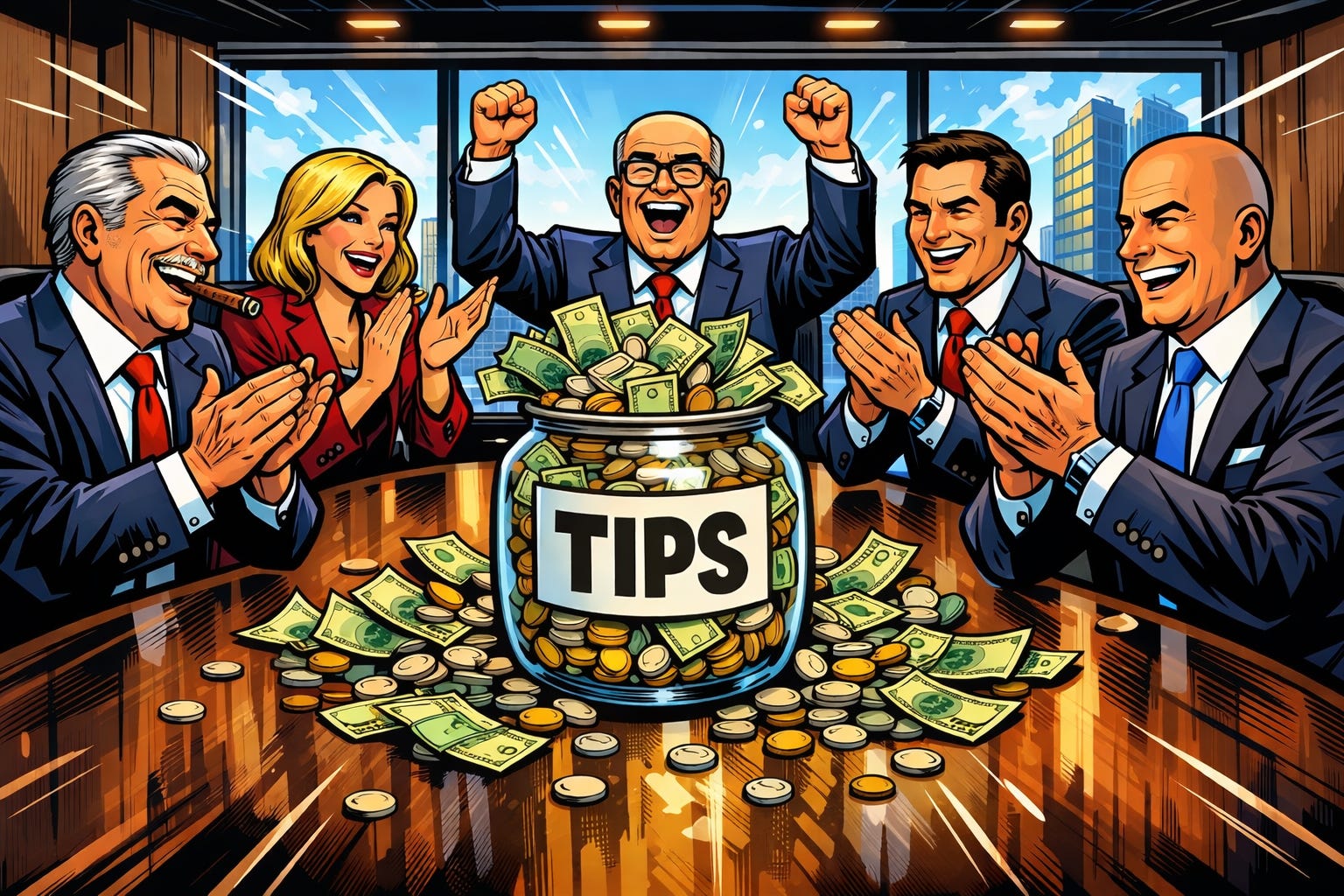
You thought your tips were going to drivers who dutifully delivered your order. Guess again.
This Week In Blunders – Feb. 22-28
“No business which depends for existence on paying less than living wages to its workers has any right to continue in this country.” – Franklin D. Roosevelt
The main reason tipping exists is because companies underpay their employees. They want you to make up the difference with a big, fat gratuity.
It used to be a gratuity, anyway. Now big companies make it seem like a moral imperative. Smartphone apps nudge you toward 20%, 22%, 25% tips. They do this even when you’re ordering at the counter or the drive-through window.
You’re not just buying a sandwich. You’re subsidizing payroll.
What none of us really know is whether those tips are going to the people who served us, or disappearing into a corporate accounting system.
On Thursday, Walmart agreed to a $100 million settlement with the Federal Trade Commission for allegedly deceiving its customers and delivery drivers in several sneaky ways.
Among the FTC’s allegations:
“Walmart tells its Customers that 100% of the tips will go to Drivers. However, in numerous instances, Walmart charges Customers for tips that Drivers do not receive.”
Eleven states joined the FTC in filing the complaint: Arizona, California, Colorado, Illinois, Michigan, North Carolina, Oklahoma, Pennsylvania, South Carolina, Utah and Wisconsin.
“We are continuously improving procedures to ensure fairness and transparency for drivers,” Walmart said in a statement emailed to the Associated Press.
It also said it values “the hard work and dedication of the drivers who deliver great service and products to our customers.”
Sure.
Plenty of other big companies have been spotted with their hands in the tip jar.
Last year, DoorDash agreed to pay $16.75 million to settle claims that it used customer tips to subsidize guaranteed pay for drivers. And Drizly, an alcohol delivery platform, paid $4 million to settle allegations that delivery workers didn’t always receive tips left through its app.
Going back further, Starbucks has spent years battling whether its baristas have to share their tips with their supervisors. Who wants to tip the supervisor? And who wants their tips going to a grumpy barista sponging out of the shared pool?
Companies that pinch the pot violate the trust of both their workers and customers.
You think you’re tipping the server or the driver. You may be tipping the CEO.
Artful dodger
The Epstein class has plenty of ways to avoid the taxman as they grow their fortunes.
Case in point: Leon Black, the former CEO of Apollo Global Management, secured a $484 million loan in 2015 from Bank of America using works by Picasso, Matisse, Giacometti and others as collateral. The interest rate: 1.43%.
Instead of selling art and triggering capital gains taxes, Black borrowed against it. The paintings stayed on his walls. The cash hit his account.
Over long periods, fine art has appreciated in the mid-single digits to high-single digits annually, according to the Sotheby’s Mei Moses Art Indices, which track repeat auction sales of the same works over time. In other words, if your art rises 6% to 8% a year and your borrowing cost is 1.43%, the math works nicely – without ever realizing a taxable gain.
The details of this unusually large bank loan came out in the latest release of the Epstein files.
Black, one of the most powerful men on Wall Street, has been under intense scrutiny since The New York Times published a piece in 2020 headlined: The Billionaire Who Stood By Jeffrey Epstein.
The article reported that Black wired $50 million to Epstein in the years following Epstein’s 2008 arrest for soliciting prostitution from a minor. (A later review found Black paid Epstein about $158 million over time for tax and estate planning services.)
Black has called his relationship with Epstein “a horrible mistake.” Quite a costly one, too.
Bye, bye Barings
This week in 1995, London-based Barings Bank slowly came to grips with its shocking demise.
Somehow, the stalwart 233-year-old merchant bank allowed a 28-year-old trader to bet and lose all of its capital in the derivative market.
“Star trader,” Nick Leeson could not admit his trading mistakes and managed to hide more than $1 billion in losses until it all got too big to deny.
Leeson tried to flee, but ended up in prison. Barings went bankrupt and what was left sold to ING for a pound. It was a dramatic chapter in banking history, but did the banking industry really learn?
Please welcome Nick Leeson to the Business Blunders Hall Of Shame where we memorialize the mistakes of the past in hopes of preventing them in the future.
Read More: Nick Leeson – Barings Bank
Don’t Miss These Blunders
Bombing Iran With Crypto Trump pardoned Binance founder Changpeng Zhao in October. But a sworn U.S. enemy allegedly kept doing business through the sanctioned crypto exchange
Double Duped L Brands founder Les Wexner says he was duped. But Jeffrey Epstein wasn’t the only one accused of molesting fashion models at his companies.
Sultan Of Sleaze The CEO of one of the world’s largest port mangers was sunk by his own send button – exchanging emails with Jeffrey Epstein
An Epstein Valentine Goldman Sachs General Counsel Kathy Ruemmler will eventually resign after her chummy relationship with the world’s most notorious pedophile is exposed
Bad Moon Rising His digital token was supposed to fly to the moon. It landed him in prison.
Party With Mr. Dahmer Spinmeisters should substitute ‘Epstein’ with ‘Dahmer’ to hear how they creepy sound
Red State Ripoff Insurance tycoon Greg Lindberg fleeced conservative retirees. Now he wants a Trump pardon.
Fat Brands’ Debt Buffet Fatburger operator binged on other brands and choked on the tab
Idiot Lights Wall Street lenders didn’t check the dashboard before First Brands blew the engine
The Incredible Shrinking Airline Seat Canada’s WestJet may have just saved the world from the worst trend in commercial air travel
This Is Sandgaard The CEO of Zynex Medical was indicted for health care and securities fraud. It could mark the end of his rock and roll fantasy.
Needless Markup Amazon’s $475 million bet on the Saks-Neiman Marcus merger goes to zero in bankruptcy court
Was Maxwell Smart? Ghislaine Maxwell lived her life between two international crooks: Her father Robert Maxwell and sex-offender Jeffrey Epstein. Some people think they were spies.
Volkswagen Dipsticks German automaker burns trust even faster than oil
Pork Jello Sandwich Do you mean the McRib isn’t actually made from real rib meat? Say it ain’t so.
Biggest Business Blunders Of 2025 It was a year of forbidden love, economic anxiety, corporate breakups, bankruptcies, CEO resignations, Jeffrey Epstein, and the Tesla Chainsaw Massacre
Sacking Sachs No one pulls off a smash-and-grab like a privateer
Best Read Blunders Of 2025 Here’s what clicked the most for me on Substack this year. Not my best work, not the biggest story, not even the most-important development – but it clicked.


