

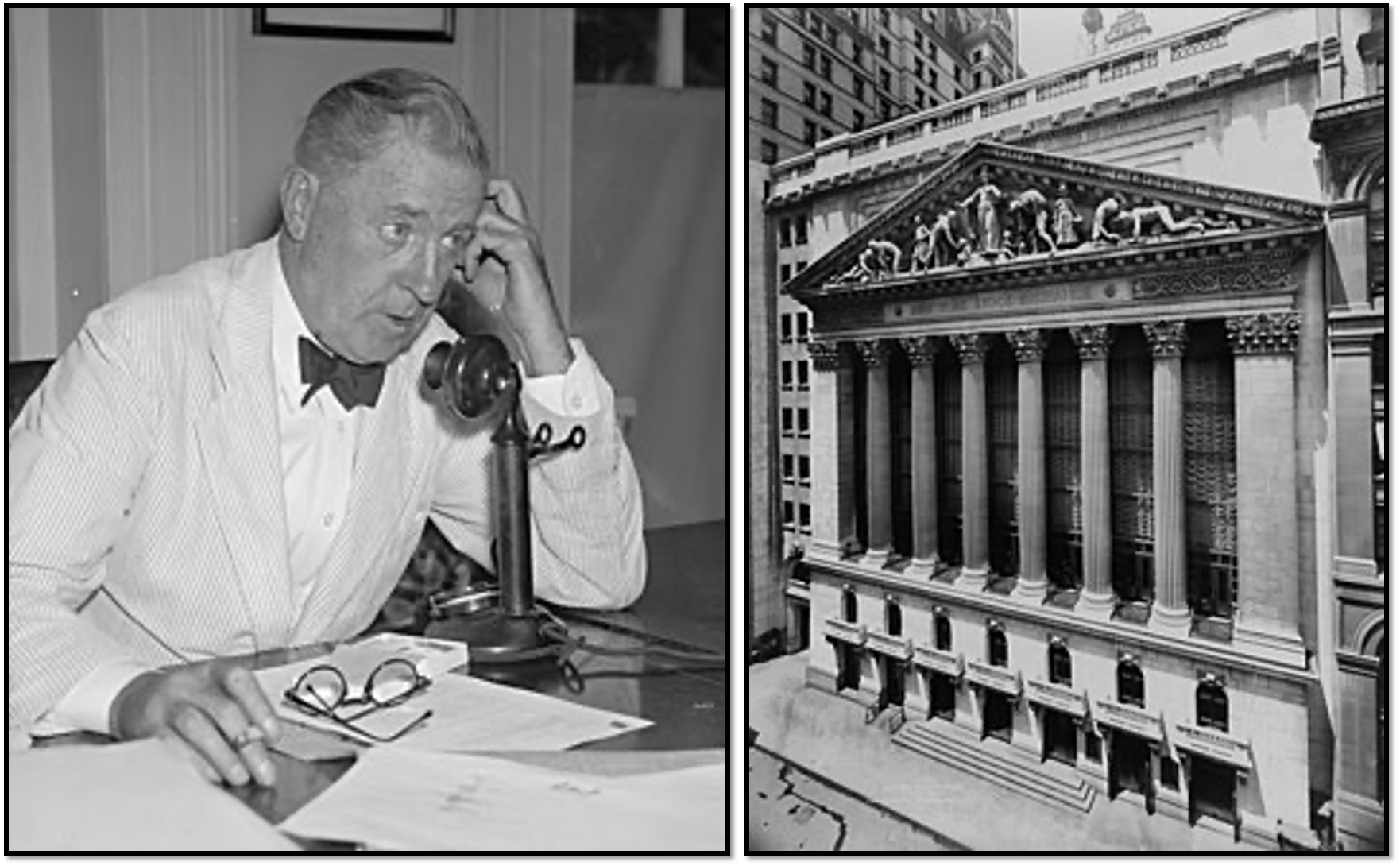
Richard Whitney, New York Stock Exchange president from 1930 to 1935, was known as the “White Knight of Wall Street” until he was sent up the river in 1938 for grand larceny.
“Wall Street could hardly have been more embarrassed if J.P. Morgan had been caught helping himself from the collection plate at the Cathedral of St. John the Divine,” wrote The Nation magazine wrote at the time.
Whitney wasn’t just some bucket-shop penny stock peddler. He was old-guard Wall Street royalty – Groton School, Harvard University, tailored suits, club ties – the embodiment of establishment finance at a time when the public desperately wanted to believe in it.
“Not Dick Whitney!” President Roosevelt cried upon hearing the news about his fellow Groton grad. “Dick Whitney – I can’t believe it.”
Whitney achieved hero status in October 1929 when strode onto the NYSE floor and bid $205 a share for 25,000 shares of U.S. Steel – well above the market price. It was a dramatic show of confidence meant to halt a looming panic.
Newspapers dubbed him Wall Street’s White Knight. But his valiant effort didn’t hold off the crash for long. The Great Depression was inevitable following the financial follies of the 1920s, just as similar economic crises befall us today.
Whitney was one of the NYSE’s most vocal defenders during the push for federal securities regulation. He opposed outside oversight, insisting the Exchange could police itself. The institution, he argued, did not need Washington minders.
But what it needed was someone minding him.
Behind its mahogany doors Richard Whitney & Co., was unraveling. Whitney speculated heavily. He borrowed constantly. When losses mounted, he turned to the one asset he had in abundance: trust.
Whitney began misappropriating securities and funds entrusted to him in fiduciary roles. He dipped into family trusts. He used securities from the New York Yacht Club, where he served as treasurer. He tapped the NYSE Gratuity Fund – a pool meant to aid the widows and families of deceased Exchange members. The man defending Wall Street’s honor was quietly pawning it.
By early 1938, the facade cracked. Whitney’s brokerage firm was insolvent. Customer securities had been improperly pledged as collateral for his personal loans. In March 1938, his firm was suspended from the NYSE. Bankruptcy followed. A grand jury indicted him on charges of grand larceny.
He was sent up the Hudson River to Sing Sing in Ossining, N.Y., in April 1938, after pleading guilty to grand larceny.after pleading guilty to grand larceny.
Crowds gathered to watch the fallen aristocrat depart for prison. The White Knight was now inmate No. 37896. He served a little more than three years before getting paroled, but he was barred from the securities industry for life.
Whitney’s fall wasn’t just a personal disgrace. It was institutional humiliation. For years he had argued that the Exchange was a perfect self-governing body. Yet one of its most prominent leaders had been siphoning funds under its nose.
The scandal reinforced the case for federal oversight and strengthened confidence in the newly formed Securities and Exchange Commission.
After prison, Whitney worked on a dairy farm in Massachusetts, milking cows instead of the people who once trusted him.