

Martin Shkreli wasn’t a titan of industry or even much of a CEO. He was a money-grubbing hedge-fund manager who bought up drug companies and learned that nothing inflames the public like jacking up the price of a lifesaving drug by more than 5,000%.
The self-styled Millennial disruptor had become the face of pharmaceutical greed. And in 2018, he was sentenced to seven years in prison for a multimillion-dollar fraud scheme.
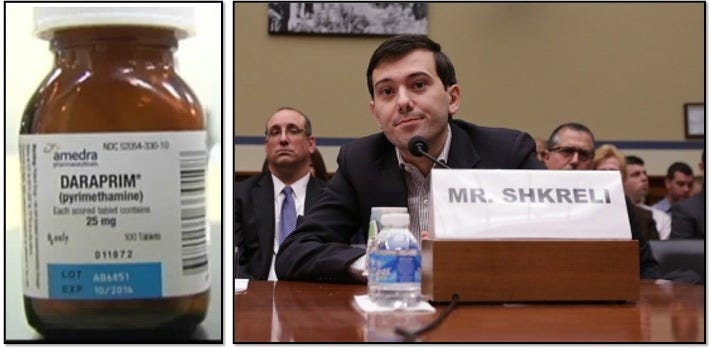
Shkreli’s company, Turing Pharmaceuticals, acquired the rights to Daraprim in 2015, and within days, its price jumped from $13.50 per pill to $750. The price hike proved indefensible. This was a decades-old drug used to treat toxoplasmosis, a potentially deadly infection that particularly affects AIDS and cancer patients.
Shkreli wrapped the flag of capitalism around the move, arguing the drug had been underpriced and that revenues would fund research. Critics called it extortion. Lawmakers called hearings. The public called him something else entirely: “Pharma Bro.”
Shkreli’s parents were Albanian immigrants who worked as janitors. He was raised in Brooklyn, N.Y., went to Catholic schools and got his first job at a hedge fund at age 17.
In 2007, Lehman Brothers won a $2.3 million default judgment against Shkreli and a hedge fund he’d started for failing to cover an options trade that went sour, but Lehman collapsed before it could collect.
Despite his checkered history, Forbes put Shkreli on its 30 Under 30 list in 2012, a decision it came to regret. The publication lauded him for killing a proposed merger of Amag Pharmaceuticals and Allos Therapeutics with his own hostile takeover bid and for antagonizing Pfizer to remove former CEO William Steere from its board.
Read More: Making A List, Checking It Twice
Shkreli seemed to relish his notoriety. When summoned before Congress in 2016, he smirked, pleaded the Fifth repeatedly, and later tweeted that lawmakers were “imbeciles.” If arrogance was a pharmaceutical, he might have cornered that market too.
Extorting dying patients through price hikes on a life-saving drug somehow isn’t a federal crime. For many people in this industry, capitalism means capitalizing on the sick and dying. And Shkreli was not charged in for anything the Daraprim price hike.
Instead, federal prosecutors charged him with securities fraud tied to two hedge funds he’d founded – MSMB Capital Management and MSMB Healthcare Management – well as his tenure at another drug company, Retrophin.
Prosecutors alleged he misled investors about fund performance, used new investor money to pay off old investors and illegally used Retrophin assets to settle personal hedge-fund debts. The Securities and Exchange Commission filed a parallel civil action.
His antics knew no bounds. In 2017, while out on bail, Shkreli put up a Facebook post offering $5,000 for a strand of Hillary Clinton's hair. He told the judge it was satire. The judge called it a solicitation to assault the former First Lady and revoked his bond.
In 2017, a jury convicted Shkreli on securities fraud and conspiracy counts.
“Martin Shkreli was notoriously ambitious, seeking to enrich himself at the expense of those who unwittingly invested in his lies,” said FBI Assistant Director-in-Charge Sweeney in a press release.
The judge called him a “danger to society.”
Shkreli, who fancied himself some kind of hip-hop hipster, purchased the one-of-a-kind Wu-Tang Clan album Once Upon a Time in Shaolin for $2 million. It was later seized by the U.S. government as part of asset forfeiture proceedings and ultimately sold to help satisfy judgments against him.
Nothing says “legacy” like having your rare rap album confiscated by federal marshals after trying to beat the rap. The court also seized a Picasso painting he’d purchased and $5 million he’d put up for bail.
Shkreli was released from federal prison in 2022 after serving about four years, receiving credit for good behavior.
In 2022, a federal judge also barred him from participating in the pharmaceutical industry for life and ordered him to pay $64.6 million in disgorgement in a civil antitrust case related to Daraprim pricing.
He has since attempted to reinvent himself throuh crypto commentary, live streams, and social media provocations, but the “Pharma Bro” label remains welded to his misanthropic public persona.