

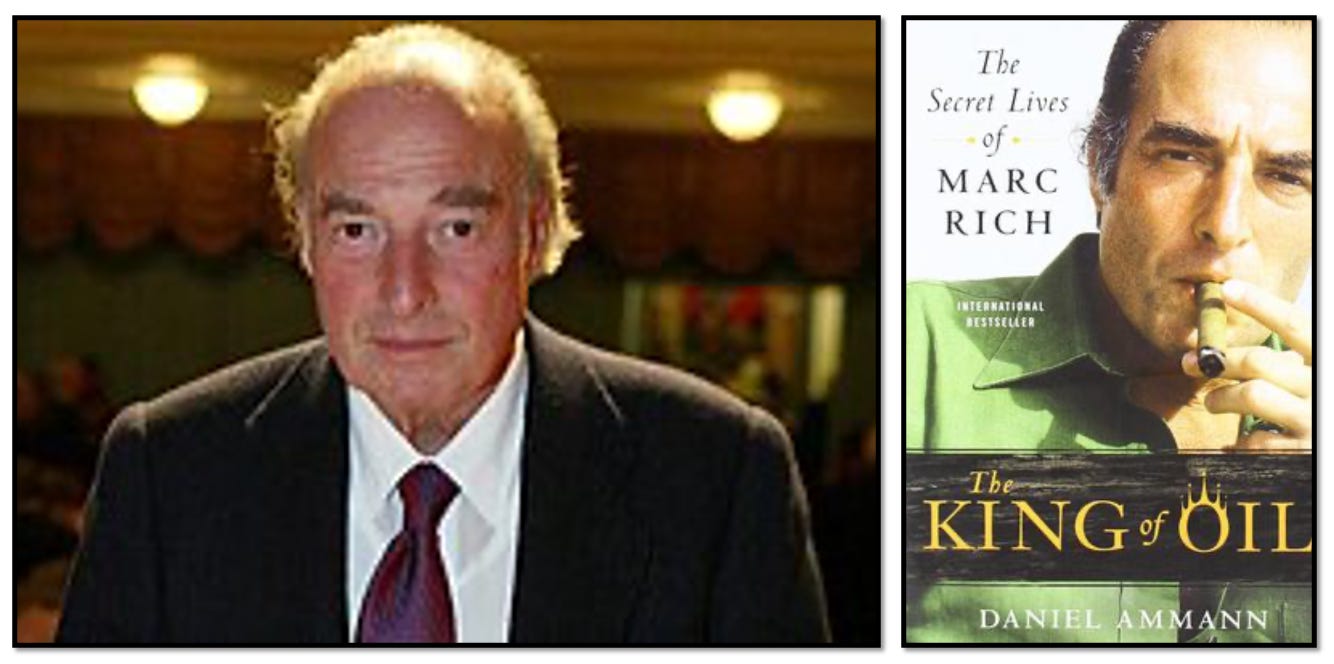
Marc Rich was a billionaire commodities trader who helped pioneer the global spot-oil market and later founded what became international commodities trading giant Glencore.
He is better remembered as an international criminal who got a controversial pardon from President Bill Clinton in 2001. Critics called it controversial, because unlike today, pardoning a white-collar fugitive could prompt a congressional investigation and sully a president’s reputation back in the day.
Rich was indicted by a U.S. federal grand jury on more than 50 felony counts in 1983. The charges included wire fraud, racketeering and making oil deals with Iran during the 1979-1981 hostage crisis.
He was also accused of dodging $48 million in taxes, which prosecutors called one of the largest tax-evasion cases at the time.
Rich’s companies pleaded guilty to charges filed against them, paying fines of about $170 million. But Rich, himself, dodged prosecution by fleeing the U.S. for Switzerland. He remained on the FBI’s Most Wanted List for 18 years.
“It’s an unfortunate situation,” Rich told the Associated Press in 2013. “But the question is, was there crime? And I’m saying I don’t think so.”
Big words, but he never had to say them in court.
Rich was born to in Antwerp, Belgium, to a Jewish family that fled Nazis and settled in New York. He dropped out of college to work as a commodities trader. He eventually started his own firm with a partner, Pincus Green, and they pioneered the spot oil market together.
Rich didn’t care who he traded with, whether it was U.S. sanctioned Iran, Cuba, Libya or South Africa during apartheid. “You can’t run a business based on sympathies,” he once said. “Otherwise our business would be hampered.”
Oh, those pesky U.S. embargoes. You can’t have your trading business hampered over garden-variety national security issues, like holding Americans hostage in Iran or conducting state-sponsored terrorism around the globe.
Rich’s firm eventually grew into the world’s largest commodities trading company, Glencore, and gave him an estimated net worth of $2.5 billion.
It was more than enough money to dodge justice for a lifetime. But as a fugitive, Rich had a few close calls, narrowly escaping arrests in Finland, Germany, Britain and Jamaica.
During his final hours in the White House, Clinton gave Rich a full pardon along with Rich’s partner, Green. The move immediately ignited bipartisan fury and earned the label “Pardongate.”
The pardon was controversial because:
Rich got rich supplying energy to sworn U.S. enemies.
He dodged justice for decades.
His ex-wife, Denise Rich, donated hundreds of thousands of dollars to the Clinton library and Democratic political funds before and after the pardon. She contributed $450,000 to Clinton's presidential library foundation and more than $100,000 to Hillary Clinton’s Senate campaign.
Critics said the pardon undermined the integrity of presidential clemency and appeared to reward wealth and connections over justice.
A two-tiered justice system. Imagine that.
Congress launched a bipartisan investigation into how and why the pardon was granted, including hearings before the House Government Reform Committee.
Even longtime Clinton supporters distanced themselves.
“I don't think there is any doubt that some of the factors in his pardon were attributable to his large gifts. In my opinion, that was disgraceful,” said former President Jimmy Carter.
Clinton soon came to regret the pardon, although he denied that he did it for the money. “It was terrible politics,” he said in 2002. “It wasn't worth the damage to my reputation. But that doesn't mean the attacks were true.”
So Rich never saw the prison cell he so richly deserved, or even a perp walk. He never returned to the United States. He continued living a life of wealth and influence abroad until he died in 2013 at age 78.