

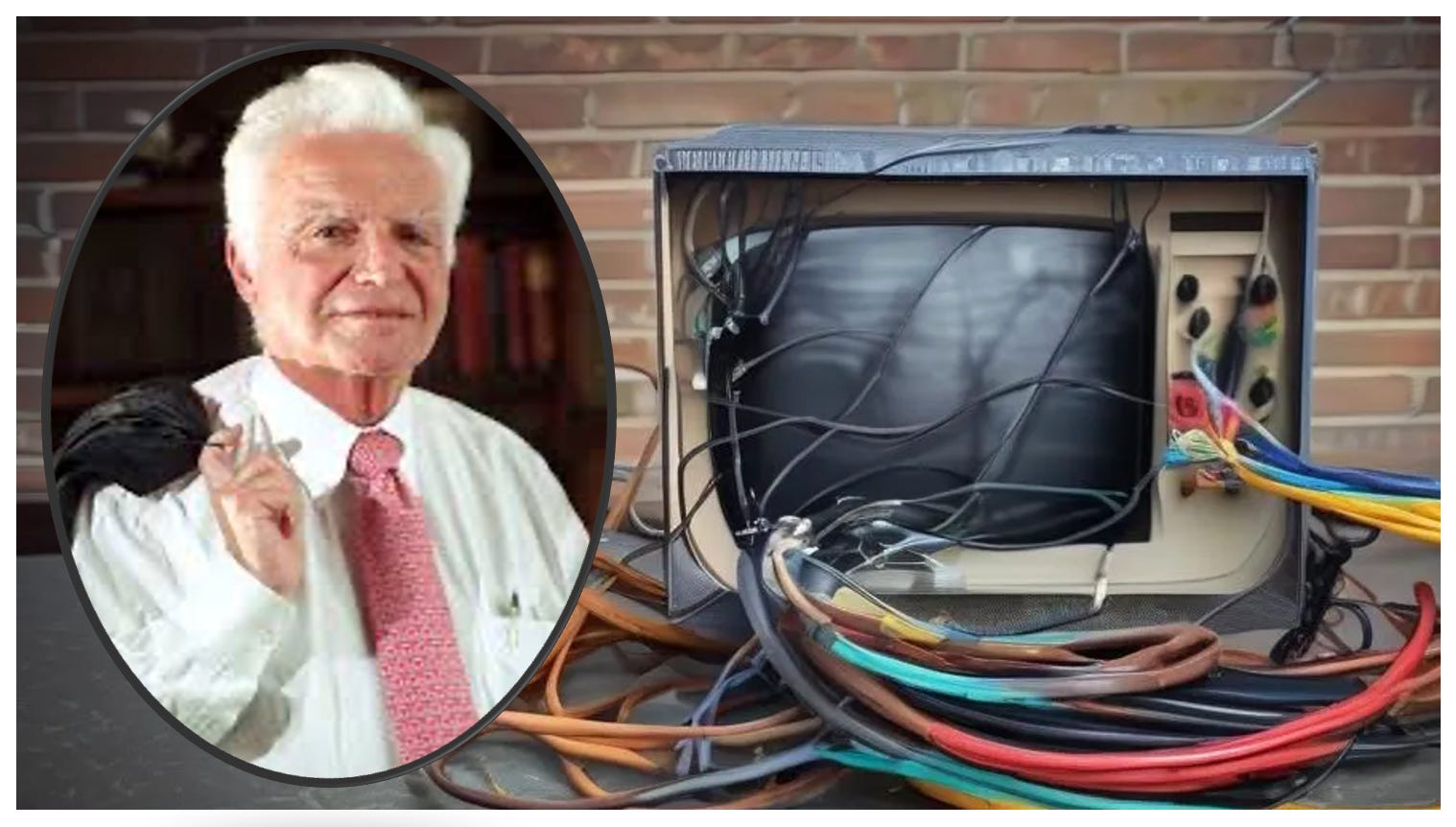
John Rigas founded cable TV giant Adelphia in 1952 in Coudersport, Pa., and turned it into his family’s piggy bank.
With a tad over 3,200 residents, the former lumber town was an unlikely place to launch what would become a sprawling cable empire. But with the success that followed, such humble beginnings could be easily forgotten.
Rigas was the son of Greek immigrants and a World War II veteran. He bought a movie theater after college and morphed into cable television when it was barely an industry. He paid $300 for a cable license and began stringing wire around his tiny Pennsylvania town.
Half a century later, Adelphia was the sixth-largest cable company in America, serving more than 5 million customers.
Over time, Rigas brought his sons into the business and ran the publicly traded company from Coudersport as though it were still the family trust account.
Prosecutors alleged that he took as much as $1 million a month in cash withdrawals from Adelphia. These transactions weren’t documented, nor did Rigas sign any papers promising to pay them back.
On and on the looting went.
He used Adelphia funds to acquire the Buffalo Sabres hockey team.
He set out to build a 1,000-acre golf course on his own land for $15 million.
He bought 3,600 acres of timberland. Prosecutors said Adelphia spent about $26 million on the property, in part to preserve the view from Rigas’ home.
He and his sons used $1 billion in company funds to buy Adelphia stock for themselves. Then they borrowed $250 million in cash to cover margin calls when the stock price plunged.
Rigas’ daughter got $3.7 million to set up two film production companies.
Rigas’ son-in-law got $65 million to fund his own venture capital firm. Rigas’ wife’s interior decorating company got a $371,000 order.
He spent $6,000 flying Christmas trees to his daughter in New York.
Trial testimony also described 17 company-provided vehicles, a masseuse and 100 pairs of bedroom slippers charged to Adelphia.
Rigas proved to be a generous man with his shareholders money, especially in Coudersport, where Adelphia was the dominant employer.
He helped finance a medical center, supported local causes and allowed Adelphia employees and their families to attend his movie theater for free.
He once recalled walking into a packed theater and asking the manager how much money it had taken in. The answer: “$37.50.”
Over time, Rigas’ success transformed his hometown of Coudersport. He kept the headquarters there rather than move it to Buffalo or Pittsburgh, poured as much as $100 million into offices and renovations, and became the town’s patriarch.
In 2002, Adelphia disclosed $2.2 billion in previously unreported liabilities. Its stock, which had traded above $20 early that year, collapsed to little more than $1 by May.
All the while, Adelphia was cooking the books to hide more than $3 billion in unrecorded debts owed by the Rigas family. The Securities and Exchange Commission called it “one of the most extensive financial frauds ever to take place at a public company.”
Adelphia filed for bankruptcy in 2002. Comcast and Time Warner Cable bought it in pieces for $17.6 billion in 2006.
Rigas was sentenced to 15 years in prison, for running a “massive securities fraud,” which was later reduced to 12 years.
At his sentencing, the 80-year-old Rigas cast himself as the little guy who started from nothing and offered an apology that stopped a bit short of admitting guilt: “If I did anything wrong, I apologize.”
His lawyers pointed to his philanthropy but U.S. District Judge Leonard Sand wasn’t persuaded. “To be a great philanthropist with other people’s money really is not very persuasive,” he said.
He was released after severing less than nine years due to his declining health. His son, Timothy, received a 20-year sentence, later reduced to 17 years. He ended up serving nearly 12 years. Rigas’ other son, Michael, received 10 months of home confinement.
Rigas claimed Adelphia’s bankruptcy filing was misunderstood and that he was a victim of an aggressive corporate prosecution in the Enron era.
“It was a case of being in the wrong place at the wrong time,” he said in a 2007 interview with USA Today. “If this had happened a year before, there wouldn’t have been any headlines. … There was no fraud.”
He also never parted with the idea that Adelphia was fundamentally his company.
His defense attorney, Mark Mahoney, did him no favors when he resorted to an imperious analogy before the jury.
“John Rigas was a king,” he told jurors. “His sons were the princes. When the time came for blaming, all the fingers were pointed at them and they were overthrown. It wasn’t regicide, it was Rigas-cide.”
Despite his claims of declining health for a compassionate prison release, Rigas made public appearances in 2016. He died Sept. 30, 2021, at the age of 96.