

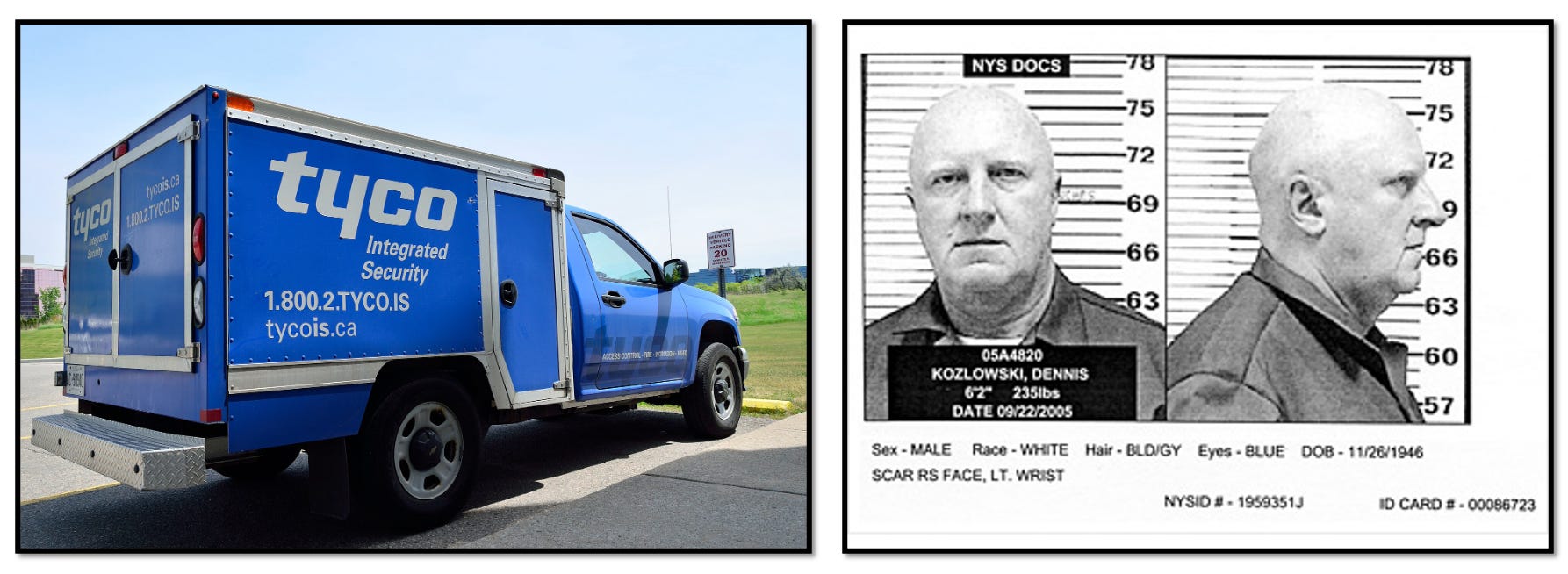
Dennis Kozlowski became a caricature of corporate greed after allegedly using company funds to buy impossibly priced things, including a $15,000 umbrella stand, a $6,300 sewing basket and $6,000 shower curtains.
That might not sound like such a ridiculous amount of money now with today’s untamed inflation, but back then it was an eye-popping load of loot.
The company Kozlowski led, Tyco, is a conglomerate that runs a security business, yet it couldn’t even protect its shareholders from its money-grubbing CEO.Kozlowski paid himself $81 million in unauthorized bonuses, according to prosecutors, and that was just the tip of his decadence.
He was renowned for the $2 million party he threw for his wife’s 40th birthday in June 2001 on the Italian island of Sardinia. He hired Jimmy Buffett and a staff of toga-wearing waiters for the Roman-themed bash. He also ordered an ice sculpture shaped like Michelangelo’s David that dispensed vodka from its penis.
On June 17, 2005, Kozlowski was convicted on charges that he looted Tyco and manipulated its stock. Chief Financial Officer Mark Swartz was also convicted.
Kozlowski served more than six and a half years in New York state prisons. He was fined $70 million and, along with Swartz, ordered to pay $134 million in restitution to Tyco.
An acquisition machine
Kozlowski had joined Tyco in 1975 and became chief executive in 1992.
It had been a relatively obscure industrial company, but under his direction, it became a sprawling conglomerate, selling everything from medical supplies and fire alarms to electronic components and security systems.
Under Kozlowski, Tyco snapped up hundreds of companies. Revenue soared, the stock price climbed and Kozlowski became a celebrated corporate executive.
At its peak, Tyco was worth more than $100 billion. Kozlowski became known as “Deal-a-Month Dennis,” and his success made him one of the highest-paid executives in America.
Despite their successes, or perhaps because of them, Kozlowski and other Tyco executives treated the company’s treasury like personal checking accounts.
Tyco had a loan program intended to help executives pay taxes associated with restricted stock grants. According to the Securities and Exchange Commission, Kozlowski borrowed about $270 million through the program between 1997 and 2002.
Only about $29 million went toward its intended purpose. The rest helped finance real estate, art, jewelry, yachts, investments and Kozlowski’s increasingly lavish lifestyle.
Then the loans magically disappeared.
Prosecutors accused Kozlowski and CFO Swartz of arranging to have tens of millions of dollars in loans forgiven without proper approval from Tyco’s board. They also allegedly awarded themselves unauthorized bonuses while keeping the payments from investors and some members of the board.
“This is a looting case,” the SEC declared in the first sentence of its 2002 complaint.
Stephen Cutler, then the SEC’s enforcement director, put it another way: Kozlowski, Swartz and former Tyco general counsel Mark Belnick had “treated Tyco as their private bank.”
An artful dodge
The unraveling began in early 2002 as questions mounted about Tyco’s accounting and Kozlowski’s compensation.
Then investigators discovered another problem.
Kozlowski had purchased about $13 million worth of artwork, including works by Renoir and Monet. Prosecutors accused him of creating phony invoices and shipping records to make it appear the paintings were going to sales-tax-free New Hampshire instead of his Manhattan apartment.
One art consultant left a candid memo: “Here is a list of the five paintings to go to New Hampshire (wink, wink).”
Prosecutors said five empty boxes made the trip to New Hampshire instead while the art went to New York.
“Over the years, there has been too much winking at this kind of activity,” Manhattan District Attorney Robert Morgenthau said. “And we don’t intend to wink.”
Prosecutors said the scheme saved Kozlowski more than $1 million in New York sales taxes.
The beginning of the end
Kozlowski resigned from Tyco in June 2002, shortly before he was indicted on sales-tax charges.
Then in September 2002, Manhattan prosecutors indicted Kozlowski and Swartz in a sweeping corporate-fraud case. They accused the two executives of taking about $170 million in unauthorized compensation and company funds.
Prosecutors also said they made another $430 million by selling Tyco shares while concealing their conduct from investors.
The case arrived just as corporate America was melting down.
Enron had collapsed. WorldCom was unraveling. Executives who had spent the 1990s being celebrated as visionary wealth creators were suddenly making courtroom appearances. Few made a better symbol of executive excess than the guy with the $6,000 shower curtains.
Kozlowski and Swartz first went to trial in 2003. The defense argued that Tyco’s board knew about their compensation and that the payments were legitimate. After nearly six months of testimony, the trial ended in a mistrial in April 2004 amid controversy surrounding one of the jurors.
Prosecutors tried them again the following year.
This time, the jury convicted Kozlowski and Swartz of grand larceny, securities fraud and other charges. Kozlowski was found guilty on 22 counts on June 17, 2005. And on Sept. 19, 2005, a judge sentenced him to 8⅓ to 25 years in New York state prison. Swartz received the same sentence.
In 2006, Tyco agreed to pay $50 million to settle an SEC case alleging a billion-dollar accounting fraud.
“In addition to looting the company, Tyco’s Kozlowski-era management lied about the company’s financial results,” said Linda Chatman Thomsen, the SEC’s Director of Enforcement at the time.
A log palace
A few months into Kozlowski's sentence, I got a look at some of what he’d left behind. While writing for The Denver Post, I toured an eight-bedroom, 9½-bathroom log mansion he owned in Beaver Creek, Colorado.
He had paid $8.5 million for the ski-in, ski-out home and was trying to sell it for $11.5 million.
Read More: A peek inside a jailed exec’s log palace (Denver Post)
It had a heated driveway, multiple Sub-Zero refrigerators, a wine refrigerator stocked with Dom Perignon, a pool and hot tub, ski boots plugged into electric warmers and a garage containing two Lincoln Navigators.
What I had really come to see was the shower curtains. I fondled them, wondering if they were on par with the $6,000 variety Kozslowski infamously hung in the Fifth Avenue apartment where he lived rent free on Tyco’s tab.
By then, Kozlowski was reportedly getting three showers a week in prison.
I asked real estate broker David Nilges whether Kozlowski’s notoriety might make it difficult to find a buyer.
“I don’t think it matters,” he told me. “There’s always somebody with a bigger ego than Dennis.”
Since when is wealth a crime?
Kozlowski eventually spent more than six years behind bars. He was granted parole in 2013 and released in January 2014.
The SEC case followed him as well. In 2009, Kozlowski agreed to a permanent ban on serving as an officer or director of a public company.
After prison, Kozlowski maintained that the popular image of him as a corporate thief was wrong.
In March 2007, he granted a jailhouse interview to “60 Minutes” in which he suggested his enormous income had worked against him with the jury.
“I was a guy sitting in a courtroom making $100 million a year,” Kozlowski said. “And I think a juror sitting there just would have to say, ‘All that money? He must have done something wrong.’”
But was it all the money he made? Or all the money he took?
Reminds me of someone else using, instead of corporate compensation, borrowed money for a family corporation to launch ventures that went bankrupt. To the point where the CEO had only 1 bank left in the world that would lend to him. And his children/corporation were banned from serving in any charity's board because it and they were convicted of fraud in connection with a children's cancer charity. But you know the rest of that story, too.
Also reminded of Michael Milken, pardoned in the first Trump administration. And Jordan Belfort, who served out his 22 month sentence.
Apparently, when you're CEO, 'they let you do it,' or, at least, you don't serve as much time as Al Capone.
If you'll recall, Wall Street was rampant in the 1980s-2008 with people who had no qualms about using 'OPM' - 'Other Peoples' Money' - to live extravagantly.